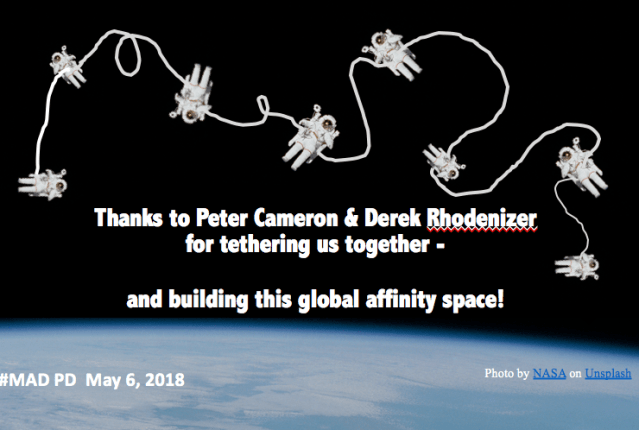
What a great way to share ideas! M.A.D. PD – it’s about Making a Difference in professional development! Thanks Peter Cameron and Derek Rhodenizer for getting this started and keeping it going into a second annual event.
This is a model for P.D. that could be applied to any setting or educational context! This opportunity could become a model for others to engage, share, provide resources and learn from each other. It shifts beyond the physical meeting spaces but can connect within face-to-face locations. Imagine learning from the wisdom of others – no hierarchies or status – just people who are educators – sharing together. Choice and voice are baked into the framework for the day!
The landing page [MAD PD] provides a video introduction to all the presenters – almost 100 of them. Many were using Flipgrid for the first time. Then, just before kickoff, a Master Schedule collection page was created (thanks Jennifer Casa-Todd and Jen Giffen) – it was my first look at how Awesome Table works. With this searchable list, it was easier to find topics of interest or presenters you’d like to hear. Best part is that this ‘gift of sharing’ will keep on giving into the coming year – it’s archived and accessible for all!
As I dipped in and out of the MAD PD sessions on Sunday, May 6th, I was struck by the variety of topics, the willingness of the presenters to risk in this open forum, and the supportive community surrounding this network of educators. If you’ve never experienced that in your teaching environment, take a look at the MAD PD hashtag (#MadPD) to see how others responded as the day evolved. There were many errors, glitches, and issues that arose throughout the day, but these did not stop presenters from sharing their ideas and resources. There were many who provided support and words of encouragement when the technology went wrong – read Diane Maliszewski‘s blog post where she describes her experiences [Fearful But I Finished! #MADPD and Hemming].
My own issue with technical issues was quickly resolved. As I set up a new YouTube live event with a new watch link, it was immediately posted to the spreadsheet by Jen Casa-Todd. The session notes for PLNs: Finding Friends and Fans in Affinity Spaces were adjusted at the last minute to include the #MADPD spreadsheet link since this is a great place to start building a PLN, with all the Twitter links available [slide notes are here]. Thanks to Lynn Cartan and Steven Secord for joining in. I was proud to support Madi Prinzen in her first PD presentation as a brand new educator – risking in the open and gaining the rewards by sharing her knowledge with others. Her presentation is Connecting Globally with DHL.
Noa Daniels shared a quote that certainly wraps up the insights and impact of the #MADPD event for me.
Yesterday, #MADPD invited educators from across the world to share what makes a difference in their classrooms. 100 presenters over the course of a day shared their ideas and many more learned from each other. Here's the who and what: https://t.co/tURNOXPKcx#CelebrateMondaypic.twitter.com/dVa7M3MmRx
So, let’s keep this MAD momentum going. Let’s keep sharing in the open! There are risks, I know, but oh so many rewards as well! What kind of difference will you make today?
As an Open Education Fellow with eCampus Ontario, I had the pleasure of attending the Open Education Consortium #OEGlobal18 Conference in Delft. It was held within the common areas of the University of Delft where students took it in stride when over 400 open educators from around the globe inundated their space. I’ll thank the organizers for selecting this site since it put students at the forefront of our thinking as we moved from session to session. As we intermingled with students who attend the university, enjoying their foosball games as we wandered into their classroom spaces, our awareness of the students was a subtle reminder of why we were there. This was an opportunity to engage in deeper dialogues with others from diverse settings and fields of study. Few silos or hierarchies were evident.
As I navigated into these open streams at the conference, I experienced many course corrections and special docking points. My rich conversations over lunch times and breaks helped debrief or revise my understanding of recently attended sessions. My planned and preselected sessions were diverted as other interesting topics came to my attention through conversations with others. I’m still exploring the conference schedule, re-viewing some of the live streamed keynotetalks, and revisiting the twitter stream (#OEGlobal18) for gems or links I’ve missed.
The group of eCampus Ontario OEFellows used the #OEGFellows and #OEOntario hashtags to share our learning and insights as we moved through the conference sessions. There is now a rich repository of information from the conference collected for further reflection. Several blog posts written by other OEFellows explore deeper understandings from the conference, share insights gained and include curated links.
Closing keynote speaker Peter Smith stated, “We stand at the nexus of liberty and social justice and that’s a pretty great place to be”. Individual work as an open educator brings forward the agenda for an inclusive, accessible, fair, and equitable education system for all learners around the globe. Paul Stacey shared the state of open education in a graphic that describes where growth is being realized and areas that are currently germinating. This hints at the movement evident in the open educational movement.
Each of us stands as one image in a mosaic of moving parts. This is the open education (OE) movement. This OE movement is part organizational and systemic, part incremental individual iterations. It’s a moving landscape with shifting elements going from one direction or another. Our concerted decisions and individual efforts to make things better for others is at the crux of what we do in open education.
From the #OEGlobal18 conference, the many faces of open become clearer and the colours become brighter, while the ideas around open education take shape. While the image of OE continues to shift focus it’s the defining terms and acronyms that continue to be problematic. There is confusion and overlap in how facets of open are named. Open educational resources (OER) was certainly one key topic at this conference. Open educational research (OER), supported through the GO_GN networkbrought new ideas to the forefront. Open educational practices (OEP) and open educational pedagogies (OEP) were explored and defined (Cronin, Roberts, Kuhn). Many at the conference discussed and shared open educational policies (OEP) to establish frameworks and engage others in the work of open education. Other key topics focused on innovative tools and applications, as well as the student impact of OE.
For me, this moving mosaic takes shape through the collaborations and networks where people add clarity and colour to this image of open. It’s the supported collection of individuals that will make this open education mosaic take shape. The open education rangers in Ontario (#OEORangers) is one such network. The eCampus Ontario Extend cohorts (@OntarioExtend) is another. The GO_GN network is one focused on research. Others focus on policy and implementation (@SPARC_NA– Open Education Action Plan Template thanks to Amanda Coolidge). There was even a small but mighty meetup at the conference for those involved in K-12 open education –
UNESCO is in the consultation phase, one of the final stages of an Open Education policy statement that will reshape the picture of OE across the globe. These were all the moving pieces to this #OEGlobal18 conference picture. These connections, collaborations and networks will continue to shape the image of OE for me into the coming year.
As I continue to focus on open, shape my understanding and image of open, and keep the moving mosaic in view, I’ll keep Amanda Coolidge’s final reflection in mind.
We, as a movement, have GOT to stop raising #OER awareness by fueling the negative, we need to BUILD awareness by CELEBRATING the good work and good people doing the work. #OEGlobal18
The OEConsortium, Creative Commons Open Education forum, and eCampus Ontario are doing just that – celebrating the good work of individuals, networks and moving mosaics in the global and Ontario open education landscapes, sharing open educational resources and building the network of collaboration to fuel the positive of OPEN.
This past week has been a P3 kind of adventure. And it’s not over.
It’s important to take time to pause, reflect and consider the impact of events as you move forward. It’s moments of reflections that shift and reframe your next steps. Checking the rearview mirror as you head on down the highway towards the next place and space can be helpful.
It’s a necessary stopping point before I head off to the Netherlands to attend the OEConsortium OEGlobal Conference in Delft, and after experiencing the Creative Commons Global Summit, as well as sharing conversations through Virtually Connecting with folks attending the #OER18 conference in Bristol, UK. This is a moment to reframe and reflect.
But this pause isn’t a reflection of these events. It’s about something more personal.
This past week I’ve shared parts of my story in three spaces. Each story focuses on elements of my ‘self’ that I would not have shared otherwise – what I know about education (thanks Ramona Meharg), what brings me into the Creative Commons (Humans of the Commons), and how music, specifically three selected songs, metaphorically represent my life (thanks Noa Daniels). These three podcasts, my personal P3, explore my personal story and my professional roles. These P3 examine places where potential and possibilities abound, and where personal connections and networking are promoted. Since some of these podcast recordings are not yet released, there is patience in the waiting. More P’s than I can alliterate!
The selection of these songs required some deep reflection, specifically which songs meant something to me, resonated on more levels than mere enjoyment. I reflected on the impact of those songs and how they share something about my identity. Not an easy task. Try it! Pick songs that reveal your past (nostalgia) or uncover your identity (who you are and what’s meaningful to you). Then listen to each song a few times to let the lyrics and melody sink into your psyche. You’ll come up with lots of connections from the riffs that resonate and words that make you stop and think.
I’m going to take some time to listen and learn – there’s lots to hear when your voice echoes back to you. Thanks Noa Daniels, Ramona Meharg and the Humans of the Commons project for opportunities for reflection.
I’m posting links to Ramona Meharg’s podcast I Wish I Knew EDU and to Noa Daniel’s Personal Playlist Podcast so you can check out all the other great reflections in conversation.
Where and when will you bring your reluctant voice into the conversation? Which personal podcast space will you share your story? There’s many in the VoicEd Canada podcast lineup. Pick one. Reach out and let someone know you’re ready to reflect.
Attribution of feature image photo by Gritte on Unsplash
This is a reflection on the questions asked in the Scholar module of Ontario Extend. This is about the Scholarship of Teaching and Learning – SoTL. I’ll look closely at each of these questions, one at a time, and craft a separate entry for each one. Here are the big questions.
SoTL #1: What are the three key characteristics of SoTL that are meaningful to you?
SoTL #2: What would motivate you to become more engaged in SoTL activities?
SoTL #3: What areas of teaching practice would you like to explore?
SoTL #4: What’s the plan for this SoTL inquiry?
SoTL #5: Going public? where, when, why and how?
So what’s the answer? I don’t know. Just like in good teaching, the answer lies in the struggle. My teaching practice is ever shifting, always informed by student learning.
“the syllabus as a hypothesis“: Since I’ve been struggling with the crafting of a syllabus document, as many instructors do, it’s been several years of examining closely how to improve student engagement and learning with the syllabus as a primary focus for learning. I’m currently looking at the open options for syllabus creation where students craft the syllabus when they enter the course. How will this practice impact student learning of the required course content? It’s something I’d like to try but have continued to struggle with student expectations and context specific requirements for syllabus production.
“the amateur work of SoTL“: Since I don’t have a research background or a specific research skill set, will what I do really matter in the end? Will it meet the rigorous standards of those who do the work of research? As a contract, sessional instructor, my work in SoTL will be primarily unpaid and potentially unnecessary since my position may not be renewed in subsequent years.
“going public“: This can be as unstructured as talking to colleagues within the faculty or as formal as conference presentations and academic publication. I’ve done the first two, but the daunting task of searching for potential publications, writing about my collected reflections, then submitting this to a peer reviewed journal for editing and feedback, is not something I’ve considered. I blog about some of my work, but not most of my teaching or learning experiences. I’ve co-authored a few pieces. I’ve gone through the peer review process. The toughest question I ask myself here is ‘what have I got to say that anyone would want to read’? I’ll need to shift this question to ‘what can I write that others may need to know’?
Lots more to think about in this SoTL work – there’s no answer yet …. and there may never be one!
Here it is. My report for the Experimenter Module for the Ontario Extend activity bank. It’s part of my commitment to participate with the #ExtendEast cohort to further our collective knowledge. It’s not the first experimenters report, nor will it be the last!
My Lab Report – I’m an experimenter! Fanning the flames of learning!
First, I’m going to admit to being a secret scientist, and that this is not your usual lab report. My methods and conclusions are interwoven throughout. I’ve done my experimenting in the confines of my home, saving to my laptop or in hidden corners of the web, while no one was watching. I’ve examined the explorations of others and subversively integrated their insights into my own ways of knowing and doing. My experiments are amalgamations of ingredients that others have openly shared.
As I reflect on my experimentation, I need to consider how I can espouse to being an open educator while being a closet experimenter? Sometimes I have to take time to play and make mistakes without everyone watching. Sometimes I have to try things and admit they’ve failed – like my first full class use of a google doc or the Cacoo experience where students deleted the work of others. Today, I lay it out in the public eye to share my positive, and negative, results. This is just a report not a manifesto.
I admit to being attracted to shiny new tech. I’ll ‘take a try‘ at new and interesting digital tools with a critical eye to whether it’ll work for my teaching and learning. That’s how I got hooked on cool tools like Answer Garden, Padlet, Linoit and Flipgrid. Having students complete assignments using a tech tool of their choice is how I ended up exploring nifty resources like FlipSnack, Buncee and Blabberize. Looking for new learning opportunities, through MOOCs or conferences, often leads me to new tools to try in my classroom or online teaching spaces – like Scalar, Mindomo and the Learning Designer. That’s why I’ve been using Google Classroom with an open sandbox space for collaborative explorations with my students in the physical classroom.
As I experiment with tech tools and mobile apps, I try to find digital resources that don’t take much time to apply within a learning event. It’s more about exposure and application than adoption or integration for the students. I like using tools that don’t require students to sign up or log in, even if they are free. Ready access through an embed or link which I can share with students on the course website is another consideration. That way the flow of a lesson isn’t derailed while students struggle with a new tech tool. It’s the learning, thinking and analyzing of topics or issues that I want students to be doing during these moments, not struggling with sign in or sign ups. However, this is not always unavoidable and there are lessons to be learned from going through that struggle.
A big factor for me is whether it’s free for me, or for these future educators, to use within a classroom context. I’ll integrate tools I know my students may be able to use in their future teaching experiences within the K-12 classroom landscape. I’ll defer to OSAPAC tools [Ontario Software Acquisition Program Advisory Committee] since they are free to Ontario teachers (full list for K-12 educators) and available in any classroom in the province.
I admit to paying for accounts, on rare occasions, when it’s a tool that will significantly alter how students engage with tasks they are required to complete. I stayed away from Flipgrid until their funding model included a free grid to get you started. I fully funded my students to use WeVideo this year, through an informed choice, due to experiences with technical struggles from previous years, and memories of headaches and heartaches due to lost digital story productions prior to project completion. It’s ultimately why I’ll leave Padlet when their access changes in the coming months [Listen to Padlet’s CEO Explain Recent Changes].
But it’s not just the experimenting with tools that I’d like to report here. It’s the experimenting I’ve done that results in dramatic shifts in how I teach and why I design classes or online learning modules the way I do. I’ve experimented in MOOCs that have transformed my teaching practice in significant ways. The Hybrid Pedagogy [MOOCMOOC] was the first of such experiences. I’ve been reading their journal articles regularly. My learning with the Digital Pedagogy Lab, over several years, has happened as a virtual engager, using Virtually Connecting as my window into the conversations. I’ll look forward to one day attending in person. My experiences with the HumanMOOC pushed my understanding about COI – Communities of Inquiry from the theoretical to the practical. I’ve been experimenting with the application of COI into online learning as a result of that MOOC experience.
In the meantime, I’ve become deeply engaged in the Virtually Connecting community in efforts to bring ideas from conferences venues to virtual visitors who face barriers to attending but need to connect to like minded, different thinking and diverse teaching and learning contexts. This grassroots, global group of voices works diligently to open portals for digital campfire conversations. I’m happy to be named the Canadian regional lead. Experiment with me anytime – there are many upcoming events [Creative Commons Global Summit-Toronto, OLCInnovate-Nashville, OER18-UK, OEGlobal-Delft, Netherlands) to engage your thinking.
I’m thinking deeply about negotiating the syllabus in the open, thanks to Robin DeRosa and Rajiv Jhangiani‘s experimentations. I’m revising my assessment and evaluation practices through a deeper discourse about grading, thanks to experimenters like Laura Gibbs and Jesse Stommel. I’m still experimenting to see how things fit for my students and the specific contexts in which I teach. I’ve been lurking along with Mia Zamora and Alan Levine as they craft open digital media in the #NetNarr Alchemy spaces [on twitter and blog site].
So, this lab report is verification of experimentations that are ongoing, both in private, closed places where things can implode without too much damage, and in open, conversational spaces where ideas explode into the digi-sphere. This report has little detail on the methodologies used or the specific equipment used. It’s a report with few conclusions and mostly winding threads to follow. So take this report, see where you can connect. Build your own experimental learning style with a keen eye to how all this messiness will impact the students you teach.
The experiments are in the remakes, remixes, revisions and re-iterations. Let the art and science of teaching and learning continue! Fan those flames. Manage the burn. Enjoy the embers at the end.
How do I explain this Ontario Extend – Extend East collaboration?
I’m going to try since this week’s module is about collaboration.
It’s like a club, but there’s no physical clubhouse, and everyone’s welcome to join in!
It’s a group of people who hang out together, but we’re never in the same place at the same time, just finding each other on blogs and twitter, liking or commenting as we pass in the hallways of these open spaces.
It’s like a party, but the bling and jokes are all shared virtually (and when Terry’s around, there will be jokes!). There’s even got a shared playlist on Spotify!
It’s like a workplace, where there’s stuff that has to get done, but there aren’t any due dates or timelines (unless you count the one for #oext125) to make sure you’re working on stuff.
It’s like a project where you’re working with others, you get to see what they’re doing, and you’re all building something together, but no one’s got any idea what it’s going to look like because it’ll be different for everyone.
It’s like a course that you start and quickly realize it’s more work than you thought, but you’re too busy having fun, reading, writing and thinking, that you forget to fill in the ‘I want to drop this course‘ form, even if there isn’t one!
So what is it, really?
It’s the best collaboration space to learn and engage in conversations about higher education teaching and learning with those in Ontario higher education spaces.
It’s a sandbox in which to play, build, watch, listen, learn, join in, talk to others, figure things out, get messy and just have fun.
It’s a chance to learn about, and use, social media tools to share ideas, practices, past experiences, future planning and current contexts.
It’s a clubhouse that has no walls – you’ll hear diverse voices since many others are pulled into the conversations from other global higher ed contexts.
It’s a chance to say “I think I’ll try that” and knowing there are others around who are there to help every step of the way. You just need to be brave enough to say “I need a little help here!“
It’s a daily obsession, if you chose to engage, with a new ‘daily extend‘ shared on Twitter. It’s something quick and easy to dip in and try, share with others who are also trying, and learning while it’s getting done.
It’s a focus for your thinking – modules that change every week – with ‘general guidelines’ of what and where to contribute.
It’s an opportunity to talk to others outside of your ‘silos of work’ or ‘spheres of influence’ – to realize there are people who talk the same language and engage in deeper conversations about topics that are important to you.
It’s a chance to explore, experiment and just push your learning …. and know there are others there with you.
If you haven’t checked it out, take a closer look or tweet to anyone using #oextend or #ExtendEast and tag @OntarioExtend in this collaboration.
If you want to figure it out – don’t stop. What’s holding you back? Let’s COLLABORATE!
The table is set! Appetizers are ready! The rabbit hole awaits! Don’t wait for dessert!
This is a response for the Ontario Extend module focusing on Curation, specifically accessing and curating from repositories for course content. This is not new for me. I’ve mentioned that I consider curation as a new literacy for teachers to acquire [The Web We Weave]. It’s shifting to a critical stance to examine, analyze and reflect on the resources and materials we use in our teaching. In the past, collections were done in a variety of ways. Even today, it’s easy to build collections of digital stuff around a topic or event. Just look at Pinterest as an example if you want to come up with an idea for an art activity.
Curation is NOT collecting. Curation brings sense making and critical analysis into the process. It puts the learners’ needs at the forefront. It takes context into consideration.
As I build a domain of my own, thanks to eCampus Ontario and Reclaim Hosting, I am rethinking about the curation of SELF as a means of crafting your digital identity. I’ve acknowledged that my digital identity is an ever evolving iteration [Radical Doubt and Digital Identity] that I curate with care. Rebuilding a domain of my own puts me squarely in the role of CIO, or chief information officer, as I read, reflect, discard and curate the bits and pieces of my digital creations.
But it’s not just ME I’m curating. I curate for my students to extend their learning beyond the confines of time or LMS space. As part of my sense making with course design, I’ll curate resources around topics or modules. I openly share the curated course sites that I use as a springboard for my teaching. Since these are open and accessible beyond the time frame of the course itself, they become repositories for engagement with content and topics. They become searchable collections of meaningful connections that lead to learning. [Curation as Course Web Sites].
Also, as part of this curation module, I’ve pulled together and analyzed a number of open, free, image resources and a couple of handy attribution tools so your media is creative commons friendly – One Picture.
So my call to action, don’t just collect it, – CURATE IT – it’s yours to make meaningful!
I’ve been dabbling into the process of design and examined various definitions of design thinking as it applies to education. I’ve dipped into design thinking [see some resources below], participated in a couple of IDEO courses to extend my thinking about design, and I strive to apply visual and universal design principles in digital spaces with an eye to user experiences (UX), since this is driving online and everyday design these days.
Learning design, teaching design, online design, instructional design, and design thinking are all buzz words floating in the educational landscape. In the educational contexts in which I work, planning is often seen as the learning and doing, while design applies to the physical spaces within which the planning and doing happen. There’s big business in this notion of design thinking in educational spaces, with new furniture purchases and classroom layouts as only the beginning of that design process. Design is rarely thought of in the same sentence as planning and delivery of learning events.
Concepts and definitions get even messier when you look at planning and designas synonymous to preparation of lessons or learning activities, since the design of the physical or online space and place are factors in the delivery of teaching and learning events. This messiness exists in every level of teaching and learning in today’s educational contexts.
In K-12 contexts, teachers are taught in the Faculties of Education to prepare lesson plans and unit plans. These detailed, elaborate and sequenced documents become the ‘playbook’ for the lesson delivery in the classroom. Explicit instruction about instructional design is not a factor in these learning events around lesson planning. Teachers, once in the classroom full time, streamline these planning documents to suit their needs and styles, but planning continues to ensure teaching is effective and student learning results. But again, design thinking is not necessarily applied to this process, since it’s seen as linear not iterative. In Ontario, there is a vision for integrative and design thinking in K-12 classrooms – see the Edugains and Learning Exchange [Empowered by design video series] as examples of this direction.
In higher education contexts it’s frequently a powerpoint that is planned and crafted with care by instructors, used to deliver the learning to the students – whether they are present in the room or not. In online learning, the design of learning activities sometimes takes a back seat to the delivery systems employed to connect students, instructors and content. Planning and design of learning is often sublimated by the constraints of the design of the required learning management system. Designing effective teaching and learning activities that improve the student or instructor UX are often not evaluated. At the end of a course, the teacher and instruction are evaluated by the students, but the management system by which instruction is delivered is not considered.
In each of these contexts, the UX (student experience) is rarely examined or assessed. While some may argue that educators are doing this as they plan and teach, I’ll ask “When was the last time you asked your students how your lesson went or how the online course experience supported their learning needs?”. If UX becomes more prevalent in education, the design of learning events and activities will certainly shift from instructor experience to learner engagement. The eCampus Ontario Student Design Lab is one of many such spaces in higher education. The power and potential to shift thinking from planning to design, with influence on instruction and learning, is yet to be fully seen. The Open Learner Patchbook, currently accepting contributions from students, strives to help shift collective thinking from instruction to design with UX and student engagement at the forefront.
Is this something new? Are we just covering this lesson planning process or unit planning process in a shiny new package? Haven’t we been designing learning experiences all along? Didn’t Plato and Socrates design their instruction from their ‘user’s experience’? Many more questions are rattling around right now.
As part of my participation in the EUN Academy Online Safety MOOC, I’ve had an opportunity to explore a relatively new, FREE, learning design platform for educators. Created by Diane Laurillard and a team at the UCL Knowledge Lab in the UK, this platform is “based on the six learning types from Diana Laurillard’s Conversational Framework – a model of the conditions necessary for learning to take place.” [Learning Designer front material]. I’ll let this video describe the platform.
By creating a lesson plan using this learning design tool, I was able to balance the activities, link in the resources, establish assessment strategies and ensure that my lesson was balanced in the plan to apply a variety of teaching methodologies. While the focus of my lesson was online safety, I was able to ensure that a variety of online and offline activities were included. I crafted my lesson for a fictional class, adapting one of the many resources from the Media Smarts repository of lesson plans.
This was an interesting experience since I was also tasked with evaluating three lessons created by others in the online MOOC using a rubric to provide feedback in the use of technology, collaboration, creativity, real-world connections, and general lesson design. I’m planning to return to this platform to see how a face to face class for my higher education context can be designed using this framework. As I’m planning lessons, using a variety of resources, this Learning Designer platform can potentially help me focus more on UX and assessment strategies.
If you’ve never thought about learning design, this video [Here Comes the Learning Designer] will help you understand the basic shift that needs to happen in our collective understanding. The higher education organizations, there are often instructional designers who collaborate with educators to consider design principles when creating online learning spaces. With a clear focus on student learning experiences, this discord between designers and teachers can be reframes and resolved. Collaboration on UX brings a greater focus on student engagement and student learning outcomes.
Design Thinking Resources – thinking deeply about design in education
There is more, oh so much more to this topic than one blog post can share.
What are your basic understandings about learning design, instructional design and design thinking? Where do these differ from lesson, unit or course planning?

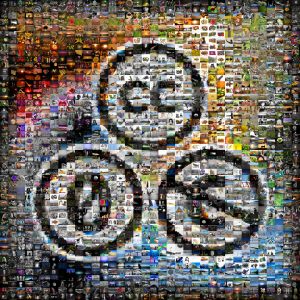 Each of us stands as one image in a mosaic of moving parts. This is the open education (OE) movement. This OE movement is part organizational and systemic, part incremental individual iterations. It’s a moving landscape with shifting elements going from one direction or another. Our concerted decisions and individual efforts to make things better for others is at the crux of what we do in open education.
 For me, this moving mosaic takes shape through the collaborations and networks where people add clarity and colour to this image of open. It’s the supported collection of individuals that will make this open education mosaic take shape. The open education rangers in Ontario (
 In the meantime, I’ve become deeply engaged in the
  I’ve been dabbling into the process of design and examined various
  In each of these contexts, the UX (student experience) is rarely examined or assessed. While some may argue that educators are doing this as they plan and teach, I’ll ask “When was the last time you asked your students how your lesson went or how the online course experience supported their learning needs?”. If UX becomes more prevalent in education, the design of learning events and activities will certainly shift from instructor experience to learner engagement. The

 Five Flames 4 Learning