Like driving a car

This is a response for the Ontario Extend module Teacher for Learning, specifically the Mastery section which looks at mastery of a subset of skills that educators deconstruct and teach, in order for students to achieve competency of the subset and the expected outcomes. The metaphor of driving a car is used to bring meaning to this notion of mastery learning.

So what skill is like driving a car in the field of teacher education? I’d like to look more closely at lesson planning and delivering a planned lesson to a classroom full of students. It’s really challenging when teacher candidates look at a lesson plan template and then teach from that plan for the first time. Once they sit in the seat, behind the wheel, the look of a ‘deer-in-the-headlights’ comes over them, just like that teenager behind the wheel for the first time.

Lesson planning is not natural, but it is necessary. Learning the fundamentals ensures a confident ‘driver’ emerges in the end. Teachers who don’t go through the steps carefully, think critically about goals, success criteria, differentiation, cross curricular connections, strategies, questions to ask, assessment, student’s actions, management directions, or their own locations in the room, are doomed to crash that car. They think they know what to do first [e.g. put the key in the ignition] and where to start. But, once faced with the awesome responsibility of planning the lesson, then sharing that lesson with students in a classroom with a whole host of potential actions and reactions, it’s pretty scary. Lesson plans can look great on paper but crash and burn in the doing part! Some of the worst planned lessons can be jewels in the moment of delivery. Getting both parts right is necessary for safe and effective ‘teaching’ (driving) experiences.

With a graduated system of ‘licensing’ it’s a process of perfecting the lesson planning from the paper to the real events. It’s like starting the car in the driveway before taking the car out into the empty parking lot. It’s about having multiple, low risk experiences before going out to the #401 highway. In lesson planning, it’s planning for a small group instructional event before taking on the whole class.

It’s driving with a master driver before it’s done on your own, without anyone else in the vehicle. Being mentored with a practicing teacher is an essential part of the lesson planning system. It’s seeing lesson plans as the evolve from detailed, specific documents to free-flowing guidelines for actions. It’s seeing that what is written is often shifted in response to student needs, actions, reactions and interests. It’s watching from a master practitioner that the static plan on paper is a living, breathing opportunity for learning.

Is it a perfect system for figuring out how to write and deliver lessons? No. There are still places where accidents can and will happen in the lesson planing process – from paper to classroom experiences. And even efficient and effective drivers don’t always get it right. Reacting to the context, conditions, and the unexpected is part of the ever evolving process in lesson planning and in teaching those lessons.

So I guess what I’m trying to say is that lesson planning and then teaching that lesson is sort of like learning how to drive a car, not like actual real life, driving. It gets easier to do. You get better with experience. You can transfer those skills to new ‘vehicles’ when you move from grade to grade. You don’t need to refer to the manuals each time you step in to do the deed of driving, just as you don’t need to refer to the curriculum documents every time you sit down to plan. You can drive further, farther, and in a variety of conditions, the more practice you get behind the wheel. Lesson planning is like that! Teaching from those plans is like that!

BUT, I’m not saying that teaching is like driving a car – that can never be said! Lesson planning and teaching is not like taking control of any kind of complicated machinery. Nope, not even like rocket science. It’s harder than that! Just listen and decide for yourself.
Posted in #OEOFellows, Ontario Extend, Teaching | Tagged , , , | 3 Comments

Combining Strategies for #oextend

This is a response for the Ontario Extend module Teacher for Learning, specifically the Organize Knowledge section which outlines the purpose of providing students with better opportunities for note taking.

When I first saw the Cornell notes I had a deep reaction of distaste, probably from the memories of note-taking from lectures, rewriting book chapters while reading texts and then re-reading all those notes in preparing for tests and exams. This is still necessary in many subject areas where information recall is an essential part of the learning process.

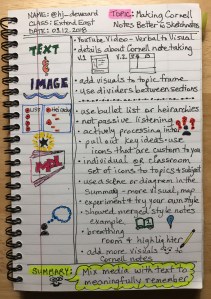
After reviewing a few videos to learn more, and taking a look at variations of Cornell note templates, I decided to give it a try. I’m reading a text that I feel has particular importance for me so I’ve been sketch noting the chapters to visualize the content. My note taking practice now includes graphic images and icons. Then the video below caught my attention and I was convinced. Combining these two strategies may be just the  knowledge organization technique to make remembering meaningful and note taking less tedious.

Here is my combined sketch note and Cornell notes about this video.

IMG_2565

Here is a sample of one sketch note from one chapter of the book I’ve been reading.

Functional Art Chapter 3 v1

Posted in Learning, Ontario Extend | Tagged , , , , , , | 2 Comments

Mapping a course for #oextend

This post is a response for the Ontario Extend module Teacher for Learning in the Organize Knowledge section. The extend activity was to create a concept map of my course but since I’ve been using concept maps in course design, I’m pointing to the ones I’ve already created as examples.

All the maps for my current online course Critical Digital Literacy (CDL) can be found on the course site – overview of CDL, code breaking, meaning making, use and understand, analyzing, and persona. These maps outline the five resources for critical digital literacy found in the core reading from the course.

Each of these maps was created using my all time favourite concept mapping software VUE – Visual Understanding Environment. It’s a free, open source software produced by Tufts University. This software was easy to learn but also had exceptional depth in it’s ability to create visual presentations from the maps. I haven’t used this lately since the most recent updates were done in 2015 and I’m using a newer computer that may have compatibility issues.

I’ve done work in CMap, concept mapping software created at the Florida Institute for Human and Machine Cognition (IHMC) but would need to go back and relearn since it’s been a few years since I’ve used this digital resource. It’s full potential comes through the collaboration options available.

Because my students will become teachers in Ontario schools, I introduce them to Mindomo concept mapping. This is licensed for use in Ontario K-12 classrooms so, for my students, it is a FREE digital concept mapping resource teachers should know about. Students in my online course are required to create a concept map for their inquiry project which allows me to see what they are planning to do, what resources they may have found and I can identify potential gaps in their project plan. Mindomo can also be used collaboratively in whole class or small group maps depending on the purpose. Before the students do their individual maps, they explore Mindomo in a collaborative mapping task with no marks or grades attached, so they can become familiar with the software’s functionality and affordances.

Mapping is a great way to make learning visible and see how students are making connections but you need to give them time to play and explore before you attach marks to a map since their familiarity with the tool will impact their production. If you want to see other maps I’ve created as I’ve learned, you’ll find a collection of them on my electronic portfolio site for the UBC Masters of Education (MET) program.

Posted in Ontario Extend, Teaching, Technology | Tagged , , , , , , , | Comments Off on Mapping a course for #oextend

Analogy for ‘Learning’

This is a post for the Ontario Extend ‘take it to the bank’ activity ‘So Misunderstood‘ in the Teacher for Learning module. It’s a dip into understanding prior knowledge and how it can impede or enhance student understanding. One of the most challenging concepts new teachers need to grasp is how to know when students know ~ or in other words, what is learning?

Teachers need to be able to ‘see’ learning in the actions, reactions, and reflections of their students since learning is not visible to the naked eye in any other way. Teachers need to discern where learning has occurred through the products students create, tests they take, assignments they complete, and conversations they have. Learning is not an easy concept to understand.

I’ve used the analogy ‘As Easy as Riding a Bike‘ in one previous blog post where I explored my own learning at the end of a course. I used the Backwards Brain Bicycle video as a prompt for reflection and wrote about five things I know for sure about digital teaching and learning. The video helps students think deeply about their work in the course, the progress they’ve made over time, and identifying where their learning has happened. In this way, I too get a glimpse into their learning.

As a way to consolidate the ideas around ‘what is learning?’ I’ve used this video as a provocation for student thinking, both at the beginning of a course and again at the end of a course. The intended purpose is to revisit to review, reframe and revise prior knowledge about what learning is and ensure clarity of this concept as students venture into the field of education.

What is Learning? from CLRI on Vimeo.


Posted in Ontario Extend | Tagged , , | 2 Comments

Extending into the Open #oextend

Getting started with Ontario Extend is one way to extend my thinking and extend my engagement into digital spaces that are new and interesting. Contributions to the Daily Extend, into the collection of resources in the Activity Bank and capturing the blog sites of others in the community using Domain of One’s Own will be the passion to drive extensions of my learning. At the end of this morning’s workshop, I’m exiting with new connections, new interests and opportunities to add purpose to my passions. I’m excited that this will energize my blogging. I’m extending my blog into the Ontario Extend ecosphere and hoping to learn from the work of others in this space over the next few months.

manuel-meurisse-350263-unsplashAs an exit ticket, I’m paying attention to the prompt: “Use words and pictures that paint the picture of the future of a world with you in it” and sharing an OPEN INVITATION to sit down, have a chat and share your thoughts as we start extending our steps into the OPEN together.

Check other Extend activities using  @OntarioExtend on Twitter and the activity bank link found here: Exit Through the Workshop – Ontario Extend Activity Bank

Follow other Ontario Extenders on this Twitter list.

Posted in Ontario Extend, Teaching | Tagged , , , , | Comments Off on Extending into the Open #oextend

Uncommonly Ordinary

This notion of being ordinary continues to pervade my thinking and catch my attention.

I’ve just watched uncommonly gifted athletes compete in the Winter Olympics, my jaw dropping each time there’s a flip, throw, toss, spin, slide or crash. It’s incredible to think that ordinary people are doing these extraordinary things. Anyone who participates and competes at that level of sport is uncommonly gifted – even those who were selected to drive the Zamboni to clean the ice at the Olympics.  For those who did not achieve their dream of acquiring a medal, I commend you for being there and putting your uncommon talents and gifts on the line for family, friends and country. That is no ordinary feat!

Thanks to Donna Miller Fry for nudging these ideas further with her post As It Is, Not As We Wish It To Be. Here she talks about the Olympic experience for those who didn’t achieve their life’s mission of winning a medal and about failed dreams. How we message this for our children can be a valuable way to “make the ordinary come alive and let the extraordinary take care of itself”.

So how does this connect to my teaching?

It’s here in this blog post by Chris Kennedy – They’ll Keep Coming, Until They Don’t. He starts with the challenges of student recruitment but shifts to the bigger issue of staff recruitment – educators, support staff, and leaders. Finding and keeping talented staff engaged in the work of teaching and learning is like finding those Olympic athletes who’ll put their heart and souls on the line. How will systems shift, as all systems must, to accommodate the elusive Olympic athletes of the educational world? These extraordinary teachers make the ordinary come alive and are rarely recognized for allowing the extraordinary to take care of itself. But, they’re being identified, as the Olympic athletes within the educational field and are finding recognition in other places. How can their extraordinary talents be sustained and celebrated, within educational systems, when the market world of educational business is scooping them up and hiring them for more money than school systems can afford?

How do ordinary educators stand out as extraordinary and find their place, sustain their efforts and make a difference to students? With a world wide focus on school improvement, student success, engagement, well being, and global competencies, this is not an easy ask for ordinary educators. This is an extraordinarily complex task, not solvable by individuals in isolation. It’ll take a network of support. It’ll keep the educator as the focus for the endeavour.

network-3139208_1920

A focused network of support

When being interviewed after their event, it wasn’t unusual to hear the medal winning athletes talking about their team, their fellow athletes, their equipment managers, and their family and friends as being their support system for the work they do as Olympians. Having this wrap-around system of support is an essential factor in bringing their extraordinary talents to fruition, whether there’s a medal in the end or not. This system of support is also essential, as Chris Kennedy points out, for ordinarily talented educators, support staff and school leaders. Sustaining and maintaining quality people in schools and classrooms should be as important, if not more critical, than finding, recruiting and supporting our Olympic athletes. Let’s make sure supports for these ordinary ‘amateurs’ are considered or they’ll be enticed to ‘turn pro’.

Creating and building a quality and qualified team around our ordinary educators is an essential way to ensure their success in the extraordinary work being done in classrooms. In today’s educational contexts, it’s supported through a network of engagement, not found only in the physical space in which the teaching happens. It reaches beyond the geographic confines of city, country or systems. It’ll take ordinary educators to create ordinary networks to support ordinary educators – in that, the extraordinary will take care of itself.

Have you found networks to support educators in the classroom?

Here are some of mine:

These networks bring ordinary educators into ordinary conversations, sharing ordinary events, building ordinary connections with some extraordinary results being created.

Share your networks!

Let other educators know their ordinary efforts are making a difference! Let’s recognize that those “who win, inspire others with messages about working hard and achieving your dreams” (Donna Miller Fry), but let’s also make sure the ‘failed dreams’ become visible for others to see. There are extraordinary lessons in supporting teaching and learning found in these ordinary networks.

Posted in Learning, Talking, Teaching | Tagged , , , , , , , , , , | Comments Off on Uncommonly Ordinary

Fellowship in the OPEN

The journey has now begun, the fellowship has been formed. As intrepid travellers, we each come from different spaces and places – in both our physical and digital realms! We carry our own packs full of tools and tricks as we journey together, into the OPEN. We’ll  apply our talents and insights to strengthen our bonds as a fellowship. We’ll share our fears as we face the journey together. Our individual presence is essential for the success of the fellowship and the quest will move us further into the open spaces in Ontario higher education.

We will not journey alone. There are many who will support and provide guidance along the way. Just as the Fellowship of the Ring, from J.R.R. Tolkien fame, set out on their quest to destroy the ring and save Middle Earth, so too will we face our own ‘demons’ of doubt and despair. Our journey into the open will not be without it’s own set of challenges and tribulations – maybe not on the same scale as Frodo faced as he carried the ring – but they may feel as daunting. There will be times we’ll need to travel alone!  There will be times our Fellowship will join forces to celebrate our journey.

What is this fellowship? It’s the #OERFellows for @eCampusOntario. It’s a small group of advocates in higher education spaces in Ontario who are passionate about shifting higher education into the open. Within minutes of coming together, as we did at the eCampus Ontario offices this weekend, we’ve bonded in our common interests and passions about teaching, learning and student success. We’ve shifted our own thinking about what it means to be an ‘OERFellow’ and how to engage with others in opening conversations about open education – resources (OER), practices (OEP), and movements (OEM).

Individually, we are one voice. Together we’ll share our voices in chorus. We shaped our song and shared some laughter. We left with a feeling we’re not alone anymore. We’re connected in our passions, in our future endeavours as an OERFellow, and in our journey as gallant leaders in OER, OEP and OEM in Ontario higher education spaces. We’ve got two new hashtags to connect our conversations as we echo across the province – #GlisteningLearningFish and #OEOFellows (Open Education Ontario Fellows). We’ve got a supportive team at eCampus Ontario to provide guidance along the way. We’ll have the #OEORangers to draw strength from, since there are many others on similar paths.

So how did I get to be part of the fellowship of this OPEN Ring? (#OEOring – Open Education Ontario Ring of people). The application was a series of ‘quests’ (letter of intention, CV, letter of reference, social media writing sample, video) where my commitment to open education was ‘tested’. Here’s one part of the application process – a video about WHY I wanted to be part of the fellowship. This will introduce me to my fellow OEOFellows and others interested in seeing what this fellowship is all about.

If you’d like to get to know others in the fellowship – take a listen to these Getting Air podcasts recorded in conversation with Terry Greene from eCampus Ontario on VoiceEd.ca.

Now that we’ve become a fellowship, the work and journey can truly begin! Here’s a sample of how this journey started – in tweets and images! Since it started and ended with snow falling, the snow globe theme seemed appropriate.

For my fellow #OEOFellows and those who will join us on this journey – the greatest adventures lie ahead!

Let’s make this an epic trilogy where amazing memories happen! This story is open – we’re sharing as we travel. If you want to follow this journey – join the conversations at #OEOFellows and #GlisteningLearningFish. Follow where the story will be shared:

OEOFellows

Supported by 

Posted in #OEOFellows, Talking, Together | Tagged , , | Comments Off on Fellowship in the OPEN

Create, Connect & Share Respect on #SaferInternetDay

Today is Safer Internet Day!SID2018_date_and_year

It’s one day that can spark a year long pursuit to create, connect and share in safe and respectful ways.

Today’s that day! It’s Safer Internet Day!

This year’s theme, “Create, connect and share respect: A better internet starts with you”, is a call to action. Everyone has a part to play in creating a better internet for everyone. We should do this for those youngest users in our homes, schools and media making spaces. Safer Internet Day brings everyone together to talk and engage in a respectful way in order to ensure a better digital experience. The aim of Safer Internet Day is to raise awareness of emerging online issues and highlight  topics that reflect current concerns. The global site for Safer Internet Day provides resources and links to open the conversations about creating, connecting and sharing respectfully on the internet.

In Canada, the Centre for Child Protection promotes Safer Internet Day with a focus on educating parents about the biggest risks kids face online and how they can help keep their kids safe. On their website are resources to support this initiative.

Not sure what kids are doing online? ProtectKidsOnline.ca provides a reference tool to look at what ages 5-7, 8-10, 11-12 and 13-15 are doing online, what the risks are, and how to talk to children about the creating, connecting and sharing respectfully on the internet.

Online-safety_mooc_badges22For teachers, at the primary and secondary level, as well as administrators, there’s another way to build your skills and become informed. This is important since teachers should be able to provide their students with all the necessary tools to face the online world in an empowered and responsible manner. As students create, collaborate, share and connect in online spaces, there are ways for teachers to ensure this is done in a safe and respectful manner. Being an informed educator is the first step to managing this ongoing conversation. The new and updated edition of the Online Safety MOOC will help teachers gain a better understanding of the risks and challenges children face when they go online. The Online Safety course shares strategies for supporting young people to develop safe and responsible online and offline behaviours. A wide range of resources that teachers can use in the classroom will be provided, This can be one way to build a better internet. Completing this course will ‘show you know’ what it takes to teach children about internet safety – the badges will represent your skills.

So send a tweet today, share a post and spread the word! Take a moment to learn more about Safer Internet Day with this infographic. Start today, begin and share. Be part of a global wave of support for creating, connecting and sharing respect on Safer Internet Day!


Posted in Teaching | Tagged , , , , , , , | Comments Off on Create, Connect & Share Respect on #SaferInternetDay