Part 3: Why have a PLC?

Your PLC will support the process and product of your learning. Subject, need, practice or inquiry shapes your PLC.

  • If you need to extend your own learning on a subject area or topic, find people who are doing work in those areas.
  • If you have a specific need, such as enhancing your ability to teach online courses, find others who are currently teaching online or those with expertise developing online courses.
  • When you want to collaboratively make something, work with a PLC. Focus on collaboration, communication and building relationships, and take it a step at a time.
  • When looking for ways to extend your teaching practice, connect to those who are doing the same thing, e.g. using twitter in the classroom, and talk about what you are doing.
  • If you are looking to resolve a specific question or inquiry, find others that may have the same interest in finding answers e.g. how will blogging support writing in mathematics? This can result in rich, interdisciplinary research.

Will your PLC be structured as a community of practice or COP, a community of inquiry or COI, or an affinity space?  Understanding the structure of a community of practice (COP), community of inquiry (COI) and affinity spaces can help you find and understand your location and role within your chosen community. Each of these communities of learning function and focus on subject matter and relationships differently. Selecting the type of learning community is based on your own preferences and the topics for learning.

The structure and interaction within a COP is founded on theories of social learning,  originating with Jean Lave & Etienne Wenger, was further developed by Etienne Wenger-Trayner and Beverly Wenger-Trayner. The community is structured around a domain, examines an area of interest within this domain and develops a shared repertoire of experiences to respond to a need that comes from the community. Various positions within the community change and evolve as members take on different roles or move into/out of the community.

The concept of a community of inquiry is based on work done at Athabasca University by Terry Anderson, Randy Garrison and others. This model for community was developed for online learning and outlines elements for social presence, teaching presence and cognitive presence. Much more can be learned from the COI:Athabasca.ca site. Mirroring this notion is the work of Paloff and Pratt. The idea that your personal learning community will have members who can focus on or support each type of presence, whether working in digital or physical spaces, is an important one. This will help members of the community collaborate and share individual strengths.

Within an affinity space, individuals take on a variety of roles, both self assumed and authorized by others. John Paul Gee’s work From Age of Mythology to Today’s Schools outlines the parameters of a community structured around an affinity space. The elements are further outlined HERE. The key features include:

  • people relate through their common interests
  • no segregation of skill or interest level
  • anyone can contribute content for the whole community to use
  • people are encouraged to become both specialists and generalists
  • distinction is made between individual knowledge and distributed knowledge
  • people are encouraged to travel outside the site for more knowledge
  • multidisciplinary and interaction with other skills, ideas, areas are encouraged 
  • tacit knowledge is commonly accepted – e.g. language of the craft
  • many different forms of participation
  • status can be achieved in a number of different ways
  • leadership is based on being a helper and teacher 

However your personal learning community is tightly or loosely structured, you have choices to make when you enter into these shared spaces.

Use the Four D’s

Within your PLC you can determine your own role, place and direction. How deeply you become engaged in the community space is at your discretion. With you at the center of your learning, you control the direction, duration, depth and dissonance of your learning experiences.

Your own learning needs and interests determine direction. This can even change mid-stream when you become engaged within a PLE and PLN that catches your interest. But keep your initial goal in mind and work to achieve one or two goals at a time or you will find yourself adrift, not know which direction is up or down.

Duration is dependent on the current or future demands on your time and skills. Finding convenient times and spaces to engage with others in a COP, COI or affinity space depends on priorities. Carving out time to attend to work within a community of practice may be determined by outcomes and rewards. Some community spaces support your own research endeavours, while others may award digital badges as tokens of effort.

Learning can be done on the surface level for a quick outcome. Learning done at a deeper level will transform and renew you as a learner. Decisions about surface or deep learning can be made as you engage and feel the connections grow to the content or members within the community. You will determine the depth of your learning within a COP, COI or affinity space by available time, effort and interests. Your passions and connections will drive the depth of your learning.

Some learners can tolerate high levels of complexity within learning communities while others find comfort in lower levels of cognitive dissonance. You will determine and shape the range of dissonance you can accept in your learning environment or network. Some dissonance is essential – enough to ‘make your brain sweat’ (M. Duncan). Higher levels can lead to frustration or ‘aha’ moments, depending on your own learning preferences.

People need others to help focus, shape and add accountability to their personal learning plans. Your PLC will help you stay committed to completing a course of study or learning project. Relying on PLCs can help engage and excite your learning journeys.

References and Resources

Wenger. E. (n.d.) Communities of practice: A brief introduction.  http://wenger-trayner.com/wp-content/uploads/2012/01/06-Brief-introduction-to-communities-of-practice.pdf

Lave, J. (n.d.). Situating learning in communities of practice. Retrieved from http://www.seachangecop.org/sites/default/files/documents/1991%20Jean%20Lave%20-%20Situating%20learning%20in%20CoPs.pdf

ELO at UPEI. (2014, Nov. 14). Terry Anderson – Interation, learning and teaching.  https://www.youtube.com/watch?v=3hOxg4dGaP0

Posted in Learning, Talking, Teaching, Together | Tagged , , , , , , , , , , , , , , , , | Comments Off on Part 3: Why have a PLC?

Part 2: Who’s in your PLN?

So, who are the people that shape, influence and share your interests? Who are the movers and shakers of your thinking?

Your PLN may be shaped by the tools you use within your PLE. When building and maintaining connections you will need to develop relationships with people that matter to your content and context. Connecting with others who can support your learning needs is a great way to learn from, and with, others. Howard Rheingold provides eight steps to cultivating a PLN – explore, search, follow, tune, feed, engage, inquire and respond. To learn more about how to work through these steps, read How to cultivate a personal learning network: Tips from Howard Rheingold.

Rhizome metaphor

Rhizome as metaphor for PLN

  • Basing your PLN image on a meaningful metaphor can help ground and connect you within your network. Some common PLN metaphors include roots, trees, water, light, or family.  Looking closely at images and metaphors can help you visualize your PLN and connect people or groups in logical ways.
  • Use your own interests and research to help find reliable sources of best practice in your area of interest. Connect to those who also work in your area of endeavour or research focus within global spaces. Are there ways to communicate and build relationships with these individuals through social media or direct messages?
  • Find networks already established in your area of interest. For example the Educator’s PLN or The Technology Using Professors group on LinkedIn may be a place to start. When using social media such as Twitter, spend time to search to find people with similar interests. As Rheingold suggests, follow the eight steps to use, understand and create in your digital network spaces.

Your PLN will be your go-to source for support, information, resources, critique and affirmation. Those you select to include in your PLN need to understand and be aware of your personal learning needs. Build those connections and have those conversations regularly and deeply.

To read more about personal learning communities, see Part 3: Why have a PLC?

References and Resources

Connected Educators, Corwin Press. Chapter 1 available at http://www.corwin.com/upm-data/64023_The_Relevant_Educator_Ch1.pdf

Posted in Learning, Talking, Teaching, Together | Tagged , , , , , , , | 1 Comment

Part 1: What’s in your PLE?

Within higher educational spaces the ‘how and where’ learning occurs can vary dramatically. In physical learning environments, the places and spaces where you spend time and conduct your teaching and learning may or may not include a private office, current technologies, elements of the perfect classroom (The Perfect Classroom, According to Science), or even a personal computer. Within digital spaces, variances in available tools and technologies can also impact the direction your personal learning will go. Despite these inconsistencies or perceived barriers, there are many opportunities within your physical and digital environments to learn.

Participating and engaging in a variety of learning environments will shape your view of ‘best practice’. Through a process of using, understanding and creating, while critically analyzing through a teaching lens, your PLE will serve to support communication and building relationships. Reflect on the digital environments that shape your personal learning with the intention that there is a transfer into your teaching practice e.g. Twitter, Blogging, Hangouts, webinars (see guest post by Rusul Alrubail).

PLE’s within digital spaces include learning management systems (LMS), massive open online courses (MOOCs), web 2.0 tools, open educational resources (OER) and learning commons resources.

  • Variances in the available LMS can determine how you share your learning with students and other educators. Each LMS and higher education provider will establish parameters in how, where, and when learning environments are opened, closed, shared, accessed and created. Blackboard, Moodle, Sakai, Desire 2 Learn (D2L), Canvas or other LMS may be adopted as a means for teaching and learning within face to face (F2F), blended and online learning environments. As the teacher, your personal learning environment will be shaped by decisions made by others. But you are not alone. Support through your higher ed organization will help make this learning space more comfortable. Set a goal to learn how to do one new thing in your LMS this year. For me, this will be the creation and distribution of video feedback within D2L.
  • When given time and space, participating in a MOOC can extend your personal learning. My recent experiences participating in SOOC2015 and the HumanMOOC  certainly enhanced my understanding of universal design principles and how online learning can be humanized. Finding a MOOC to extend your personal learning from an extensive selection can be done through  this searchable MOOC List. Set a goal to participate in one MOOC this year. I’ll continue to engage in MOOC experiences to support professional growth to help me provide quality online learning experiences for my students.
  • Keeping a focus on personal learning to support your teaching practice can help manage the direction for learning about web 2.0 tools or apps. Since there is a vast array of tools available, careful selection and critical analysis is important. Finding tools and apps that support your content and context should be the priority. Relying on your PLN can help. Using, understanding and creating with some tried and true tools can be a starting point, e.g. Twitter, blogs and wikis. Thinking about enhancing communication and relationship with/for your students will help decision-making. Set a goal to learn how to apply five web 2.0 tools to your teaching practice this year.
  • Examining and selecting OER for your PLE can be time consuming. Connecting with others in your field of study can be a good place to start. Sending out requests to your PLN can also help. Resource collections exist in a variety of spaces and places so the challenge is finding those the best suit your personal learning needs. Edudemic, iTunesU and edshelf can be starting points for your search. In Ontario contexts, Contact North has great resources to begin your work. Set a goal to tap into one resource from one of these OERs.
  • The concept of a learning commons (library system) is applied differently at each higher education organization. Tapping into the commons is essential for every educator in higher ed. Building a relationship with one or two people in the commons will extend and enhance your personal learning. Ease of use, affordances and navigation are highlighted and streamlined when you find a guide into this digital environment. Set a goal to connect in a personal way to one individual in your organization’s learning commons.

With so many options and opportunities in these learning environments, it’s up to you to decide where to start and where to go next. But if your focus remains on building relationships and enhancing communication, your personal learning environment will suit your own learning needs.

References and Resources

Jensen, K., & West, Q. (2015) Open education resources and the higher education environment: A leadership opportunity for libraries. College & Research Libraries News. http://m.crln.acrl.org/content/76/4/215.full

Digital skills for collaborative OER development. Course DS4OER http://ds4oer.oeru.org/

Posted in Learning, Talking, Teaching, Together | Tagged , , , , , , | 1 Comment

You Are Not Alone

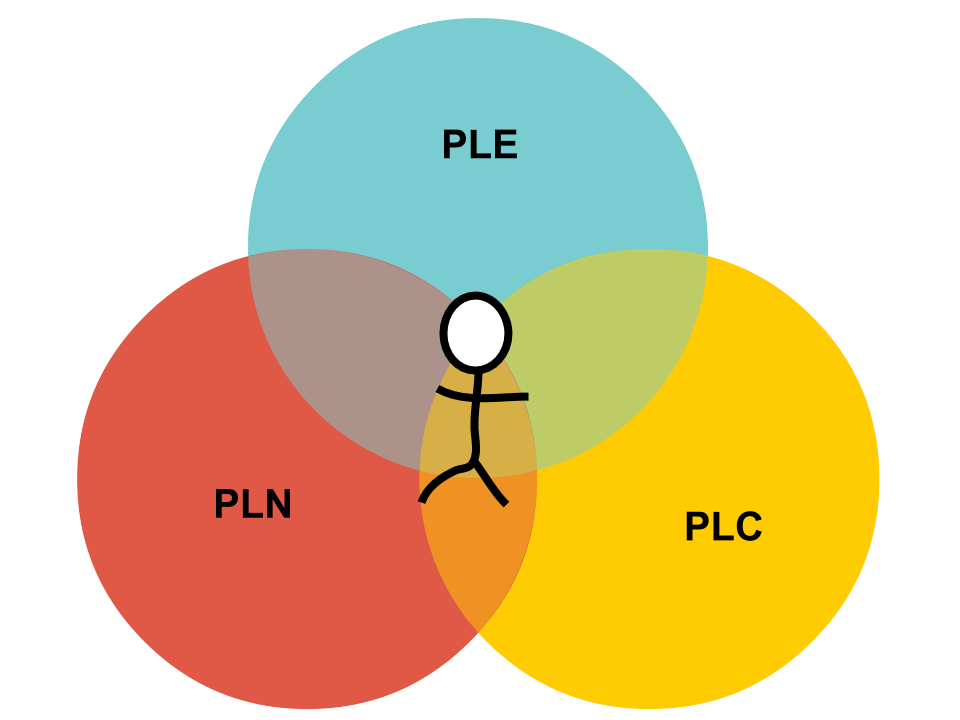
When you step into the classroom you are not alone. As the teacher, you may feel alone. You may be the only one in the teaching role, but you are not alone. You bring into this teaching and learning space all the elements from your own personal learning environment (PLE) and your personal learning network (PLN). For many teachers, participation in a professional learning community (PLC) will focus and support your teaching practices in the classroom. These other entities and identities shadow and shape who you are in your classroom space.

Who’s got your back?

Exploring and constructing an image of your own PLE, PLN, and PLC can bring awareness that you are not alone. Reflecting on your own learning environment, network and community can help set goals for what comes next. Notice that these terms refer to personal learning as the focus, not teaching. We are all learners.  For your own learning as a teacher, these will be interconnected and recursively looped. Alec Couros, in his blog post What is a PLN? Or, PLE vs. PLN? examines and differentiates these two terms. You can find more about these terms on the course site for 3239DTL here. For me, a PLE is the how and where learning occurs while PLN is best described as the who or people in the learning space. A PLC helps define, but does not always determine, the what and why for personal learning.

PLEYour PLE – 

Within higher educational spaces, PLE’s can vary dramatically. In physical environments, the spaces and places where you spend time and conduct your personal learning may or may not include a private office, current technologies, elements of the perfect classroom (The Perfect Classroom, According to Science) or even a personal computer. Within digital spaces, variances in available tools and technologies can also impact the direction of your personal learning. Despite these inconsistencies or perceived barriers, there are many opportunities within your physical and digital environments to learn.

Participating and engaging in a variety of learning environments will shape your view of ‘best practice’. Your PLE will serve to support communication and building relationships through a process of using, understanding and creating (MediaSmarts) in digital environments, while analyzing through a teaching lens. A critical first step is to reflect on the digital environments that shape your personal learning, with the intention that there is a transfer into your teaching practice e.g. Twitter, Blogging, Hangouts, webinars (see guest post by Rusul Alrubail).

Examining Dr. David Thornburg’s article Campfires in Cyberspace: Primordial Metaphors for Learning in the 21st Century can help identify the types of spaces in which you are comfortable or can best engage with others. Do you find yourself drawn to the campfire, cave or watering hole? A variety of environments can add value to your digital networks and communities as well as enrich your learning experiences.

PLE’s within digital spaces include learning management systems (LMS), massive open online courses (MOOCs), web 2.0 tools (to collaborate, provide voice and choice or create learning objects), open educational resources (OER) and learning commons resources. More about each of these PLE’s are found in Part 1: What’s in your PLE?

PLNYour PLN –

Your PLN will be shaped by the tools and spaces you use within your PLE. When building and maintaining connections for your own learning, you will need to take time and make an effort to develop relationships with people that matter to your content and context. Connecting with others who know something to support your learning needs is a great way to learn from/with others. Using your research can help find reliable sources of best practice in your area of interest.

Connecting through social media and professional organizations is also a way to develop your network. This can be hard work, but make the time and focus your search. It’s worth the effort. Using Twitter and selecting relevant hashtags can help you find people that reflect or shake your thinking.

It is becoming more critical to share your personal learning with your PLN through social media – blog, twitter, Facebook or other networking locations. Members of your network may become part of your PLC for a specific time and place. HigherEd Camp is a great way to extend and enhance your PLN. For additional ways to connect with others, read Part 2: Who’s in your PLN?

PLCYour PLC – 

Subject, need, practice or inquiry shapes your PLN. Focus on one learning exploration and take it a step at a time. Your PLC will support the process and product of your learning.

  • If you need to extend your own learning on a subject area or topic, find people who work in those areas.
  • If you have a specific need, such as enhancing your ability to teach online courses, find others who are currently teaching online or those with expertise developing online courses. There’s a MOOC or OER for that.
  • When looking for ways to extend your teaching practice, connect to those who are doing the same thing, e.g. using twitter in the classroom, and talk about what you are doing.
  • If you are looking to resolve a specific question or inquiry, find others that may have the same interest in finding answers e.g. how will blogging support writing in mathematics? This can result in rich, interdisciplinary research.

Understanding the structure of a community will shape and extend your learning experience. Knowing more about a community of practice (COP), community of inquiry (COI) or affinity space can help you find and understand your location and role within your chosen community. More about COP, COI and affinity spaces is found in Part 3: Why have a PLN?

You are not aloneYou are surrounded

With you at the center of your learning, you control the direction, duration, depth and dissonance of your learning experiences. Step forward, step back, side step if you need to, but take that first step! Discover and reflect on your PLE, PLN and PLC before or after you come to the HighEd camp. But reflect you must! Your learning depends on it! Your students’ learning depends on it! But remember, you are not doing it alone!

  • Where and how will your personal learning develop?
  • What will you learn next?
  • Who is currently in your network to help your learning?
  • Where will you connect to others?
  • Who would you like to connect to next?
  • How can you connect with a group of ‘like minded’ learners to support your own professional growth?

Starting with HigherEd Camp, how will your PLE, PLN and PLC change so you know and feel that you are not alone?

Posted in Learning, Talking, Teaching, Together | Tagged , , , , , , , , , , , , | Comments Off on You Are Not Alone

From Squirrels to Rhizomes: An intro to #rhizo15

There’s a humorous statement that’s made around here that when you get sidetracked from something, you say “squirrel”. It’s reminiscent of what happens to dogs when they are out for a walk. Every squirrel catches their attention. Movement of a bushy tail creates the compelling need to chase it down. I’m not a fan of squirrels, but they do catch my eye and I somehow cannot resist the urge to watch. I’ve been saying “squirrel” to myself, under my breath, in the last few days. I really think they plant rhizomes!



So this squirrel phenomenon is representative of my early #rhizo15 experience. The bushy tails of ideas, posts, videos, images, surveys, responses, recipes, tweets, and music have all caught my eye. The Rhizome Cowboy was engaging and the Rhizo15-We find our way through was reflective. Thanks to Ann G. I’ve got the Song that never ends stuck in my mind. And in true “squirrel” fashion, The Rhino Song wags a bushy tail. Is this what rhizomatic learning is like? I’m sure I’ll find my way through, if I can stop chasing bushy-tails and dig into something.

I’ve gone back to the Open Learning Recipe many times, put it down, lost it, found it, reread it. It’s growing with so many great ideas and ‘ways of doing’ Rhizo15 –  I’ll try to remember to blend ideas, to fold new concepts into my previous understanding rather than mashing them together. I’m not a bad cook, but there are too many ingredients for me here. I’ll need to clear the counter and get rid of the squirrels. I’ve figured out that if I have all the Rhizo15 tabs open in one window, I can minimize the clutter and get on with other things for a while. I will consciously make every effort not to use ‘but’.

OK. Window closed. Squirrel’s gone!

My learning subjectives? After watching the video prompt, I was stumped. How do we design for learning when we don’t know where we’re going? This isn’t an easy question to answer. How do we unstructured the structures of learning? How do we open learning environments to ensure directions and experiences can happen fluidly? I’ve been thinking about this as I delve into personalizing learning experiences, humanizing online learning and designing learning using universal design principles. The structures need to be there to scaffold and support students without constraining the learning opportunities.

Then I took a bit of time to read through a few of the early blog posts to see what others were thinking. I commented on a few where I ‘turned to wonder’. This helped the direction of my thoughts.

After returning to reread Maha Bali’s article Embracing Subjectivity I am reminded that I cannot remain neutral in my own learning or teaching. Neutrality is impossible in rhizo15. I will need to visibly show my stance. It will be a process where others will share as I uncover “what might be hidden behind claims or arguments” (Maha Bali) that I may make in digital spaces. Then maybe I can blend or fold them together with my own conceptions.

Then Ann Gagne posted her thoughts on Everything is Subjective: A “Timely” #Rhizo15 post for Week 1. She states that “subjectives live in that smooth space (woot D&G) and are always there alongside learning objectives” and that “holistic instructional design sees everything, does not hone in on that one learning outcome node but rather opens the space up to non-linear organic learning”. Subjectivity means that my learning with Rhizo15 will not focus on any one particular item and will smoothly move from topic to topic. I am certainly OK with this – smooth, fluid, movement from idea to idea. How can I provide this same experience and opportunity for my students or will any of them even want it this way? Just because I’m ok with it, doesn’t mean they will be. I can’t be neutral in learning or teaching spaces, but I can be honest and open about it. Maha reminds me that “Embracing subjectivity entails opening ourselves to questioning and evolution”. Rhizo15 may help the evolution of my learning and teaching.

So, I better get myself straight on the subjectivities for this course, before the squirrels catch my attention again! I will not be neutral in Rhizo15.

  • I will state my intentions, ideas and stance in public and allow some uncovering or challenging to occur, no matter how uncomfortable the push or pull may feel. My students deserve the transformed me that may evolve from the experience.
  • I will move (put creeping rhizome analogy here) fluidly and smoothly within ideas and conceptions, putting out shoots, planting some nodes, connecting to others in this dynamic learning space.
  • I will evolve my ideas and practices about teaching by reflecting and applying this experience of unstructured learning.

OK…. ooops… ‘squirrel’!2796304725_dd354ef50d_m

Posted in Learning, Talking, Together | Tagged , , , , , , , | 7 Comments

ME in MEdia

I’m still new at this. My adventures after I ‘Awaken the Dragon‘ now leave me very visible and present in social media spaces.  I need to carefully examine where that leaves ME. I’m not sure how my media creations look and sound in digital spaces. Am I being too loud? Do I talk too much? Who’s seeing me or even listening? Who am I in digital spaces? Is my ego showing? Who is the ME that is evident in my Media?  The message others take from my MEdia should reflect who I am. Do others see ME in my writing? Is this rather shy, farm girl from rural Ontario evident in what I write? Do my Dutch roots show when words spread into media spaces?

I was humbled this week by the many connections and comments that came my way from people whom I respect as leaders in connected digital spaces.

  • @HumanMOOC sent a link to a ‘call for book chapters’ relating to humanizing online learning to see if I was interested in writing on this topic.Screen Shot 2015-04-10 at 9.23.48 AM

Throughout this week, I continued to read and connect through social MEdia and reflected on ME in digital spaces. After reading Sherri Spelic’s blog post On the Other Side of a Twitter Tizzy and Maha Bali’s blog post Ego, Self-Promotion & Empowering Minority Voice, my ego and sense of self needed to be checked and reviewed. Where is ‘ME’ in my MEdia. Am I in it for the ego-boost or, as Lee Skallerup Bessette states in Shameless Self-Promotion, “shameless self-promotion isn’t about just you; it’s about being better because of the people you’ve reached”? More reflection and self-checking results in renewed focus.

It’s not about ME in this MEdia. It’s about becoming a better human, teacher, person because I’m making a difference through sharing my MEdia with others. So that’s where I’ll leave it for now.

Where do you find your ME in your MEdia? What does your MEdia say about you?


Posted in Talking, Together | Tagged , , , , , , , , , , , , | 12 Comments

Teachers are Humans too!

Hand imageWhat does it mean to be human? Why do teachers or educational leaders feel excluded from this category when public perspectives and dialogues reference teaching? In a very human struggle, my thoughts strive to resolve a multitude of issues and perspectives surrounding what it means to be human in digital spaces and how our humanity impacts what it means to be a great teacher.

Jean Vanier presents a vision for what it means to be truly human “to discover who I am is also to discover a unity between my head and my heart”. Vanier states ‘to love is not to do things for people. It’s not to tell people what to do. It’s to reveal.’ Isn’t that what teaching is all about – revealing the layers that lie beneath. For teachers, this is an essential element of who we are and what we do. The words ‘who you are is something about your heart being open to others. A heart that is not filled with fear.’ This resonated for me since my one word for 2015 is HEART.

But this image of a heart filled, loving, fearless and very human teacher conflicts with other images of teaching found in today’s popular media. After watching a Huff Post Live discussion about the trial of eleven educators in Atlanta who were convicted of cheating on standardized tests, I struggled to find the heart and head of those human teachers. My thoughts turned to finding the human side and understand who those teachers are to their students and the school communities where they teach. No wonder some teachers live in fear.

Jean Vanier reminds me that ‘because people are filled with fear they can no longer be open to others. They’re protecting themselves…’ Is it fear that drives the human side of the teaching endeavour in today’s ever-critical environments? How do we ‘let down the barriers, to open up’ not just from within ourselves but within our learning spaces both physical and digital? These are not easily answered or resolved.

With these conflicting ideas about what it means to teach ‘humanly’, I looked for some thoughts, models, practices to support what I hope will lead to humanized teaching. My personal experiences with Parker J. Palmer’s Courage & Renewal brings me back to seek for answers. In The Heart of a Teacher, Palmer outlines the critical factor in teaching when he states ‘we teach who we are. Teaching, like any truly human activity, emerges from one’s inwardness’. He continues by recognizing that ‘a good teacher must stand where personal ‘ and public meet’ which makes teachers vulnerable to criticism and judgement. Interestingly, current culture works against this idea that heart and head come together in teaching from a human stance. Palmer identifies the paradox between subjective (human) and objective (facts) elements in education – ‘this culture, objective facts are regarded as pure while subjective feelings are suspect and sullied. In this culture, the self is not a source to be tapped but a danger to be suppressed’. This reminds me of the importance of  bringing the self, subjectivity and engaging the heart of teacher + student into educational endeavours.

The topic of honouring subjectivity is further explored by Maha Bali in Embracing Subjectivity where she states ‘Subjectivity is the human condition. Let’s reconcile ourselves with it. Or better yet, embrace it.’ The opportunity to bring heart and head together into teaching practice while teaching from our inner selves is the human way to teach.

Deanna Mascle’s blog post Teachers: We reap what we sow combined with Seth Godin’s post Enthusiasm and contempt are both self-fulfilling together remind me that if we want to be treated as humans who teach, we need to teach as humans. There is a self-fulfilling prophecy about this reciprocal relationship. Deanna Mascle shares how efforts to build community, model, guide, scaffold and delve deeply into topics can plant the seeds to  transform learning and benefit the inquiring and curious mind. It’s harder to see or measure human effort when teaching efficacy is counted by data collection rather than felt in the heart or understood in the head. Teachers who fearlessly remove their personal barriers and open themselves to being human in their teaching and learning are themselves transformed.

Sharing with others is a human way to start conversations and connect to the heart of teaching. Sylvia Rosenthal Tolisano shows how learning to share can focus the head and heart to improve practices for teachers. Her work with educators in boot-camp and virtual forums (Learning to Document FOR learning and sharing) provides a model for sharing fearlessly to make a difference in education.

I’m sure there are many more examples and models where educators are humanly teaching by combining head and heart into their learning efforts. There may be many other heart-warming stories (such as this one from CTV News Toronto) of teachers being celebrated rather than denigrated or incarcerated for their efforts to bring heart and head into their classrooms.

Take a look at this collection of articles, videos and reflections about what makes a great teacher – it may shape your human teaching efforts. Bring your heart and head into this inquiry.

Please find more examples and share them! Tweet to me @hj_dewaard.

Together we can show the world that teachers are humans too!

References

Bali, Maha. (2015, March 30). Embracing Subjectivity. Hybrid Pedagogy. http://www.hybridpedagogy.com/columns/embracing-subjectivity/ 

Friedersdorf, C. (2015, Mar 15). ‘What it means to be fully human’: Profound words from an advocate for the mentally disabled. The Atlantic. http://www.theatlantic.com/international/archive/2015/03/what-it-means-to-be-fully-human/387550/

Huff Post Live. (aired 2015, April 8). Atlanta teachers face 20 years in cheating scandal. [Video] http://live.huffingtonpost.com/r/segment/atlanta-teacher-cheating-scandal/551ee2962b8c2afbd6000392

Palmer, Parker J. (n.d.). We teach who we are. Courage & Renewal. http://www.couragerenewal.org/parker/writings/heart-of-a-teacher/

Posted in Talking, Teaching | Tagged , , , , , , , , , , , , | 1 Comment

We are not algorithms!

Last time I checked, I teach in a decidedly human way. And my students are spectacularly human in their reactions to my teaching. Their learning is uniquely their own in a very human process. Together, this combination of student+teacher is an unstoppable equation. But any way you add it up, we are NOT algorithms!

Deep Learning equation

Deep Learning equation

In responding to some controversial concepts in an article by Michael Godsey written in The Atlantic, I can confirm that there are many roles teachers are asked to take on – sage, guide, facilitator, model, coach, designer, developer, promoter, supporter and activator to name a few. It is with certainty that I can also agree that technology is changing the way teachers and students interact and do the work of teaching and learning. There is no doubt that these changes are evolving in dramatic ways and that things will never be the same. That is not necessarily a bad thing. But removing the human relationship and conversation from the process of teaching and learning, through the algorithmic equations of computers and data management, is certainly not the vision for education that any parent would wish for their child. While computers can be programmed to calculate equations, compute incorrect responses, present information and collect content, there is no human originality or creativity involved. There is no spark that creates an ‘aha’ moment, shared by teacher and student, when ideas finally click.

Godsey’s vision of a teachers’ role being the ‘dictator of subject content’ is not one that rings true for me. Teachers in K-12 classrooms are teachers first with subject content taking a secondary role – “I teach science” or “I teach English literature”. The idea that one teacher imagined they held sole rights to all information within a subject domain is absurd. Teachers in K-12 settings have looked to others to share ideas and information. Lesson plans written and shared are always adapted and modified to suit the learners in the classroom. Human teachers focusing on the needs of their human learners.

Since the time of Plato, teachers have always relied on a collection of content and subject matter resources to engage students in a number of ways, based on interests, needs, readiness or aptitude. This hasn’t changed in these digital days. Flipping, blending and engaging online still requires the discerning mind of a teacher to ensure the learning opportunity fits the learner. It’s now easier to find or create large repositories of information and apply great resources to excite and entice learners to engage with content. Godsey uses the example of a golf coach using video created by a golf pro to teach mechanics of a swing. That isn’t changing the essential teaching equation. It’s still a very human endeavour to match the materials to the student and shape the learning with great questions and close relationship.  Algorithms, no matter how fast the computational speed of the computer or engaging the game, cannot fully engage the mind of a young learner in the right way, at the right time, or detect the newly discovered learning opportunity.

Godsey encourages educators to draw a line between being the local expert teacher and the teacher facilitating packaged education created by big business. This is an important distinction to make. However, this is not a new line that needs to be drawn in the educational landscape. Educational vendors and publishing companies have been interjecting and dictating educational directions since textbooks were first published and blackboards were mass produced. Digital directions for education will continue to create opportunities for education venture capitalists. Human decisions will continue to determine where, when, why and how these materials and resources are applied to engage learner with learning.

Godsey comments about advice for new teachers considering a move into the world of education. Making a decision about teaching is never an easy one, particularly in today’s educational climate. It takes a very strong and confident individual to tough it through the many tasks, roles and responsibilities found in today’s classrooms. Technology is only one of the many challenges teachers face. But it’s not false hope to tell students that it is the most exciting time to be a teacher.  Connecting and conversing with students about subjects and content has never been more deeply rewarding and life fulfilling. It’s about making a difference for individual children in significant, life inspiring ways.

One thing Godsey does have right though – expert teachers, and all teachers around the globe, need to talking about a ‘line in the sand’. It’s a matter of importance that teachers continue to talk to policy makers, publishers and parents and emphasize that every teacher is and will continue to be the resident expert in knowing why, when, how and where to engage and excite each individual child to learn about subjects, ideas and dilemmas. But it’s not an either/or decision – expert or facilitator – it’s BOTH. Expert teachers will continue to apply every role to ensure that children learn. It’s about teaching first, and that requires a very human element.

It’s the addition of a human student with a human teacher, factoring in human unknowns and creating uniquely human events where deep and lasting learning results. There’s the equation that adds up – done without an algorithm in sight.

References and Resources

Godsley, M. (2015, Mar 25). The deconstruction of the K-12 teacher. The Atlantic. http://www.theatlantic.com/education/archive/2015/03/the-deconstruction-of-the-k-12-teacher/388631/

Posted in Learning, Talking, Teaching, Technology, Together | Tagged , , , , , , , , , , , , | 2 Comments