It’s only human!

Can’t help it – it’s only human.

I am honoured and feel humbled when being commended for work I’ve done. Sharing my thoughts in digital spaces has resulted in many opportunities to feel gratitude and gratified for those who take time to share a thought (through a comment or a like), offer support (through tweet or text) or extend my thinking by pointing out omissions or asking questions. I’m human in my excitement to connect and collaborate with others in digital places. I feel proud of creations that are shared on blogs, tweets, and links. I ‘turn to wonder’ when others reveal information, links, ideas or feelings. I feel discomfort when others reveal anguish, despair or anger.

The more I write and publish in digital spaces, the more I think about what it means to be human in a digital world. I wrote an article, recently published in the Catholic Principals’ Council of Ontario (CPCO) publication Principal Connections that shares thoughts on how to be human when managing school communication in digital spaces from a school principal’s perspective. A sneak peek is available – Being Human: Managing Communication in Digital Spaces. Keeping an image in mind of the human faces of people and physical places helps me remember to write and share from a human stance.

By ‘letting go the ego‘, as Jean Vanier reminds me in the video below, I am revealing rather than doing. My work, while not life altering or earth moving, may help someone, somewhere. It may be a model or source of inspiration. It may be just the insight someone was trying to voice. It’s an opportunity to reveal for myself and another.

Sometimes this is a lonely process, finding just the write words to type or tweet. Other times it feels like ‘whistling in the wind’ – who’s going to hear it? Vanier again reminds me to be human when being in digital space – with heart and head. I do not need to prove anything, only to reach out and find or reveal the human in others. Not always easy when the digital sometimes hinders understanding or relationships.

Sometimes it’s a noisy process – try participating in a twitter chat or a google hangout (e.g. Virtually Connecting) and you’ll know what I mean. Getting your voice or tweet into the collection can either frustrate or energize you. It’s only human to share your feelings when overwhelmed, feeling left out or getting celebrated – as Sarah and Maha shared this week. It’s human to work through these things to build relationships – whether we are in physical or digital spaces.

As teachers and educators, we model through our actions and words how to ‘be fully human’ both in physical and digital spaces. Remembering the person on the other side, the ones who are sharing the space with you is often a challenge, but that’s only human!

How are you revealing your human side in digital spaces? Is it the real you or a shadow of your true self? How do you find the face or the place of others in your digital networks? When is ‘ego’ in the way?

If you are an educator, how do you help students reveal and share while staying safe and secure?

Jean Vanier, Templeton Prize 2015 – What Does it mean to be Fully Human?

Posted in Talking, Together | Tagged , , , , , | 4 Comments

The Expert Within

Roles for educators are changing. There’s no doubt about that. The shifts are dramatic and many teachers, professors, instructors, course developers or content providers find it hard to find their way or share their voice. If you don’t understand your role, the classroom can be a daunting place. For every teacher, the aspiration should be to find the ‘expert within’.

circle with four characteristicsSo what if you feel you were born to teach?

What if you stumbled into the profession?

Can you find the expert within?

Rob Jenkins, in his article The 4 Properties of Powerful Teachers, shares some insight into this notion of finding the expert within. Through passion, preparation, presence and personality your inner expert is shared. Fine tune your personality traits, be ‘in the moment’ and 100% there for students when in the classroom, continue to learn and grow in the profession and the craft of teaching, and model a love for students and your teaching matter. Your inner expert will be revealed.

Within each teacher there lies an inner facilitator, initiator, and provocateur. Transitioning from traditional teaching roles of lecturer, guide, planner, assessor and enforcer, today’s teachers bring new skills and ‘ways of being’ (Skillen) into the learning space. Expert teachers bring forward many and varying roles – researcher, designer, questioner, collaborator, instigator, collector and provoker. Looking outward to find inspiration, looking to life altering events to spark the flame for expertise, and connecting to others who help you get better are all important ways to release your inner expert.

Screen Shot 2015-09-16 at 10.15.04 AMExpert – in mind and deed!

Finding your inner expert is more than being aware of the 8 mind frames for teachers, although this can help you become more visibly present in your changing roles as an educator. What matters is how your actions reflect this expertise. Actions do speak louder than words so let your mind frames reflect your passion, personality, presence and preparation. Experts are shaped by the expertise of others so being visible helps us all become experts.

Finding the expert within takes more than a growth mindset (Dweck), although this is an important stance from which to learn about the craft and art of teaching. Believing that you can become an expert and improve your teaching practice leads to success. You are just not there ‘YET’ – but you are on the continuum to finding the inner expert. Learning within an ‘appreciative inquiry’ along with ‘evocative coaching’ (Skillen) will move your expertise along the continuum toward getting there.

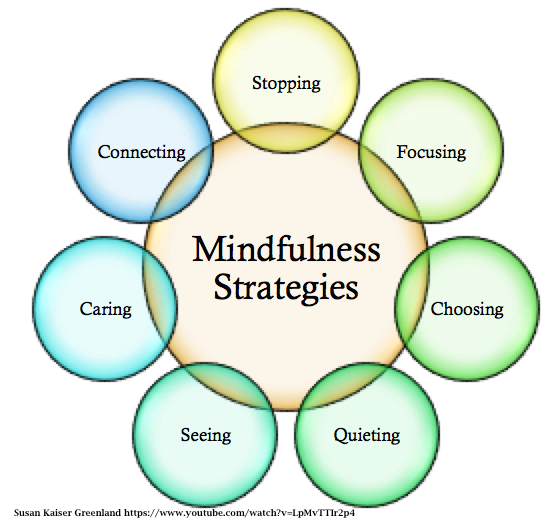
Screen Shot 2015-09-16 at 9.54.19 AMBeing mindful or teaching mindfulness can infuse a sense of purpose and an awareness of self and others, but won’t necessarily lead to finding your inner expert. If teaching mindfully only happens in thought not action, the expert within will be in mind only. Being attentive, balanced and compassionate –ABC’s (Kaiser Greenland) can help teachers ‘check in’ and become aware or pay attention. The recursive inner to outer experience needs to happen in thought and action. This becomes a foundational process for expert teachers – actions lead to thoughtful reflections that lead to more precise or effective actions. Focusing on mindful reflection about presence, personality, preparation and passion can peel away the layers toward the inner expert.

Being an expert isn’t an ‘end-stop’ moment. There, I’m an expert, now I can stop!

It’s a continual process of revealing the layers and roles to teaching that come from within. Our personality, passion, presence and performance shape and reveal the inner expert. Our mindfulness keeps us focused on why being an expert teacher is important – and it’s not about you.

image of two hands

Tawheed Mansoor https://flic.kr/p/dbQyGG

Finding the inner expert is about the face of the child, the human elements of parents who bring their children into your care, the colleagues who share your time and space, or the leaders who walk with you into day. Revealing the expert within is about being the best you can be for the children, students, or adults with whom you share all the roles in your teaching practice.

How will you reveal your inner expert? What roles shape your passions, presence, personality and preparation? Where will you share the expert within?

References and Resources

Dweck, C. (2014, Nov.). The power of believing that you can improve. https://www.ted.com/talks/carol_dweck_the_power_of_believing_that_you_can_improve?language=en

Ontario Ministry of Education. (2013, May). Inquiry Based Learning. Capacity Building Series, Special Edition #32. Retrieved from https://www.edu.gov.on.ca/eng/literacynumeracy/inspire/research/CBS_InquiryBased.pdf

Skillen, P. (2015, March 13). Teaching is a ‘way of being’ – part 1: Developing expert teachers vs. experienced non experts. Canadian Education Association. http://www.cea-ace.ca/blog/peter-skillen/2015/03/5/teaching-%E2%80%98way-being%E2%80%99-%E2%80%93-part-1

Visible Learning. (n.d.) John Hattie’s Eight Mind Frames For Teachers. http://visible-learning.org/2014/08/john-hattie-mind-frames-teachers/

Posted in Learning, Talking, Teaching, Together | Tagged , , , , , , , , , , , , , | Comments Off on The Expert Within

Evidence for ‘expert’ teaching

Reflecting is a key element of learning. Asking a question, constructing an answer, putting your response ‘out there’ for others to review, then taking it all and reflecting on the process and product – that’s the crux of learning. When I asked myself the question about being an expert, I never suspected that my response would shift.

John Hattie outlines the difference between expert and experienced teachers in this video.

Do I understand my impact in the classroom? Do I live with the messiness or ‘staccato’ of active learning? Do I look for evidence when teaching? Is my work open and does it build trust? These are good reflective questions to ask when examining my own teaching practice.

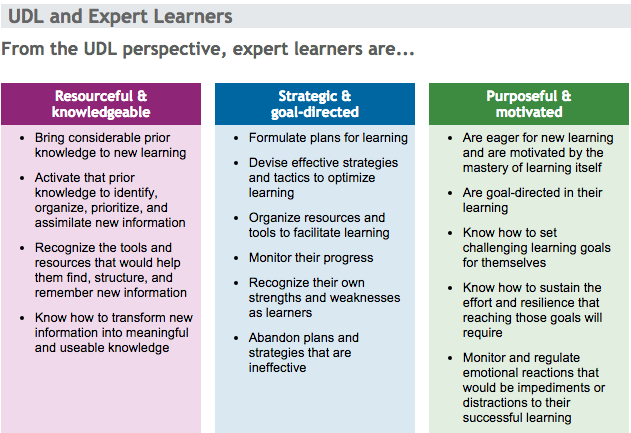
image from CASTThen my reflection went to this summary from the UDL (Universal Design for Learning:CAST) perspective. Expert learners are resourceful & knowledgeable, strategic & goal directed, as well as purposeful & motivated. These points can focus on my work as a teacher/learner and the work that I do with students.

The most informative source of reflection comes from the CEA (Canadian Education Association) series written by Peter Skillen:

There is a quote included that resulted in a shift in my understanding about being an expert:

“Experts, we propose, tackle problems that increase their expertise, whereas non experts tend to tackle problems for which they do not have to extend themselves.”

(Bereiter & Scardamalia, p. 78)

Simple yet complex idea! Experts become experts by taking on challenges that will change themselves and those around them.

Skillen explores models that promote and sustain the development of expert teachers – the stages of change model, appreciative inquiry and evocative coaching. Weaving these three complex models into an understanding of expertise requires, as Skillen states ‘a change in fundamental beliefs about human nature and learning.’

Becoming an expert requires a teacher to work from a change perspective (moving forward or upward), incorpate a ‘valuing of the act of exploration’, and a learning community involved in a supportive recursive process of listening, designing and thinking (Tschannen-Moran, B. & Tschannen-Moran, M., 2010). Developing expert teachers requires a shift in the locus of control for teaching/learning, a renewal of teacher/learner facilitation and agency, and fundamentally raising the awareness of each individual teacher/learner within a community of learners/teachers.

Screen Shot 2015-09-15 at 7.13.24 PMSkillen further explores the notion of expert learners using an infographic that is helpful in focusing attention to key details and attributes found in those who are ‘expert’ students. Can this also be done for teachers, especially those who are lead learners or experienced inquirers? I think so.

  • Expert teachers recursively plan, monitor and reflect.
  • They apply multiple representations of how students learn.
  • Expert teachers generate multiple entry points to problems or learning challenges.
  • Expert teachers enlist in knowledge transformation while relying on a multitude of sources and resources in both physical and digital spaces.
  • Expert teachers see opportunities in errors or failures.
  • They transfer skills and understandings to a variety of contexts, but don’t rely on these skills without being open to change.
  • Expert teachers know and engage in the social contexts that are important for themselves and their students, but know when individual context or disconnecting from social networks is necessary.

So, getting back to my original question – am I an expert? I think I am, maybe more so now than at the outset of this inquiry, thanks to insights and reflections gained from other experts in examining expertise. I think there are more teachers who should consider themselves as experts in the field – their expertise speaks for itself!

Who are the experts you turn to? What do you learn from these experts and how do they increase your expertise?

Update (09/19/2015): This blog post is now also available in Spanish, thanks to Angela Novoa, whom I met as a classmate in the University of British Columbia’s Masters of Educational Technology program. Her work with teachers and educators in Santiago, Chile models the evidence for expert teaching. Here is the link to the Spanish translation.

References and Resources

Hattie, J. (2003). Teachers make a difference: What is the research evidence. Retrieved from http://www.sd45.bc.ca/leadinglearning/pdf/Teachers-Make-A-Difference-What-is-the-Research-Evidence-Hattie-John-2003.pdf

Skillen, P. (2014, Oct. 14) Using Visible Thinking Strategies to Develop Expert Learners. Novice vs Expert Learners. Infographic. https://inquiryblog.files.wordpress.com/2014/09/noviceexpertinfographic-825w.jpg

Tschannen-Moran, B. & Tschannen-Moran, M. (2010). Evocative coaching: Transforming schools one conversation at a time. http://www.amazon.ca/Evocative-Coaching-Transforming-Schools-Conversation/dp/0470547596 

Posted in Teaching, Together | Tagged , , , , , , , , , | 2 Comments

Am I an Expert?

It was an epiphany moment! It was a question I didn’t know how to answer! It revealed my inner uncertainties! Really, am I an expert? Can any teacher claim to be an expert?

image for keep calm and practice onExpert, by definition is “having or showing special skill or knowledge because of what you have been taught or what you have experienced” (Merriam Webster Online). I have been taught, by formal courses, informal learning and by experience, to be a teacher. By my actions and intentions in teaching and learning, I practice. My teaching practice has lasted a lifetime as I’ve attended to formal or informal education. Practicing the craft and art of teaching is a never-ending negotiation between the possible, the probable and the potential. Does that mean I can call myself an expert? Then aren’t all teachers experts?

My practice, particularly with educational technology, began in the early stages of ed tech – before the pundits professed to be experts, even before teachers knew what to do with the gadgets (anyone else remember ICON computers?). It’s been a long history of learning from failures and mistakes. Guess that makes mine a ‘growth mindset’ kind of journey. It’s made me expert at learning from my mistakes. Am I an expert? Not yet!

I don’t think it’s over …. YET! At no point along the journey did I ever feel I had a handle on best practice or optimal integration with educational technology. I was practicing all along the route – and still practice now. Isn’t that why it’s called a ‘teaching practice’? I guess that makes me an expert at practicing.

poster image

Manitoulin IgnitED poster

So, when I was invited by Heather Theijsmeijer to share my practice with other educators at Manitoulin IgniteED, I jumped at the chance – more time to practice what I teach! There are others I can learn from, fellow educators with whom to collaborate! To my surprise I was billed as ‘guest expert’ on the information poster. So, why shouldn’t I be an expert? Teacher’s can be experts, can’t they? Should we ever so humbly state to parents, colleagues, students or school leaders that we are ‘practicing’? Yet I didn’t feel that I had crossed some invisible line from becoming a teacher to becoming an expert. Can I be both?

Then I thought of all the great teachers that I recommend, share, follow and connect to because they are expert at what they do. Sylvia Duckworth, Brian Aspinall, Doug Peterson, Sue Dunlop are some examples – they model expertise, but more importantly, they visibly practice! They share their experiences & reflections and their insights & failures. They reflectively engage in practice to make themselves and others ‘get better’. As an educator, being an expert isn’t about the label or crossing a line. It’s about making a commitment to practice to perfection, fully knowing that perfection is a never-ending quest!

image for not an expert yetWith this insight into being an expert, I’ve come to understand but not necessarily accept this title. In my own mind I’ll never be an expert. Yes, I may have skills and experiences with educational technology and continue to practice the craft, but I don’t think I will ever comfortably fit the title of ‘expert’! Being an expert sounds like an end-point. My ed tech journey is still under revision while I practice the craft. I’m opting to be a ‘lead learner‘ or a ‘learning technology specialist‘.

How about you? Are you an expert? When can you call yourself an expert? What are you expert at teaching?

Posted in Teaching | Tagged , , , , , , | 2 Comments

Catalysts

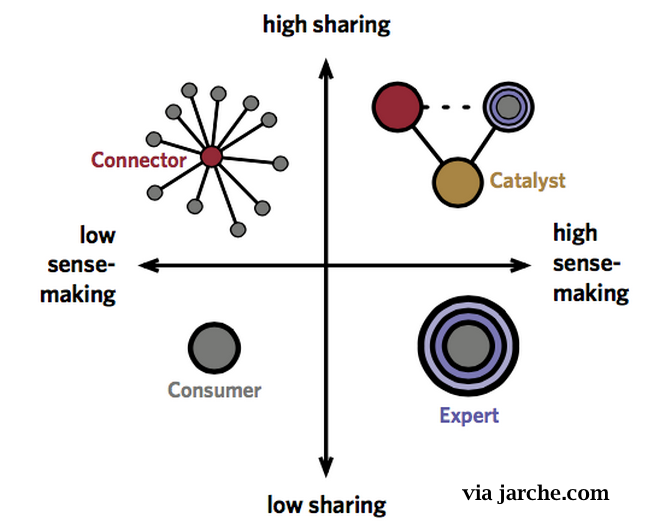
Teachers activate learning. They are catalysts for ideas and concepts. With a thoughtful question or timely prompt, they set thinking into motion. This spurs action from their students – actions in thought or physical tasks. In the truest scientific sense, catalysts remain unchanged by this interaction but in knowledge building, the catalyst becomes transformed by the sharing and sense-making process.

This past week an image and tweet was a catalyst for my own thinking. Harold Jarache’s blog post Knowledge Catalysts was the source of the image and tweet. I immediately thought of those people who are my knowledge catalysts – those who prompt me to think, filter, curate, and do within digital spaces. These people are high on the sense-making scale, high on the sharing scale and engage in diverse knowledge networks. They go beyond consuming or connecting by modelling an expertise in domains such as higher ed, leadership, digital proficiency etc.

What makes someone a catalyst in digital places? How would you describe the catalysts that keep you coming back to digital spaces?

image with inspirational statement

Courage

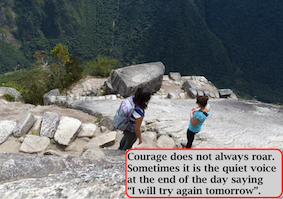
Catalysts are quietly courageous. They put themselves ‘out there’ on a regular basis. They leap off the ledge into the unknown digital spaces and test out the waters of new technologies while sharing their insights and failures. My catalysts shape my practices and decisions by leading the way. My recent foray into writing a chapter for an e-book resulted from one catalyst. Jumping into trying Slack and virtual connecting using Google Hangouts came from other catalysts. Joining ISTE PLN’s in a leadership role came from yet another catalyst, Kendra Grant. Catalysts don’t lead you off the cliff without holding your hand or being at your side – digitally speaking. They guide your first steps and are probably jumping with you.

Catalysts glow in the dark. In Seth Godin’s post Glow in the Dark he talks about people who create energy, generate urgency, and restart momentum, but most importantly they know how to regenerate. Catalysts take time to sit and ponder, walk and wonder, listen deeply or watch attentively. My catalysts glow in digital spaces where they illuminate ideas, shed light on tips or tools, or position the lens onto something I may not have considered. Dave Cormier, of Rhizomatic Learning notoriety, recently illuminated the idea of moving from ‘we to them’ or was that ‘them to we’ in open, online communities. This connects to notions of hospitality, belonging, and presence in digital spaces.

Catalysts ask thought provoking questions. They take everyday events and turn them into opportunities to delve a little deeper. Their questions are sometimes conversation starters, as Aviva Dunsinger’s blog posts often become. The comment section is as rich in thought provoking discourse as the blog post itself. Some catalysts prompt an inquiry or focused exploration such as the one by Stephen Hurley around supporting children for the first day of school. By asking these questions, a catalyst sets thinking in motion and connections begin to revolve.

Catalysts are storytellers. They share compelling personal narratives about what they do, experience or explore in digital or physical spaces. These stories are shared openly as an effort to make sense of something. Catalyst stories often cross the quasi digital lines to engage new audiences. My catalysts come from diverse physical spaces (local, regional, national, global) and a variety of learning networks (teachers, leaders, thinkers, higher ed, K-12, humanities, sciences, business). Maha Bali’s Reflecting Allowed blog is one example of storytelling in, of, & on action. Sylvia Duckworth creates catalytic conversions with her array of sketch notes.

Catalysts are invitational. They suggest, proposition and present options. Whether it’s an open field or secure sandbox, catalysts will invite others to explore, experiment and engage. These spaces are sometimes created by the catalyst (my recent Slack encounter) or one they’ve found that they’d like to share with others (such as the invitation to join in a group to explore the Human Centered Design course with Whitney Kilgore). The OSSEMOOC network is inviting leaders and educators across Ontario to connect and engage in digital spaces.

image of social media connectionsBeing a catalyst is a reciprocal relationship in knowledge networks. My catalysts entice a reaction from me to create, curate, connect, do, or think in some way. These reactions and actions may then be a catalyst for someone else. Sometimes these symbiotic events can be cataclysmic, creating great change in all those involved. Usually catalytic events are slow moving, revolving and evolving dances with ideas where collisions can initiate new directions. My catalysts engage with me in this dance in digital spaces, with digital technologies, creating new digital artefacts that become catalysts for others.

Who are your catalysts? Where do collisions in the dance occur for you? When has a cataclysm occurred and what was the outcome?

Posted in Talking, Together | Tagged , , , , , , , , , , , , , , , | 5 Comments

Stories and Spaces within a #blimage challenge

One image can generate a story. One image can define a space.

image of Machu Picchu

One image

This is true of physical places and digital spaces. We learn to recognize a story or space from one image, icon, logo, or representation. Think of an image of the Eiffel Tower or the Statue of Liberty. The iconic scene of ruins in Peru represents a place rich in cultural, metaphysical and historic importance. An image of a pair of red, heeled shoes draws forth the Wizard of Oz journey or a white picket fence the Adventures of Tom Sawyer. Images connect us individually and collectively to these stories and spaces. We share meaning from our own perspective when our shared experiences connect us to a particular image that we hold in common.

For CLMOOC, week five make cycle, the focus is on open, public spaces, both physical and digital. One image, from the Project for Public Spaces, captures the qualities and characteristics of great physical spaces. This shared image connects our common understanding about open physical spaces. The intangible elements from this image connected my thinking to the notion of affordances within digital spaces. One image can shape our understanding, but does not define the totality of the space or place. Just as an image of the Great Wall of China brings forward underlying concepts of power and control, the image does not define all that relates or connects people’s learning to that place or space. This resulted in my ‘aha’ realization that there is no space that can be all things for all people at all times. There is no image that defines all there IS to a space or place. There is a balancing required – to seek out that which is most important – to bring meaning to images.

So with these thoughts about images, places and spaces, it brings me in a natural progression to #blimage challenge. The background to this challenge can be seen on a variety of blog posts:

The interesting thing about this challenge is that it puts an image into a blog with a focus on an educational context and frame of reference. It builds connections and meaning among those who see, share, relate experiences and tell stories around a particular image. It openly integrates the key attributes of great physical places – sociability, use & activity, access & linkages, and comfort & image – into digital spaces.

So here’s my #blimage response to Ignatia’s challenge and the image she shared.

Screen Shot 2015-07-21 at 5.42.16 PMThis image represents education and tells a story of connecting, relationships and making the most from what you’ve got. The individual is alone in the educational landscape. This learner (whether teacher, student, leader or designer) is resting after an intense day of making and creating. Although they are isolated within their own meaning making space, they are connected through technology to others. Creativity and craftsmanship has resulted in a mechanism that will reach out to others. Ingenuity and innovation has enabled the individual to connect outwards and view new vistas. Although the environment is impoverished there are resources available to make the most from the available materials. Secure in a safe place, with a solid foundation upon which to rest, the individual can spread their wings and soar. The paradoxes found in today’s digital learning spaces are evident – alone but connected, secure but unbound, resting yet active, innovative within limitations, open but with closed arms, seeking outward while viewing inward.

So my challenge extends to those who see this and feel the call of the open, wild, untamed spaces. The learning landscapes await – it’s yours to discover. Link to these images – MatthewWiebeJordan SanchezBlake Richard Verdoorn. Here are three images that may generate a story or define a space.

image of girl on subway platform

by Matthew Wiebe @ Unsplash.com

image of girl in forest

by Jordan Sanchez @ Unsplash.com

image of kayak on dock

by Blake Richard Verdoorn @ Unsplash.com

Posted in Talking, Together | Tagged , , , , , , | 1 Comment

Find Five on Friday

Friday is a good day. It’s a day to relax a little bit and look forward to the weekend, whether you work weekends or not. So finding five things on a Friday is a good habit to develop. These could focus on friends, food, celebration or serendipity. Finding five real or digital gems is sometimes easy but sometimes it takes a while to stumble around until you find five of something. It’s part of your reflective practice.

So here’s my FIND FIVE for this FRIDAY. These are some of the resources and connections that I’ve made in digital spaces this week.

  1. Thinking about systems by Linda Booth Sweeney: As I explored systems, design and complexity, this site kept me coming back to check, reference, rethink and connect to other ideas and people’s writing.
  2. Screen Shot 2015-07-17 at 5.32.17 PMReMEDIAting tires – this is where I collected some interesting connections and ideas about how to repurpose tires. This resulted from a few posts in the CLMOOC Google Community referencing Piles of Stuff and Piles of Tyres. As I result of this divergence from systems thinking, I created a motivational poster for those feeling tired or deflated.
  3. The Digital Learning Horoscope came across my twitter stream. Anything from Renee Hobbs catches my attention, so this one I investigated further. After I completed the horoscope I shared it out to several connections in my PLN (Kevin, Kendra, Dina). This also caught the attention of Renee Hobbs who retweeted and starred the shared results.
  4. I’ve been trying to work on research and writing on the topic of feedback in online learning spaces but kept getting pulled into interesting digital conversations. There’s been a Self Regulation Summer Symposium happening in Ontario featuring the research by Stuart Shanker.  The CEA/ACE article Self Regulation: Calm, Alert and Learning focuses on the growing awareness in education of the importance of self regulation in mastering complex skills and concepts. Then Aviva Dunsinger blogged that self regulation was Not Just for Kindergarten. This whole topic connected to Amy Cody Clancy’s share Through Your Child’s Eyes from Understood.org. This site increases awareness of learning and attention issues with simulations to build understanding. This highlighted my own lack of self regulation in staying focused and getting my work done, despite the interesting connections.
  5. HarnessFinally, fun has been encouraged this week. My fun time has been overtaken with the PanAm Games being held in Toronto. It amazes me that these athletes are having so much fun and the community is sharing this fun as a result of the games. So my fun contribution came after an interview where an inspirational quote was mentioned. I quickly returned to my IMGFLIP site and crafted Butterflies, then tweeted it out to the PanAm hashtags.

Five, fun, fulfilling ways I’ve learned, connected and created this week.

What are yours?

Posted in Teaching | Comments Off on Find Five on Friday

Digital Learning Horoscope

I recently came across the Digital Learning Horoscope. It’s a survey for teachers to take as a reflective tool about their beliefs and commitment to teaching with and about digital and media literacy, and popular culture. This comes from the work by Renee Hobbs and the Media Education Lab. Some of the questions challenged me to make a decision about what I truly believe is important when applying media and technology to my teaching. Not an easy thing to do during the summer break, but informative for some next steps.

I appreciated that there is no flash or bling on this survey site. It simply presents 48 questions with a 5 point scale of importance. Should be easy right? Give yourself some time to take this one and really think about the importance of digital and media literacy in your own classroom. The results may confirm and reaffirm your understanding of your role in media education. The results may highlight your passion for teaching students about digital literacy.  The results will certainly provide you with an opportunity to think deeply about choices you make to support students to understand and connect to their world. As a result, you are provided with an infographic-style page that identifies three areas of strength and two ‘leanings’. The score breakdown provides further insight into your least dominate characteristics. These can also provide some insights e.g. why was I so low in a particular area?

Screen Shot 2015-07-15 at 8.33.20 AM Your digital learning horoscope will identify if you are a demystifier, watchdog, activist, professor, professional, teacher 2.0, techie, spirit guide, motivator, trendsetter, or alternative. The labels are not that important to your overall understanding. It’s not about the label you acquire, but the understanding that you gain about your role and what it means for your students.

My results identified me as a professor, techie, spirit guide with leanings toward empowering and protecting. It confirms that I see the opportunities and advantages of using media and digital technologies as well as the risks and challenges using media and technology in my teaching practice can present. The results reaffirm my dedication to student well-being in recognizing that media and digital presence is a crucial facet of their identity and sense of self worth. My commitment to engage students using digital and media technologies to learn more deeply and authentically was validated.

The results also link to more information where a deeper description is provided, and strengths and challenges are identified. It highlighted my need to think beyond the engagement with flashy technology to ask key questions about how it will apply to the everyday lives of my students.

So, what’s your digital learning horoscope?

What are your leanings when it comes to digital and media literacy in your own teaching practice.

Take the quiz to find out, then tweet out to @reneehobbs to let her know you appreciate the work being done to strengthen the skills of digital and media educators.

Posted in Learning, Teaching | Tagged , , , | 1 Comment