Finding Joy in the Ordinary

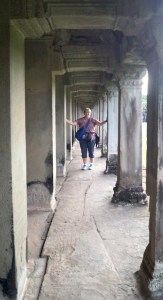
I admit I’m pretty ordinary. I’m not a shining star or a front page person, and I’m okay with my ordinariness. I certainly want to feel extraordinary on occasion. Being in the spotlight once in a while helps me feel special. Recent recognition of my teaching efforts in two VoiceEd Radio podcasts (Getting Air with Terry Greene & Que Sera Sarah? with Sarah Lalonde) bumped up my feelings of being unique. Being interviewed by Doug Peterson was a confidence boost. Participating as one of the OER Fellows through eCampus Ontario makes me feel extraordinarily special. While I travelled through Northern Vietnam, I was the extraordinary ‘other’ in a sea of extraordinary events and vistas which were ordinary to those who live there.

But, aren’t we all extraordinary in some way? Aren’t our ordinary events unusual and novel to others?

I’m reading a book. For me, that’s an ordinary thing to do. For many people in the world it’s unusual to own a book, have access to books, or be able to decode and understand the text. It would be extraordinary to read a book that you own.

I write and create stuff on my computer. For me, it’s an ordinary thing to do. For many people in the world, who can’t access technology or spend the time in their day to be creative with text and image, what I do would be appear to be extraordinary.

I drive my car to work. That’s certainly an ordinary thing, isn’t it? Not when there are so many who only dream of owning a vehicle, let alone have permission, skill or license to drive. It’s an extraordinary event for many in this world.

I teach at a university. For me, that feels ordinary, but for many it would be unimaginable to attend or be part of a university community. It’s a very uncommon event, in many parts of the world, to participate in higher education.

REFRAME the ordinaryI’m REFRAMING the ordinary.

My ordinary can be extraordinary. Your extraordinary can become ordinary.

As I go through my day, do I find joy in common events? Do I see anything exceptional in the many tasks I complete?

In a world focusing on the perfection of self and the enhancement of the mind, how can we, as ordinary humanity, find joy within the mundane? With global competition battling for market share and viral fame, while acquiring likes and stars on social media, how can ordinary find a space for joy?

In education, we’re focusing on being the best we can be, maximizing student engagement, designing perfect lessons for our exemplary classrooms and immediately celebrating student success. With pressure to constantly be extraordinary, we’re losing the joy to be found in the ordinary. There are so many ordinary moments in a school day that are missed in our ongoing mania to ‘bump it up’ to make it special. This impacts our mental health, our relationship with the students and their parents, and our confidence in the ‘ordinary acts’ in our extraordinary work of teaching.

Finding joy in the ordinary isn’t easy, but it’s necessary. It’s a false narrative to imagine our every moment will be extraordinary. It’s a negative mindset to think that every action will be innovative and lead to profound insights. Let’s REFRAME the view on ordinary.

In a recent ONedMentors podcast, Stephen Hurley relates that we need the ordinary to recognize the extraordinary. The participants discussed how a culture of humility is grounded in the ordinary, and how listening can be a profoundly extraordinary action. With a reframe on the ordinary, a practice of expressing gratitude in everyday occurrences can bring joy. As I read The Book of Joy, the Dalai Lama and Desmond Tutu lament that “our world and our education remain focused exclusively on external, materialistic values. We are not concerned enough with our inner values” (pg 29). Increasing our happiness is connected to our “ability to reframe our situation more positively, our ability to experience gratitude, and our choice to be kind and generous” (pg 49).

So, I’ll ask this question, one that I was asked while struggling through a particularly challenging time in my life – Where do you find joy in your day?

How can ordinary be reframed positively?

Let’s reframe the ordinary. It’ll be an extraordinary thing to do!

Screen Shot 2018-01-28 at 8.17.35 AMListen to the ONedMentors podcast ‘In Praise of Ordinary’. Thanks VoiceEd.ca for this thought provoking reflection on the ordinary lives of educators.

For those of you who think you’re too ordinary to be extraordinary – this video may help you reframe your ideas.


References and Resources

Abrams, D. (author) with His Holiness the Dalai Lama and Archbishop Desmond Tutu. (2016). The book of joy: Lasting happiness in a changing world. Penguin Random House Canada.

ONedMentors radio podcast with Stephen Hurley, Noa Daniels and a panel of educators. Retrieved from https://soundcloud.com/voiced-radio/onedmentors-in-praise-of-ordinary-january-25 

Image by Andrew Neal on Unsplash. Retrieved from https://unsplash.com/photos/QLqNalPe0RA 

Posted in Talking, Together | Tagged , , , , , | 2 Comments

The Web We Weave – Curation in Action

samuel-zeller-483391Teachers are collectors. They collect and weave resources together in all kinds of ways. As part of planning lessons, building units, and designing courses, teachers collect and store stuff for ‘some day’. It used to be done with file folders full of ideas and worksheets which are now buried in a filing cabinet in the basement. With digital and electronic options, it’s become a disparate collection of links sprinkled across a variety of curation sites. It’s often a challenge to figure out where to start, which curation tool to use and for which purpose, since there isn’t one tool to rule them all.

  • How do teachers apply specific curation tools.
  • How do educators make decisions about where to curate, how to build their collections and when to share with others?
  • How do educators weave the web we want?

Two catalysts prompted these questions to reframe my thinking about curation, since I see curation as a necessary critical digital literacy. It is not just the digital collections we keep on Pinterest or YouTube, or the artifacts we create and share on Facebook. It’s the analysis and reflection about the items we put into our digitally curated collections and how we collaborate with others in the spaces where we chose to share what we’ve found.

First catalyst: Jennifer Casa-Todd (@JCasaTodd) blogged about curation – Content Curation: A necessary skill for today’s learner. I couldn’t agree more with her statement –

In our information-rich age, not only is it necessary to curate, but creating content from curated resources is an excellent way to consolidate understanding and provides students with the opportunity to think critically and creatively” (Casa-Todd, 2018).

In today’s classroom, curation is a strategy for critical digital literacy when students are using, analyzing, code breaking, making sense, reflecting, creating collections, and developing their digital identity. She asks a question at the end – “What is a curation tool you use to curate social media links?” which triggered my thinking. So, my first response is – blogs are a form of curation. This is not a new idea but has been heightened by a post written by Alan Levine, aka @cogdog, (Storify Bites the Dust) about using WordPress as a self directed curation tool.

Jennifer’s blog post came to my attention through a curation of blogs done by Doug Peterson (@dougpete) in This Week in Ontario EduBlogs. Each week, Doug collects, analyzes, reflects on and shares a selection of blogs from Ontario educators. This is further shared into digital spaces through Twitter under the #FollowFriday hashtag (a form of curating a conversation). Doug extends the conversation on another curation resource, his VoiceEd.ca podcast.  VoiceEd.ca has a curated bank of podcasts relevant to a variety of topics in education. So, my second response is – podcasts are a form of curation.

Second catalyst: a conversation with Sarah Lalonde as we talked together for an upcoming edition of her podcast Que Sera Sarah? She pondered how teachers can manage to learn about, learn with and find digital technologies for their teaching practice. Since there are so many tools, techniques and applications (apps) that teachers can and are using in their planning and design of lessons and units, it’s a challenge to figure out which ones to use, when to use them, how to integrate them into classroom use, where to support students to use them, etc.

This is where educators who build curated resources can support one another as they share in the open – and that’s where critical digital literacies are applied. It’s not just about building a collection, for example popping a pinned resource onto a Pinterest board. It’s about refining, defining, analyzing and reflecting in openly curated ways that will help other educators, designers of educational resources and even students see how these particular tools, resources and apps can become effective pedagogical resources in the classroom. It’s less about sharing, for example an ABC chart of apps for Chromebook users, in a variety of curated collections and locations (Pinterest, LiveBinders, Evernote, Diigo, Symbaloo, Thinglink, etc), and more about digging into those apps and sharing the affordances, barriers, issues and benefits of using and creating with those tools in the classroom. Maybe it’s creating a curated, annotated bibliography of educational technology tools that is crowdsourced similar to Ed Shelf, but one where pedagogical and classroom integrations are shared and discussed. It could be more like ones I’ve curated for the A Kid’s Guide to Canada project to introduce educational technology resources for specific purposes. It should be more like building collections with purpose such as I’ve done with #CLMOOC where educators try different tools for specific purposes and share results and reflections in a collaborative community space.

thai-hamelin-371279

Curation is the web we weave.

Curation is about individual, collective and shared reflections that will improve teaching and learning in some incremental way. Mihailidis & Cohen state “the preservation and organization of content online is now largely the responsibility of the individual in highly personalized information spaces. This has created a need to understand how individuals choose to pull together, sift through, organize, and present information within these spaces. Sharing, appropriation, and peer-to-peer collaboration are at the centre”.

For educators, it shifts our thinking. It’s about thinking like an archivist and acting like a librarian while critically pondering the WHY before embedding the artifact, connecting the code, adding the tags, or applying the html link. It’s reflecting and connecting. It’s a weaving within our own minds and reweaving between our chosen digital resources, It starts as a solitary process, reaches out to others in open, web-connected spaces and comes back to solitary reflections on actions, in action, for learning. It’s how I chose to weave the web I want.

So I’ll add my own question to Jennifer Casa-Todd’s – As an educator, teacher, learner and open educational practitioner how do you define curation? How do you build curated resources reflexively, alone and together? 

Curated Resources:

Casa-Todd, J. (2018, January 4). Content curation: A necessary skill for today’s learner. [weblog].

Lalonde, S. (n.d.) Que sera Sarah? [podcast playlist]

Mihailidis, P. & Cohen, J.N., (2013). Exploring curation as a core competency in digital and media literacy education. Journal of Interactive Media in Education. 2013(1), p.Art. 2. DOI: http://doi.org/10.5334/2013-02

Peterson, D. (2018, January 12). This week in Ontario edublogs. [weblog]

Peterson, D. (2018, January 10). This week in Ontario edublogs with Doug Peterson. [podcast]

Voiced Radio On Demand (n.d.) Our voiced radio broadcast community. [website]

Posted in Talking, Teaching, Together | Tagged , , , , , , , , , , , | 11 Comments

Sitting Down, Side by Side

Come on, sit down. There’s space here beside me. Where ever you’ve been or whenever you need to go, that’s OK. You’re here right now. Take some time to sit beside me and let’s talk.

matthew-bennett-425573I’ve recently travelled, with lots of time spent in planes, trains, buses and boats. When we travel, in most forms of transportation, we are seated beside someone. The focus is not face to face. Our seats are adjacent, so we are close. While we are seated elbow to elbow, we look toward something else – the direction we’re travelling, the vista view through the window, the screen embedded on the seat in front of us, or the tech gadget we may be holding. Our conversations are shaped by our positions in this space. Our relationship to each other is altered by this positioning. We talk about things while we focus on something other than each other, and sometimes our conversations go quite deep.

The deepest conversations I have with my children happen in the enclosed space of the car, while driving from place to place. I will quickly offer to drive them anywhere just so we can have ‘car-talk-time’. When sitting side-by-side with my husband, focusing on a campfire, our conversations evolve into deeply reflective, problem solving discussions. While our eyes face forward, looking at the road or the fire, our voices become less about US as individuals, and more about US as partners, collaborators, or even co-conspirators. Thinking about online learning and talking in digital spaces, I wonder how this positioning of sitting side-by-side can be accomplished. How can a shared focus on the learning enhance instructor/student conversations and reflective practice? Rather than sharing in face-to-face conversations, can we focus the camera and our eyes onto the subject of the learning?

These thoughts are shaping my personal examination of assessment practices in online learning spaces. If the term ‘assessment’ comes from the Latin word assessus “a sitting by,” past participle of assidere/adsidere “to sit beside” (Online Etymology Dictionary), how can I create the feeling that I am sitting beside a student as they share their learning? If the focus could be on the ‘artifact’ created and the process of production as a representation of their learning, it may be easier to sit beside a student (virtually or in the same room) to ponder this ‘thing’ they’ve created. Screen share in a video chat can provide the illusion of sitting beside, but it’s a mindset over ethereal space that needs to shift. It’s an ‘imagine if’ scenario with me keeping the student’s face in my mind’s eye as we talk about the craft of learning and the object they’ve crafted as they’ve learned.

This also links to reflection. How can this focus on an object, idea, vista view, frame engage our internal voice or bring understanding with external voices? How can talking out loud, to ourselves or with others, enhance our thinking? How can audio recordings promote deeper listening. I’ve had an opportunity to do a podcast where I am able to re-listen to my words and re-frame my thinking on topics that are important to me. I’d like to build this activity into my teaching. This could be done in any course where students record their voice in reflection on topics, content or assignments to reframe their notions of learning. 

So, I’ll continue to invite students to sit down beside me, talk about their work and learning, even if we’re separated by space or even time. It’s an intricate evolution of the campfire conversations that continue to be great places to talk.

Reference:

Siemens, George. (2017, September 14). Learning as artifact creation. retrieved from http://www.elearnspace.org/blog/2017/09/14/learning-as-artifact-creation/

Image: Photo by Matthew Bennett on Unsplash

Posted in Talking, Together | Tagged , , , , , | 3 Comments

My FRAMES are changing

clem-onojeghuo-143743I’ve been wearing glasses since I was a young girl. The frames that hold the lens in place are updated every few years and, in reflection, are a time capsule through the trends in eyewear over the years. As I look back through a collection of pictures of myself, I wonder how I could have ever chosen those particular frames. What was I thinking? What influenced my decisions to pick those frames since I was ‘stuck with them’ for two or more years? Do those frames really represent who I was or what impression I was trying to make? Those frames are NOT ME nor do they determine what I see, but they do influence how others see me. My frames have an impact.

DSC05774As I end this year, I look back and see other frames that have impacted and will continue to change my perspectives over time.

  • Travel frames my perspectives. I’m returning from a six week journey through Thailand, Cambodia, Vietnam and Laos – the events and experiences will frame my thinking over the coming years. Anyone who travels has their frame of reference changed by travel experiences, especially if empathy, patience and open-mindedness are packed into the trip.
  • Teaching and learning frames my work. I’ve been selected as an eCampus Ontario OER Fellow – this will frame my personal and professional learning as I explore into the fields of open education, open pedagogy and open educational practices. This OER Fellowship is framed by the work of others already into OER spaces, my professional explorations into opening my teaching, and many, many, professional connections I’ve made over several years.
  • My PLN frames my engagement. I’m committed to participation in digital, media, educational literacy spaces that challenge me, provide opportunities for my students, and build connections to ideas, activities and events that shift my perspectives and structure my teaching. The spaces and places I play, learn and work are frameworks that surround me. Sometimes these frames intersect and open things up to wider vistas.

Frame (1)With this in mind, my #OneWordONT for 2018 is FRAMES. Those things that hold things up, provide structure, open views, but are never really examined. They’re just there! Where would we be without FRAMES, frameworks, frames of reference, glass frames?

As I step further into the field of open education and share my voice within various media and digital educational spaces, I’ll step back to take a closer look at the FRAMES I’m not always aware of – frames that restrict, support or surround my thinking. I’ll try to become more aware of the structures that encompass my thinking and hold up my philosophical stance. I’ll need to look beyond the door, window, lens, opening, to critically analyze the elements that are holding it up, providing the opening, keeping the space from falling apart. The more I think about FRAMES, the more I see where they impact everything – my view, perspective, opportunities, teaching, learning.

Frames can help me – they’ll hold important and critical things in place. Frames can become a stepping off point and can become a window to new perspectives. Frames can show where something stands but they don’t need to hold ideas back. Stepping through a door frame can establish new views – it’s not the door, but the frame that holds the door in place that’s important.

rawpixel-com-330228Frames can help or hinder, depending on how firmly or transparent they are created. Frames can provide a focus or eliminate the unessential. Images are framed by photographers but it’s how I frame the image that also determines what I see. Books are framed by authors but my framework structures what I read into the text. Frames are self imposed barriers or beneficial springboards for new explorations. Being aware of how frames encompass or expand my perspectives, ideas, next steps, forward motions can either lead to closing doors/windows or moving beyond the frames I see. So, this year, I’ll use FRAMES to change my viewpoint, narrow or open up my perspectives, structure my thinking and teaching. I’ll look at FRAMES for what they can do – open opportunities, open views, connect to new spaces and support where structure is needed. I’m FRAMING my framework already.

How do you see your frames? Where do frames support or restrict your thinking? Do your frames lead into the open?


Posted in #onewordONT, Talking, Together | Tagged , , , | 12 Comments

CC and ME

I’m a Creative Commons teacher. I’ve got a growing relationship with the ideas and people behind the Creative Commons movement. I’ve stepped over the licensing line and made a conscious choice to be a teacher, advocate, and connector for openly sharing  creative works. I’ve blogged about building connections with the Creative Commons (CC) organization (Remixing Recipes, April 19, 2017) and I’m working on building my own awareness of CC licensing in education.

My work as an instructor and teacher puts me squarely in the middle of the copyright and licensing mess where it’s tricky to untangle the ‘fair use’ from the copyright protected and the CC licensed. I’ve been slowly threading through the maze with the help of others. After attending the CC Global Summit last spring, I’ve joined the open CC Slack space where the conversations about CC licenses and global copyright issues spill into awareness. This recent announcement about Termination of Transfer caught my attention. I learn more about Canadian copyright issues by listening to folks within this openly accessible space.

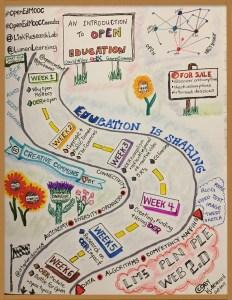
Original Open Ed MOOCAfter viewing the conversations between David Wiley and George Siemens for the #OpenEdMOOC (Week 2 Part 1, Part 2 and Part 3) it becomes clear as mud that copyright and Creative Commons licensing has an impact on my work as an educator. I know there are rules and best practice when dealing with ‘fair use’ but those lines are blurred and fuzzy – no wonder teachers have a hard time understanding them. I know that when I create something, it’s copyright mine, and I can choose to share it freely under a CC license, as I did with the #OpenEdMOOC graphic I created and shared on Twitter.

The challenge in the tangle of copyright and fair use arise when the ideas for my lessons or the resources I plan to use in my teaching really belong to someone else – I’m remixing them, or a bit of them, for a particular teaching activity. The flip side to this idea is that my students are also creating interesting items that are then copyright to them. How do I manage that issue as well or should I have to?

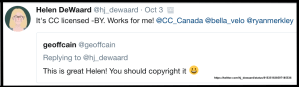
I’ve included teaching about Creative Commons (CC) in my courses to raise awareness and I advocate for the use of the CC licenses with creative works produced as a result of learning events. I’ve come to realize that my own creative productions need to have a CC license attached cc licensed BYin order to model for my students how CC licensing works as well as communicating to others how my creative artifacts can be shared. I’m trying to remember that when I write, draw, talk, or present, I need to tag my work with a CC license. I’m trying to make this an important consideration for those I teach and others in the educational community.

I am part of a grassroots organization supporting K-8 children across Canada called A Kids Guide to Canada. Students are creating and teachers are sharing unique artifacts about the country. To build understanding about copyright and Creative Commons, I’ve crafted a video (AKGTC and CC) to encourage teachers and students to use and apply CC attribution and licensing to their creative works. It’s a small step in shifting the copyright conversations into the open. It’s part of a bigger conversation about digital citizenship that is also becoming increasingly important in educational contexts. We need to step out from behind the ‘fair use’ screen and talk about how copyright and CC licensing will impact our work as educators and our student’s work as learners.

Now is as good a time as any to spread this message and work to untangle this mess together. We can unravel this mess a little bit more if we share what we’re thinking and why it matters.

  • How do you attribute the works of others that you include in your own creative works?
  • How do you license your creative work to let others know how they can use or share these artifacts?
  • How do you teach your students about copyright, fair use and the Creative Commons?

Add a comment below and let’s talk!

FOLLOWUP:

This post ignited some conversation in Ontario education spaces thanks to Doug Peterson who took some time to blog (I Got a Zero Once) and respond to the ideas presented here. Doug continued to open the conversation about the copyright and creative commons on This Week in Ontario EduBlogs as well as sharing this topic with Stephen Hurley on their weekly podcast where topics in Ontario education are shared and discussed. Their conversation is found on the VoiceEd Radio archives HERE. I thank them for extending the conversation further than I thought it would go, and prompting some new questions and ideas by doing so.

Posted in Media literacy, OpenEdMOOC, Teaching, Together | Tagged , , , , , , , | 10 Comments

Open to Opportunity

image with inspirational statement

Courage

Today, on World Teacher Day, I’m reflecting on what it means to be a life-long educator. I’m sure that many others out there, like me, didn’t set out to be a teacher, but certainly became more aware of teaching as a career choice as I engaged with great teachers. Stephen Downes, in his introductory video to the Open Ed MOOC, mentions that education is sharing. That, at a granular level is what it’s all about for me.

EDUCATION IS SHARING – writ large.

Teachers around the globe share! Every day teachers share what they have, what they know, what they are passionate about and what they fear. Teachers share ideas, images, text, activities, words of wisdom, cultural norms and so much more. Educators across the globe share what little they may have available to them with their students in an effort to bring the world to a better place. Some teachers may not be sharing with such lofty visions of world peace, but they wouldn’t be doing what they are doing without a passion for sharing. So today, I give thanks to all those teachers who have touched my life by sharing their gifts and talents with others. I remember and honour all those teachers who are no longer able to share and those who have left a lasting legacy in their schools, faculties and communities. I am humbled by the hard work of sharing done by teachers the world over, especially through troubling times and catastrophic events.

Open education matters to every teacher! Opening our hearts to accept every child or student into the classroom, be it physical or digital. Opening student’s minds to wonder and inquiry. Opening our hands to sharing with those who may need our help in our schools, communities and global contexts. Opening our emotions so our students can see the power of empathy and trust. It’s more than open educational resources (OER) since this is one part of the teaching/learning dynamic – the what of teaching. It’s more than open pedagogy or open educational practices since this is as individual as the teacher doing the teaching – the how of teaching. Open education is about being fully open to opportunities that arise in the classroom, in the context and in the learning moments. It’s about bringing your whole self into engagement with your students, the subject matter, the moments that matter.

Today, on World Teacher Day, celebrate and share your educational experiences, not just those that haunt you, but those when someone shared openly and freely, giving of themselves to make your world, your life a better place.

Today, be OPEN to OPPORTUNITIES to continue your learning journey and share it with a teacher. Education is sharing – not for sale and no strings attached.


Posted in OpenEdMOOC, Teaching | Tagged , , , , , , | 2 Comments

Doodling in the Open & Thinking About Basics

I’m doodling around again. It’s habit forming as I build some basic skills. I’m doodling in the open. I received the invitation to the #21DoodleDays through an email from a friend (thanks @beachcat!) and got hooked, for the second time this year, on some daily doodling time. My first attempts at a daily doodling routine happened in March with Royan Lee’s #DoodleADay. With a daily prompt coming through Twitter, I’d sit down with my morning coffee and doodle for a while. You can see some of my first doodle attempts in this Flickr collection. I continued to lurk in doodling affinity spaces to learn more – CLMOOC Make With Me Cycle 3 helped me dip back into doodling this past summer. With this current doodling experience, these #21DoodleDays are bringing home the idea that knowing the basics in doodling is an essential step to becoming a better doodler.

#101OpenStoriesWith the #21DoodleDays doodle work, the focus for each day has been on developing basics – lines, shapes, borders, frames, banners and more. With each day of practice, I become more confident and adept at thinking visually and applying basics into combinations to communicate ideas. I’m noticing myself slipping into a ‘doodling mindset’ where images are becoming attached to text and ideas. Knowing the basics is removing a barrier to my visual thinking. Doodling is opening new ways for me to communicate, collaborate and reflect. Some recent doodles about open education (#101OpenStories – Four Hours of Open Storytelling and Open Education – Ethos & Practice) resulted from my participation in the 101OpenStories project. It’s becoming an alternative to thinking in text only formats.

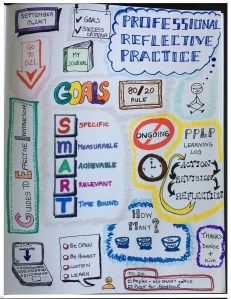
Yesterday I attended a session presented by two colleagues at the University where I teach. The focus was on professional reflective practice. The students in the audience were in their first days of a two-year faculty of education program, just getting started in their studies to becoming accredited teachers in Ontario. Thanks to doodling inspiration from educators like Sylvia Duckworth, Giulia ForsytheJen Giffen and Debbie Donsky,  a supportive network of doodlers (@grammasherri, @wentale), and my growing aptitude with doodling basics, I put pen to paper as the presentation occurred. This was the first time I’d done this form of sketching-as-notetaking. Knowing some doodling basics sure came in handy. Since the session was about professional reflective practice I reflected on how the students in the audience, who are new to teaching, are beginning to learn the basics of the craft. Reflective practice is one of those basic skills for educators.

linesKnowing the basics helps break down barriers for participation within an affinity group, such as education.

Knowing the basics builds understanding of the tacit knowledge within an area of endeavour.

Knowing the basics doesn’t make you an expert, but it helps you recognize expertise.

I’m not a whiz at the video game Minecraft, but knowing the basics of building, mining and avoiding creepers helps me enjoy Minecraft-ing experiences when engaging with a Minecraft affinity group. I’m not a martial arts expert but thanks to many years of watching my son develop his skills, I can recognize basic stances and katas. This helps me understand the intricacies of a masterful karate performance when engaging within a martial arts affinity group. With a better understanding of doodling basics, I was able to integrate images and icons into the ideas and think differently within a listening stance. Knowing the basics of how to teach doesn’t make you a teacher. That comes through reflective practice.

Not knowing the basics can become a barrier or even a health or safety hazard. Those who don’t know the basics of swimming for example are at risk of drowning when they venture out on that new paddleboard. Those who don’t know the basics of fire safety when out camping are at risk of serious burns or starting a forest fire. We’ve seen on the news that those who don’t know the basics of driving a car are in danger of a serious accident with a vehicle. I recognize and appreciate the skill my husband has in basic home repair as he replaces a kitchen faucet. Not knowing the basics of plumbing would be a barrier when completing this type of work. Knowing the basics helped him resolve and problem solve when issues arise. Having a grounded knowledge of the basics lets your mind build connections where none existed or make leaps into new areas that weren’t previously evident.

As a new sketchnoting doodler, I know that repetition and work will develop my skills and this will require practice and reflection. Seeing how others sketch and doodle can help. Sharing my work with others and seeking feedback will hone my basic skills. Doodling the basics (bullets, arrows, faces, letters, people) will shape my expertise. A gymnast who performs a stellar floor routine is recognized for their expertise without anyone knowing the hours they’ve spent working on the basics. A pilot who successfully navigates a plane to a safe landing doesn’t show or tell the passengers about the hours of working on the basics in a flight simulator. Integrating the basics into how you perform your skills sometimes makes it look easy. Sometimes it is easy because you’ve mastered the basics.

As an educator, building a core set of basic skills is foundational to becoming a teacher. This doesn’t happen overnight and it doesn’t happen easily. Those who become master teachers work on the basics until these skills become part of who they are as an educator. Reflective practice is one of those basic skills – others may not see it but it’s evident in how they perform their craft in the classroom.

Doodling got me thinking about the basics, not just about drawing, but about teaching. What are the basics of teaching practice? How do master teachers share, model and build on the basics to make their teaching look easy? Maybe there’s a YouTube video to help? Becoming a teacher requires more than the basics, just as becoming an electrician requires more than basic knowledge of circuits or, becoming a surgeon requires more than basic knowledge of anatomy. But knowing the basics is an essential part of the craft. I wouldn’t hire an electrician who doesn’t demonstrate a basic knowledge of the electrical systems in my house. Nor would I trust a surgeon to operate on my heart who can’t demonstrate the basics of the surgery. Do we recognize teachers who practice the basics to perfect their practice or recognize their expertise without seeing the hours they’ve spent working on the basics?


IMG_9289What do you think?

How are ‘basics’ manifest in your day?

Doodle around with the idea of ‘back to the basics’ for the work you do. Can you identify the basics that make your work look easy? Thanks Diane Bleck for openly sharing your 21 Doodle Days basics.

Here’s the sketchnote doodle from the Professional Reflective Practice session. It’s my basics in action. Definitely room for reflection!


Posted in clmooc, Teaching, Together | Tagged , , , , , , , , , , , , | 4 Comments

What’s Your Story?

robyn-budlender-112521Any time someone asks this question, it requires some deep thinking and honest reflection. It’s not always an easy question to answer. My students struggle with this question each year in the course that I teach. It’s dependant, in part, on what story your listener is looking forward to hearing. Some stories come easily because there is a recognizable sequence of events. Some stories are easier to tell because there is a memorable beginning, middle and end. The plot line is logical. Some stories are not so easy because the storyline doesn’t really start or end, and the plot is mired in mist. So when you ask someone to tell their story, it’s truly an individual thing. My story is not your story and my efforts to tell the story are uniquely mine.

finn-hackshaw-131930So asking me what my story is about how I became an open educator really sent me on a reflective journey. I’ve been traversing some murky thoughts these past few days, spiralling down the rabbit hole. I’ve come to realize that this story doesn’t have a distinct beginning or end. This story doesn’t begin with a specific event or a catalytic moment. This story doesn’t have an ending since I’m still pondering my next steps toward openness, as the due date for next year’s course syllabus looms ahead. My openness as an educator just IS…… it’s my default mode. My story, then, needs to focus on the steps I’ve taken toward being ‘open by default’ and how it has transformed the ethos of my teaching practice.

OPEN FIELDS:

I’m a farm girl, born and raised in the open – fields, forest, times, and spaces. Not to say there weren’t clear boundaries, but openness was an inherent quality of my upbringing. Hard work and strict requirements bounded the times of free play and open roaming. Seasons and weather dictated the schedule – planting, harvesting, sun and snow – each determined whether it was time for open exploration or closed to get the job done. Open times to engage in dreaming, imagineering (engineering ideas with imagination), alone or with my siblings was always dependent on getting the work done first.
03.09.17.V2 copyOPEN THINKING:

As I started teaching, it was never about the materials or methods found in textbooks. I would fill my classroom with  resources and methodologies that would reach and engage the children. The text was only one way to accomplish the learning tasks. Looking back, it was student centered pedagogy that was open to multiple means of expression, representation, and engagement; UDL at heart (Universal Design for Learning). My default way of teaching was open right from the start (open pedagogy & content) but I was not necessarily confident to open my classroom door to share with others. Becoming open in education is not like flipping a switch on/off. It’s shades of open, variations on open and stepping forward toward open. (Pomerantz & Peek, 2016)

OPEN MINDS:

With an increase in the integration of computers, I could open the classroom to contexts and people that enhanced learning opportunities for my students. Technology became the open window to a wider world for the small school communities in which I taught. I see now that the ideas of open access, opportunity, transparency and entry were part of my motivation to open access education (Weller, 2014). Open became a mission and responsibility for me as an educator. Building doors into the brick walls of administrivia would open options for my students, so I became an advocate for open. Technology became the way I could engage students in open spaces, through these open doors I’d pushed to create, and a way out – out of being disenfranchised, disconnected, disregarded or dismissed.

P1020872 copyOPEN AIR:

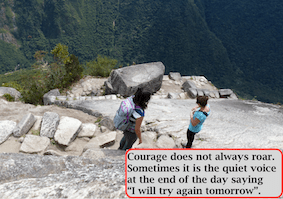
I’ve climbed that mountain! Twice! The mountain I’m referring to is Huayna Picchu. It’s captured in many images from Machu Picchu and it can only be achieved one step at a time while managing the physical barriers of altitude, physical endurance and braving the risks. But I’m also referring to my learning journey completing two Masters programs which can also only be completed by taking learning and course work one step at a time.

My passion for open was solidified through the MET (Master of Education, UBC) program where I experienced the power and potential of what David Wiley calls the 4 R’s – reuse, revise, remix, redistribute (Weller, 2014). The fifth R – retain, ensures that there is a legacy of learning in the open. These are core elements throughout the MET tasks I accomplished as evidenced in the culminating, openly published portfolio of learning – My Renovations. Open was expected, encouraged and required. Through this process, I gained confidence in working openly, alone and with others. Open meant experimentation, open to any audience, open to participate in any way possible (Weller, 2014). Explorations of open Web 2.0 tools and resources expanded my understanding of what it means to be a user/generator, a creator of content. My confidence grew as I created and shared in open digital spaces – blogs, wikis, videos, podcasts and more. I’ve taken intentional steps to reach the open air as you can see in several blog posts but specifically Awaken the Dragon. I’ll never forget my excitement when Alan Levine (aka @cogdog) commented at length on one particular blog post where I explored ME in MEdia. It was affirmation and encouragement to continue stepping out into open digital spaces. I now try to do the same for others who are beginning their open journey.

OPEN VISTAS

As I started teaching at the Faculty of Education in a local university, I began to teach the way I was learning within MET – in the open. My courses were and continue to be dual layered within the walled gardens of shared spaces within learning management systems (LMS) and within open spaces found on the open web. Iterations of course designs become a repository for my students or anyone interested in learning about Media and Digital Literacies. Because these are reused and remixed each time I teach the course, the content on the web sites becomes a living document, co-created as we learn. You can see these courses at DTL3239 Digital Teaching and Learning, MDL4000 – Media and Digital Literacy, and CDL3239 – Critical Digital Literacy.

My focus in open education continued to shift after I completed the MET program as I stepped out further to find more. I became ‘moocified’ – I call it my year of the MOOC. I started with Digital Pedagogy’s MOOCMOOC, moved into Rhizo15, then on to CLMOOC which led to the HumanMOOC and Design Thinking MOOC through IDEO. Throughout this ‘moocification’ experience, I became aware of Virtually Connecting and have been actively engaging in open dialogue through conference conversations with VC folks for a couple of years. It’s also when I became aware of how Creative Commons applied to my contributions on the web. My default mode became more open but it was still motivated by what it could do for my teaching practice and how it would be a model for my students. I focused on building communities of inquiry within affinity spaces for meaningful knowledge production. For me, it’s about building relationships and joining conversations. I continued to push, nudge, promote and advocate for open learning opportunities with my colleagues and the teacher candidates in the Faculty.

My motivation didn’t necessarily focus on my own reputation, revenue or audience but those became increasingly important as I talked about digital spaces since this impacts the future of my students (professional identity, future job prospects, partnerships with parents, collaboration with colleagues). I model and share, as well as search out other educators who model and share in the open, so my students can learn by ‘lurking and learning’ from others with experience. I push myself further into the open so my students can see the risks and rewards. Now I try to frame the open so my students can be grounded and bounded as they explore the open for their own benefits. The iterations of my open practice now includes an increased presence in open educational scholarship – pushing myself further into the open by writing beyond blogs.

OEO openSteps toward open educational pedagogies and resources are not done by standing still or walking alone. Networks of practice are an essential component of open education. This year, I have the benefit of joining others as an OEORanger – Open Educators of Ontario. With support from eCampus Ontario, I’ll be able to connect and collaborate in open digital sandbox spaces with others across the province and around the world. Together we’ll push, pull, create and advocate for open educational content and practices within higher education in Ontario. Together, there will be stories to be told, journeys to be shared, mountains to climb.

Stories about becoming an open educator are stories of iterations and adaptations. They are created one step at a time, a story with no perceived beginning or apparent ending. Yet, as you write your story, you’ll come to understand, as I did here, that the beginnings and endings become evident. They are only part of the whole story. Like climbing a mountain – take it one step at a time, stop along the way to breath and enjoy the view, enjoy the open space at the pinnacle of the climb, don’t rush the trip down and share the journey with others. There’s always another mountain to climb tomorrow.

If you’re interested in other stories from the #101OpenStories network you’ll find them on the open web and Twitter.

If you’re interested in seeing the recording done for the #101OpenStories, it’s openly available on YouTube.

References

Pomerantz, J., & Peek, R. (2016). Fifty shades of open. First Monday, 21(5). doi:http://dx.doi.org/10.5210/fm.v21i5.6360 Retrieved from http://firstmonday.org/article/view/6360/5460

Weller, M. 2014. What Sort of Open?. In: Weller, M, Battle for Open. London: Ubiquity Press. DOI: https://doi.org/10.5334/bam.b Retrieved from http://www.ubiquitypress.com/site/chapters/10.5334/bam.b/

Images in order of appearance: 

Photo of Books by Robyn Budlender on Unsplash

Photo of Open Sign by Finn Hackshaw on Unsplash

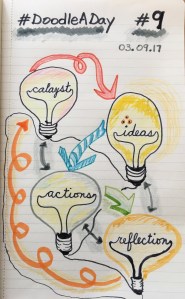
Doodle-A-Day #9 by Helen DeWaard

Personal photo at Machu Picchu by Helen DeWaard

OEORangers for Doodle-A-Day #28 by Helen DeWaard

Posted in Talking, Together | Tagged , , , | 1 Comment