Learning in Loops and Spirals

Learning happens in loops and spirals. The images of a mobius style loop and the fibonnacci spiral come to mind as I reflect on what personal and systems learning looks like within social and networked communities. This past week, my own experiences in learning occurred in both a looped and spiralling fashion. These images are a ‘generative metaphor’ (Schon) created from my reflection in, on, and of my learning.

5340808741_1cc193cfc8_z

Mobius Loop

Learning can happen at any point along a loop – it doesn’t matter where you begin or where you decide to get off. The learning experience is never the same since placement, perspective and people will change when you begin a new learning loop. You can follow the loop around a topic, context, or exploration for as long as you wish – some people make the learning loop last a lifetime. I stepped into the Hybrid Pedagogy loop this past week and will continue learning along critical literacy pathways, with many others, as I experience the #moocmooc exploration. My learning viewpoint was captured in this Storify – On Twitter dialogues & campfire classrooms @#moocmooc.

image of snail shell

Nature Pattern

Learning within a spiral has a definite starting point that sparks the learning event. It is the center-point from which the learning will incrementally expand outward. The learning experiences grow and enrich for individuals and groups as the topics, content, or exploration gains momentum. This happened for me with a #noworksheetweek experience, as shared by one teacher (A.Dunsinger), that expanded to other topics, experiences and educators. The spiral of learning continued outward from a shared exploration in one learning context, as captured in this Storify – Living and Learning.

So I’ll take this back to Donald Schon and his reminder to reflect on learning in open spaces because “learning isn’t simply something that is individual. Learning can also be social”.  This was modelled throughout my looped and spiralling learning experiences – both were conducted in very open, public forums where anyone and everyone could share, discuss, disagree, or explore further. Social media provides for looping and spiralling of ideas with, from and beside others along a learning topic.

Schon focuses on the diffusion of innovation as a way for learning systems to change. His suggestion that innovation, change and “the movement of learning is as much from periphery to periphery, or from periphery to centre, as from centre to periphery”. Learning systems can change with the diffusion of social media engagement. Within the loops of conversations in a twitter chat (#moocmooc), there are no hierarchies and the structure is loosely shaped to allow for easy entry/exit points. The topics, participants, and flow of conversation likewise had no ‘expert’ leading the way or formal structure. Ideas flow and topics slip and loop around each other. When systems engage in this type of open, social, shared and public conversation, change in the movement of learning will occur from periphery to centre and back to periphery. Leaders, teachers and learners engage in a looping of their learning with each other.

Great learning and teaching often happens at the grassroots far from the decision-making, policy setting, power centres of education. From examples such as the #noworksheetweek exploration, systems and leaders can openly learn when the experiences of teachers and students spiral outward from the classroom. Current education systems that are innovating and changing are those willing to engage in a public, shared movement of learning that focuses on what sparks learning in the classroom.  The spark of one idea, once shared and explored, can spiral outward where others can engage in the concepts, issues, questions or practices.
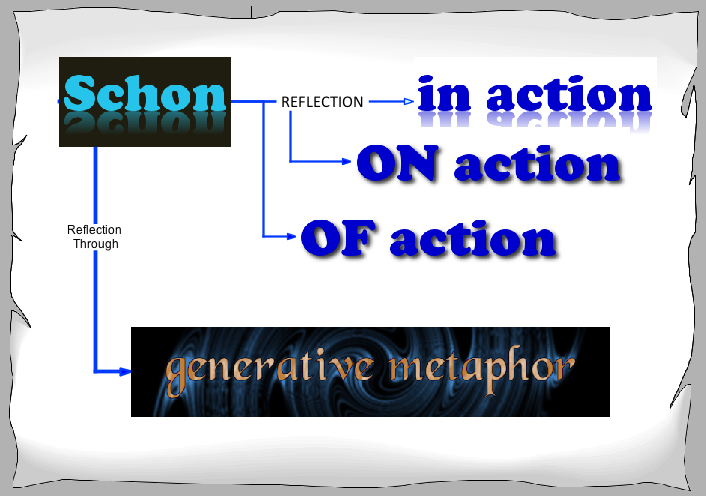
Generative reflection

Schon suggests “practitioners build up a collection of images, ideas, examples and actions that they can draw upon.” My reflections generated the images of the mobius-style loop and the fibonnacci spiral for my learning actions. These are presented for others to explore. Engaging in generative metaphors “allow for different ways of framing a situation” to create insight so learning can continue to loop and spiral.

  • What are your generative metaphors?
  • Where does learning loop or spiral for you?
  • How will your learning change the system when you share your loops and spirals in public, social ways?

References

gfpeck. (Jan. 9, 2011). Single sided. [image] retrieved from https://flic.kr/p/98X3nk

Mosdell, S. (Feb. 27, 2011). Nature pattern. [image] retrieved from https://flic.kr/p/9nscgw

Smith, M. K. (2001, 2011). ‘Donald Schön: learning, reflection and change’, the encyclopedia of informal education.[www.infed.org/thinkers/et-schon.htm. Retrieved: Jan. 23, 2015].

Posted in Talking, Together | Tagged , , , , , , , , , , , | Comments Off on Learning in Loops and Spirals

Stories to bank on!

image of ice crystals with John Dewey quoteAlthough I am not a story teller by nature, I am one by profession. Teaching is all about writing a compelling narrative with others. This is a story about opposites that come together to create a positive ending. In teaching, we learn to start with a ‘hook’ to every lesson. My hook for this story is a quote from John Dewey.

Screen Shot 2015-01-21 at 12.32.10 PMIf you wish to hear an audio recording of this blog post it is available HERE.

Dewey’s model of education is a paradox to the image of the banking model presented by Paulo Freire in his Pedagogy of the Oppressed.   Standards based, data driven, measured and counted learning events exemplify this notion of ‘banking’ education. The paradox is in who has the choice and voice in education. Dewey and Freire’s views of learning, when brought closer together and viewed through a lens of inquiry, aren’t far apart. The link between these two models is the connecting power of  educational technology when ownership and authorship, within the ‘architecture of participation’ (O’Reilly, 2004) ensures that educational banking is controlled by those living the learning.

Freire argues that education founded on a banking model – deposits of knowledge, collections of marks, returns on learning investments – goes against the narrative nature of what it means to be human. By “abandoning the educational goal of deposit-making and replace it with the posing of the problems of human beings in their relations with the world” (p. 79) we can regain our relationship, dialogue and actions with learning and each other. Teachers and students are creating and collecting their stories of learning as currency which is freely shared with others.

Participatory, inquiry based learning is re-energizing the trend toward learner focused educational practices. This is supported by new and emerging technologies in the classroom. As modelled by many teachers in inquiry based classrooms, A. Dunsinger (Living Avivaloca) is one of many who exemplify Freire’s statement where teachers and students “become jointly responsible for a process in which all grow” (p. 80). Both Freire’s vision and Dewey’s model of education are in the process of becoming a reality.  Through “problem posing”, education “affirms men and women as beings in the process of ‘becoming'” (p.84) and opens a dialogue that engages learners and teachers in the co-creation of their unique stories along the learning journey.  This is the story of life itself.

Pedagogy modelThe stories of co-learning, problem-solving and success (or failure) add to the global narrative of what it means to be human. These stories of learning are being created, shared and celebrated through a collaborative network via the integration of technology (blogs, wikis, social media). Providing teachers and students with opportunities to share the learning journey – from problem, through challenge, into comprehension, overcoming critique, and finding commitments – give both a place and space for authentic reflection.  Freire states that “thought has meaning only when generated by action upon the world” (p. 77).  Educational trends in flipping, tinkering, making, coding, creating, and gaming show that teachers and students are generating currency by co-creating their learning stories. These stories are being deposited and shared freely via digital networks.

One current trend, that of digital badging, creates images of collecting coins as the currency of learning. As with earlier banking models of education, this trend can be a form of oppression unless the ownership of digital badges becomes part of an individual’s life-learning story.  Collecting digital badges, just as collecting marks, can become the bitcoin version and driving purpose of education. From the Dewey model of education, digital badges have the potential to be images that tell the story of efforts, struggles, failures and triumph.Claiming the coin (or digital badge) and keeping the collection should be in the hands of the learner rather than the digital data banks that could deny or hoard educational opportunity.

The paradox between banking models of education and the model of education as problem posing, life as learning will remain as polar forces, like the resisting ends of a magnet. Teachers and students, by weaving technology into solving real-life problems and sharing the stories of learning can find a balance between these two opposing forces.

How are you balancing the forces – are you banking or sharing educational currency? Are you dialoguing and communicating about problems being solved?  Do you conduct the business of learning or live the learning as life itself?

References

Freire, P. (2006). Pedagogy of the oppressed, 30th Anniversary edition. New York: The Continuum International Publishing Group Inc.

Infology. (March 28, 2014) Digital badges in education: A quick overview. [blog post] http://blogs.ubc.ca/open/2014/03/28/digital-badges-in-education-a-quick-overview/

O’Reilly, T. (June, 2004). The Architecture of Participation. http://bit.ly/1xXgMgo

Posted in Learning, Talking | Tagged , , , , , , , , , , | 3 Comments

Awaken the Dragon

I’m afraid I have awoken the dragon. I am visible, standing on a shifting terrain. But I don’t think I am alone.

This one scene from the movie The Desolation of Smaug connected for me as I become more engaged within social networks and communities. In my effort to model how a connected educator works and learns in digital spaces, the dragon knows who I am. The pile of gold under which the dragon sleeps brings forth the image of Twitter and other social networks – with it’s immense volume, rolling and shimmering, threatening to bury me in a landslide, while I search for that one nugget of something precious. I know, as Bilbo does at the end of this clip, that the dragon sees me now!

In a recent post by Seth Godin, there is fear in being seen, being judged in social media spaces and for the digital trails we leave. But Godin reminds us that this is the only “generous way to change your world”. When we stand for something, as Bilbo makes every effort to do in the movie, we can alter our educational spaces, one tweet at a time. By modelling and risking judgement in digital spaces, educators allow others to watch and learn, take that leap across the shifting pile of gold, and do it visibly, as Bilbo decides to do when he takes off that ring!

I found many nuggets in the pile of gold rolling past me this week. A post by Brian Szatabnki (Edutopia A Ticket to Ride) caught my eye. He shared how his ‘leap of faith’  changed his perspective and teaching practice. His five goals for 2015 include

  1. Honour my curiosities
  2. Break bread with colleagues
  3. Reflect on failures
  4. Focus on learning experiences over learning data
  5. Thrive on the enormity of the challenge

As I awaken the dragon, I can certainly envision the enormity of the challenge! But, I’ll keep these five goals in mind as I blog, tweet, share and engage in digital spaces. I will honour my curiosities by following people and organizations that excite my interests. I will break bread with colleagues as I engage in twitter chats, post comments, and share my thoughts around digital spaces. I will reflect on failures within blogging posts and comments. I will focus on learning experiences and share these with my students so they can learn with me. Finally, and toughest of all because this dragon is pretty daunting to look in the eye, I will thrive on the enormity of the challenge and be brave in my visibility.

How will you awaken your dragon? How will you share an idea to generously change your educational world for the better?

Posted in Talking | Tagged , , , , , , , | 4 Comments

Gotta have Heart!

HEART

The challenge to find one word for 2015 was difficult. After reflecting on the words proposed by others, thinking about my own personal and professional work, and where I am in my life’s journey, I think the one word that will shape the coming year for me is the word HEART.

There are so many phrases and words that connect to this one word – have a heart, take heart, true heart, brave heart, heart felt, from the heart and heart to heart. Each of these phrases brings forth an image or feeling. Encourage the heart is one of the five exemplary leadership practices presented in The Leadership Challenge by Kouses & Posner (2007). So what do these mean for my teaching and learning with educational technology?

Have a heart brings forward the vision of a caring, affectionate, forgiving person. Having a heart means you look beyond the problem, error or omission and move on. Educators can have a heart when it comes to technology because problems are an ever-present element of the terrain. Caring enough about what you are trying to accomplish with the tools and techniques means you can move past the challenges and issues and forgive the errors or omissions of others. For me, this means moving forward despite the perceived slights or misunderstandings I may create or see when applying technology to my teaching and learning.

Take heart is a call for resilience. Visions of being uplifted from despair come to mind. In terms of educational technology, taking heart is a rule rather than a general guideline! Knowing that if you stick to it, find a way around the issues, and persevere, things will get better. In the coming year, my ability to take heart will be tested with several new possibilities and projects.

If you have a true heart, you value and cherish that which you hold dear. Being a true-hearted educational technologist means you model and share the value of learning and teaching with all things digital. Since the beginning of my teaching career, my true-heart for ed tech has been evident to those in my classroom or work space. This year, the challenge for my true-heart will need to move into digital spaces and global places.

To be brave hearted means you have courage, passion and spirit. Beyond the Wizard of Oz  or Scottish historical images, being of brave heart means you can face adversity and challenges. This one should be a requirement for all those working with educational technology – have a brave heart and you may enter. In 2015, having a brave heart means I will take on the challenge and face adversity when taking myself out of the comfort zones within digital spaces and places.

Heart-felt and heart-to-heart are about sharing, caring and loving. Making a personal connection to others in ways that are meaningful shows your heart-felt nature. Within educational technology, this means having those deep and purposeful conversations about what you are doing, trying to do or hoping to do. For me, this means opening myself up for those heart-felt, heart-to-heart discourses in places that are not just face to face or quick chats.

From the heart means your words and actions are seen as genuine and build relationships.  Speaking from the heart implies that you care and can be trusted. For educational technologists, finding trusted sources that speak ‘from the heart’ comes through connected networks, listening closely and finding those trusted sources of insight and experience. For my own learning and teaching with technology, in 2015 I will find those whom I can trust to question, inquire and challenge my thinking.

Encourage the heart, according to Kouzes & Posner, means to recognize contributions by others, show appreciation for excellence, celebrate values, acknowledge victories and create a spirit of community. In educational technology, this can be a challenge, but for those immersed in the field, taking time to do the little things will mean the difference for many just starting out. For the next year, I will make challenge myself to make a difference in one person’s digital life on a daily basis. By recognizing other’s contributions, showing appreciation for something that models exemplary practice and acknowledging the small steps and victories other’s are making in their own ed tech journeys will enrich my own experiences and encourage my heart.

So today, with heart in hand, I send from the heart a heart-felt wish to my sister to take heart, be a brave-heart and have a heart-to-heart with me. This is my moment to encourage the heart and let you know you are true-hearted and truly loved!

Reference

Kouzes, J.M. & Posner, B.Z. (2007). The leadership challenge, 4th Ed. San Francisco: John Wiley & Sons. p. 26

Posted in Talking | Tagged , , , , | 3 Comments

Do IT to Learn IT

Do IT to Learn IT Coming back to blogging for my own professional purposes is not easy. Within the walls of the classroom, putting my teaching ‘out there’ for my students to participate and engage with content and activities is easy. Take away the walls and I appear to lose confidence. While I read and enjoy the blog posts created by many others, it’s been a one sided conversation. I have largely been silent. With my newly found resolve to model what I teach, I will DO it to LEARN it.

I encourage and challenge the teacher candidates in my courses to blog for professional purposes.  In the busy days within the Faculty of Education, it’s almost impossible for them to carve out a little time to blog, twitter, or tend to other commitments. But their teaching practice will be enriched if they can learn early into their careers to work without the walls, within an ever-expanding digital space. Finding an ebb and flow, or an equilibrium, in the process of ‘doing IT’ will come with practice. My guidance to them is the same as I’m telling myself – DO IT once a day for short 5-10 minute tasks, such as checking on a twitter feed, or once a week if it’s going to take 15-30 minutes, such as a blog post or digital creation.

By focusing some time on bogging I will write my story and build my brand as a digital teacher and learner. If I don’t DO IT, someone else will shape my story for me. It’s not only good for my teaching practice for me to do this thing called blogging, it’s an essential way for me to learn how to teach other educators, soon to be educators and colleagues in education to DO IT digitally. Teaching and learning has to happen differently, so DO IT to LEARN IT!

But blogging isn’t the only way to DO IT in digital spaces. I’ve been reviewing all the work I do as an educators of soon-to-be-educators. Some much needed advice came this week from a blog post How to Curate Your Digital Identity as an Academic written by Kelli Marshall. She’s writing from experience. I’m currently paying particular attention to two tips: take control and build a network. I’ll move onto the tips to buy a domain name, monitor yourself, and practice uniformity. Some challenges ahead, but when aren’t New Year’s resolutions difficult. They are our way of renewing and re-investing in ourselves, on a personal and professional level.


Posted in Learning, Teaching | Tagged , , , , , | Comments Off on Do IT to Learn IT

OK! Alright already! a new resolution!

361611096_d5c9741533_z

High Voltage Sparks, SCholewiak, cropped

OK. Dean Shareski – this one’s on you! Just crossed your blog post If you ain’t a feed, I don’t read – about blogging. Your ‘call to action’ is prompting my words to flow onto this blank blog page. I’ve been working on the course design for digital teaching and learning and blogging is part of the requirement for course success. How can I teach what I am not learning myself?

So my confession is simple – I may have something important to say but who am I to know? The confidence to just ‘throw it out there’ has been somewhat lacking. Maybe it’s the introvert in me – do introverts blog? Well Dean – I’ll take up your request to ‘please blog’! Maybe my knowledge and understanding can be shared around this digital fireplace!

The blog post 21+ Things Every 21st Century Blogger Should Do in 2015 also challenged me to re-think my blogging presence. Lisa Johnson lists several tasks for bloggers to consider – top on my list for this year are

  • plug in your feeds – this one’s a nod to Dean – your feed to mine! I’ll certainly look forward to engaging with others more regularly this coming year.
  • tag all posts with your name – interesting way to spread your name as the word and the work
  • infuse pictures of yourself – not sure about this, but the selfie phenomenon has tainted my inner introvert. How do introverts handle the ‘focus on me’ social push? Maybe my selfies will be images of parts of me with parts of what I’m doing in learning spaces.
  • connect content you create and curate – this one should be easy – there’s lots that I have created and much more I hope to curate as this year progresses.
  • creative commons your work and/or your site – this one’s been done a few times, but not consistently. I’ve bookmarked the Choose Your Creative Commons License site and enjoy the simplicity of acquiring a license image to match my site.
  • proudly display badges – ok, this one really speaks to me since I’ve just created a badge for one of my courses and encouraged my students to post the course badge on their own blogs. I’ll have to explore this one some more this year.
  • provide consistency with content – this one’s the tough one! Resolutions in the beginning of a new year often fail once the going gets tough. Perhaps a blogging challenge or a ‘quad-blog‘ may bring hope of sustainability.

So, all it takes is the right prompt at the right time to spark thinking and learning. Thanks Dean, you sparked this blogger to ignite. Something worth remembering as I move into this new year. How can I spark others to ignite their passions for digital teaching and learning?

Posted in Learning | Tagged , , , , | 6 Comments

Returning

“The place where you continually return for love and acceptance – that’s home.”
― Richelle E. Goodrich (Goodreads Quotes)

It has been quite a while since I posted an update here. Many things have happened in my personal and professional life since my last submission. Each time I have returned to complete an update here, something has interrupted or interfered with my plan. Many drafts have been written and discarded. Many events have altered my perspectives of what I should be doing as a blogging educator. So, I am returning to this forum, despite some discomfort and angst over my public presence in digital environments. Perhaps this will feel like returning to my digital home.

I am returning, not only to openly sharing of thoughts about digital teaching and learning, but also to the classroom, to teach a new group of students, and to the public forum of conference presentations. Lessons continue to be learned in each environment, about my own preferences, the excitement about facing new ventures, and the discomfort that often accompanies the effort of putting myself ‘out there’.  I continue to develop as a digital citizen and technological teacher through this process or ‘returning’. Each time I come back to something, I return with insights, a little stronger, even a little wiser.  Such is the life of a teacher – digital or face to face – to return each new school year, only to find that things are not like they were before, since we ourselves have been changed by time, events, and our own life reflections.

Posted in Uncategorized | Comments Off on Returning

Work of a different kind!

My last post was about having some fun. Well it’s been nothing but work since that last post. But, it’s been work of a different kind. I’ve tackled some design and development of open, online course materials for a few classes I’m teaching. It’s been hard work planning and developing the right materials, the right connections, the links for learning that I hope will engage students in content and technology. But more on that later…..

Now, the work takes on a new twist. An ETMOOC twist. I signed up and have ‘lurked’ through the first few weeks. Today, I listened to the archived session by Dave Cormier on Rhizomatic Learning. Interesting analogy from a connectivist perspective. Beyond the obvious connotations of being ‘underground’, ‘subversive’, and ‘difficult to exterminate’ are the hopeful images of ‘in-it-together’, ‘connected to many others’ and ‘able to grow alone & together’. This also applies to ideas and learning. They are all connected in a chain of ‘nodes’ from the beginning of my time, and the time of others before me. My passionate use of mind-mapping also comes to the forefront when thinking about rhizomes. Some mind-mapping tools are more ‘rhizome-like’ than others, but they connect ideas and concepts in the same manner as this image suggests.

Cynefin model

Cynefin Model

I found some rooted relationships to ideas I’ve had about uncertainty, complexity, chaos and how to teach, learn and engage in a community of connected ‘work’ around curriculum. The image from “Cynefin” provided the feeling and link that I was looking for. My sense of teaching and learning ranges from the simple, through complications that are at times complex and chaotic. I’ve not really thought of this as a progression or stages that teaching and/or learning move through or connect to. This image has provided a new model for my own thinking and potentially my teaching practice. A new node on my personal learning network – mostly underground!

Posted in Teaching, Together | Tagged , , , , , | 1 Comment