Getting it Wrong

I have not failed. I have found ten thousand ways that do not work.

Thomas Edison

I’ve made mistakes. Lots of them. In my journey to become a more fluent user of digital technologies I’ve had to learn the hard way. Getting into the digital sandbox is the first step. Playing, building, knocking things down, rebuilding and reflecting are all part of the process. Tinkering around should never stop. But I need to make mistakes to get it right.

I’m not alone. In this digital sandbox I have many friends, colleagues, even casual acquaintances, that are building and playing with me. I learn from others – watching, listening, talking, collaborating – and from our mistakes, we get closer to getting it right. I need them to give me feedback, support and encouragement when things go horribly wrong. I don’t need others to always tell me when something isn’t right. I can reflect and realize when it’s wrong. My first video posted to YouTube is a testament to how wrong it can get!

Being human in online spaces should allow each of us to get it wrong to get it right. Sometimes that requires a safe, secure sandbox where we can test our ideas and explore without fear, knowing that others in the space will support us when we get it wrong. Other times we need to step out into the larger global sandbox and risk getting it wrong where many, many others can see, comment and either critique or support. That’s a scarier way to make mistakes. But it’s necessary and an essential way to engage with others who are making similar mistakes or finding someone who got it right to help you learn. We can test and try using pseudonyms or interesting avatars before we reveal our true identities. Taking risks and learning from mistakes is the human way.

“Success has to do with deliberate practice. Practice must be focused, determined, and in an environment where there is feedback.”

Malcolm Gladwell

So I turn these thoughts to how we can make mistakes, show our mistakes to others and learn from other’s mistakes in authentic online engagement. In digital communities of inquiry where our social, emotional and cognitive presence is shared and exposed, how do we find ways to practice, make mistakes and learn?

I consider the notion of affinity spaces as a way to engage around an idea, process or product. John Paul Gee talks about affinity spaces in terms of people gathering around a semiotic domain, such as online gaming. An affinity space has permeable boundaries where content, organization and portals shape the interactions and activities. It’s based on the online gaming community. Features can be also be found in an EdCamp experience or some MOOC examples (#HumanMOOC).

It’s the fluid nature of the community space that is intriguing. There are elements of affinity spaces that allow for the novice, tinkerer and experienced explorer to learn alongside, with each other, while focusing on the task at hand. Making mistakes is part of the expectation going into an affinity space and learning from mistakes is a natural outcome.  In the gaming space, the learner tries and fails repeatedly before levelling up, then shares their expertise with others. It’s not the expert who gains status, it’s the one who learns from getting it wrong and willingly examines these failures publicly for others to see.

Keep CalmHow can this type of fluidity in learning spaces impact and influence being human while learning from mistakes within online learning communities? One characteristic of an affinity space is that leadership is porous and leaders are resources. The focus is on the activity.  Within online learning spaces, leaders and teachers need to move fluidly throughout the discussions, actions and creations while modelling that getting it wrong is a good thing. Maybe this means stepping out of your comfort zone and trying something a student suggests. Perhaps it involves admitting you don’t know or you’ve changed your thinking in some way. Publicly recognizing and openly acknowledging when you’ve made a mistake is important. Providing feedback to others when they get it wrong is also essential.

So, getting it wrong is a good thing. Learning from those errors is essential. Improving, rethinking, remixing and reviewing are part of the learning process. Making mistakes in public spaces ensures that I am accountable for my own learning and also shaping the lessons others will learn.

The challenge in formal learning spaces is that evaluation and judgment become part of the learning equation. Where and when can we take a snapshot in time to determine how close we are to a particular learning target? How do we demonstrate that our mistakes have resulted in improved thinking and understanding? Why do we need to judge ourselves or others against arbitrary benchmarks, knowing that the mistakes we make may not measure up? That’s for another post…. more mistakes coming.

References and Resources

Gee, J.P. (2009, July 16). Affinity spaces: From age of mythology to today’s schools. Retrieved from http://www.jamespaulgee.com/node/5

Hoyle, M. (2011, July 27). Connectivism and affinity spaces: Som initial thoughts. [blog post]  http://einiverse.eingang.org/2011/07/27/connectivism-and-affinity-spaces-some-initial-thoughts/

Keep Calm Creator http://www.keepcalmandcarryon.com/creator/

Posted in Learning, Together | Tagged , , , , , , , , , , , | Comments Off on Getting it Wrong

Unwrapping Presence

Learning is complicated. Teaching is complex. These are not new ideas. It’s been like this for humans since caves and forests were our homes. But the new terrain in which we teach and learn has ongoing challenges for those who teach and learn as humanly as possible. So taking time to unwrap how to BE human in digitized learning spaces is important work. When blending, flipping or online teaching and learning processes move the human tasks of teaching and learning into digital places, it’s essential we don’t lose focus on the individuals. The human can become lost among the trees.

graphic for humanizing online learningSo, with a carefully crafted digital space like #HumanMOOC, I was able to take some time to unwrap my human presence in digital teaching and learning spaces. While this open, online course was intended for online teachers, I jumped into the conversations and activities looking for a way to bring my fully human self into my own digital teaching spaces. I found many ways to unwrap my presence.

HumanMOOC was designed to apply elements of a community of inquiry into a discovery of presence in online learning. This course, found within a variety of spaces (Canvas, WordPress, Google community) shapes an understanding of how to build instructor presence, social presence and cognitive presence into digital learning spaces. Readings and activities have incorporated video, audio, and text in collaborative, engaging and innovative ways to show how ‘presence’ can be designed into online teaching and learning.

Instructor presence includes how the course is designed, how feedback is provided, how discourse and interactions are facilitated and when direct instruction is provided. The instructor guides and provides a range of strategies and builds connections with both synchronous and asynchronous methods. A variety of media are applied depending on student need, subject content and instructor familiarity with tools and techniques.

Social presence outlines the personal and affective interactions between all participants. It includes social rapport, open communication and building group cohesion. This can be structured through the strategic use of humour, emoticons, setting up online teams, and sharing personal interests. Since tone of voice and nuanced non-verbal cues can be inferred or directly shared through a variety of media, being socially present within a digital café is essential.

Cognitive presence is developed through exploration, a triggering event, integration and resolution. Selecting, exchanging, communicating, brainstorming, suggesting, connecting, testing, defending, applying and synthesizing are all relevant actions to establish cognitive engagement with subject content. Facilitating cognitive presence can be done through discourse, collaboration, self-monitoring and reflection. Instructors and students work together to unwrap ideas and concepts while sharing a variety of media productions.

Unwrapping some newly discovered presences include the notions of learning presence and emotional presence. These two are still being uncovered and examined. These concepts will impact teaching and learning in online spaces. Being emotionally engaged with content, with others in the course and with the instructor will allow students in physical or digital spaces to care and empathize. Bringing an inquiring mind and a growth mindset into learning events will engage students and instructors in deeper learning.

Unwrapping presence is not an easy process. It can’t be done alone. Knowing what it looks like, sounds like and feels like can uncover the mystery that lies within the complex and complicated learning and teaching process. Sharing the gift with others can enrich the understanding of what it means to be humanly ‘present’ in online and digital learning spaces.

The HumanMOOC is a gift that allows us to peek inside and uncover what it means to be human…. and to do IT with others. Take a closer look at what I’m unwrapping from this #HumanMOOC experience HERE.  Let’s continue to uncover our presence together. Share your presence and comment.

References and Resources

Many readings, resources, videos, conversations are available within these sites:

More about Community of Inquiry can be found here:

Morrison, D. (Jan. 30, 2015). A new twist to teaching online: Considering learners’ emotions. [blog post] https://onlinelearninginsights.wordpress.com/tag/emotional-presence-online/

Posted in Talking | Tagged , , , , , , , , , | 3 Comments

Tips from a Video Voice

image of shadow against starsI’m a reluctant video star. I’m sure I’m not the only one. Once we face the camera for the first time, our uncertainties arise. My comfort with my video voice has increased with exposure and experience due to some #HumanMOOC work. The first task for this open, online course was to create a video introduction. The second task had each participant creating a video to introduce their online course to their students. Then more video capture using Flipgrid where our face and voice was recorded while answering some focus questions. After each of these experiences, and with encouragement and feedback from the course instructors and participants, I became less reluctant to face the camera.

So, with culminating projects for my own course to mark, I decided to do a video for each of the students to provide feedback on their digital stories. I sat facing the camera, notepad with jot notes at my side, green screen behind me, and I recorded a message to each of my 34 students. At the end of this process I felt that I had shared a personal message and connected in a small way to each of my students.

From my experiences creating these feedback videos, and watching videos from other #HumanMOOC participants, I have collected some thoughts about video creation for teachers and online presenters.

My background matters – Make sure you are aware of the background in your video. Consider where you are to make sure it doesn’t negatively impact the message in the video. While clutter can tell viewers what your interests are, it can also distract your viewers if there are too many things to look at e.g wondering what’s on your bookshelves rather than paying attention to your message. While recording video feedback, I used a green screen and then embedded images from the student’s work behind myself to highlight some of the key elements from their assignments.

Be still …. or not! I became very aware of my own hands since they tend to move around while I was talking. Making a decision to include my moving hands, since I rarely talk without them, allowed me to strategically communicate additional information. Sometimes moving side to side, forward or backward, leaning or reaching can be distracting or it can add the human element of movement to the video. The choice is yours, but be aware of motion that you don’t want happening.

Face it with eyes wide open! This became evident as I watched myself and others using video. Know where the camera is located and keep your eyes on the green light. Imagine the student at the end of that light. Since I work with two monitors, I frequently found myself looking the wrong way. I had to prop my laptop on some books to make sure my eyes were looking straight at the camera, not up or down. If I looked away, to peek at my jot notes, it appeared to be ‘thoughtful pondering’ rather than looking way. It became part of the message.

Sounds abound! I don’t have a particularly noisy workspace but I became aware of every interfering sound as it was captured on the video recording. I had to remember to turn my cell phone onto mute to make sure the notification chimes didn’t interrupt a sensitive or difficult feedback statement. I also became very aware of every ‘um’, ‘ah’ or ‘but’. While some of this tends to happen naturally, the overuse of these verbal ‘burps’ began to detract from my message.

Lighting it up!  Having a good light that illuminates your face from the front helps. It reduces shadows, enhances facial expressions and makes you appear ‘alive and awake’. I stopped recording when it became too dark for natural light since the lamp I was using flickered from light to dark, creating a strobe-like effect on my face. Investing in a better lamp will be necessary or I’ll record in daylight to make sure lighting doesn’t detract from the message. I also became aware of the glare that the light created on my glasses so rather than remove them, which is another option, I kept my head slightly tilted or repositioned the lamp to remove this effect.

image of microphone

Blue Snowball

Microphones come in all shapes and sizes, but my snowball works best.  For most of the videos I created, I used a blue snowball mic since it gave the best sound quality and wasn’t tapping on my necklace or getting tangled into earrings. I have tried a variety of different mics in the past and keep coming back to the snowball for quality and tone. You’ll need to find the microphone that gives the best sound quality so your voice is consistently clear and audible when recording your videos.

Pace yourself!  My goal was to create a video that was just around the 2 min mark. I jotted notes about all the items I hoped to mention, rehearsed a few times to see how many points I could fit into the message without talking too fast or repeating myself. I chose to do this feedback in one take rather than several smaller clips because I wanted it to feel like I was talking directly to my student. I also had to realize that I couldn’t say everything, so focusing on key points was important. This was a conversation, not a rant, so I had to redo videos that revved through the points too quickly.

To script or not to script – that is not the question.  I made a conscious decision to create notes about the assignment I was marking. Scripting in the truest sense was not my focus. Once the notes were made, I practiced a few times without the camera running. This helped me shape the message with an interesting statement at the beginning and a logical conclusion to wrap it up at the end.

What did I discover about myself?  I’m human. I made mistakes. I had to re-record many times because one or many of these elements didn’t work out right. But I also learned that connecting and conversing this way has meaning and purpose. I wondered if this was the first time I had spoken to some of my students in such a personal way.  In a face-to-face class, time slips quickly while students focus on tasks and learning, without a lot of one-to-one time from the teacher.  After this experience I’ll look for ways to use video in my classroom more often.  I’ll work toward answering some of these questions.

  • How can I make sure this personal connection can happen early in the course rather than at the end?
  • What can I do to make sure that each student feels they are important to me, as their instructor and teacher?
  • Where can I use my video voice to build relationship and enhance communication within physical and digital spaces?

References and Images

Iko. (Oct. 18, 2012). Made of stars. Retrieved from https://flic.kr/p/dkQKRU

Nebraska Library Commission. (Nov. 27, 2012). Blue snowball USB microphone Retrieved from https://flic.kr/p/dwQ5gJ 

Posted in Talking, Together | Tagged , , , , , , | 5 Comments

Writer’s Craft in Digital Spaces

I am an avid reader. I look for new texts written by favourite authors. I share books that leave a lasting memory. Great stories transform me. The craft of writing a great story is something I haven’t thought about much. A craft is often associated with hand-made, skilled trades. A craftsman is a “creator of great skill in the manual arts” (Visuwords). Connecting strings of words together to share a story, thought, inspiration, image is not something that comes easily. It’s a gift but it’s also hard work.

Books aren’t the only texts I read. I enjoy thought provoking and engaging magazine articles, research papers, or blog and twitter posts. Some are crafted to be casual and conversational, humourous and witty or deeply thoughtful. Every writer has a voice that is evident in the words they chose and how they shape images by strategically putting words together. I follow some blogs because of the writer’s craft in shaping my thinking and the emotional connections that are made.

This past week, I’ve been rethinking the writer’s craft in light of the digital nature of storytelling. My students have crafted unique and personally meaningful stories as part of the course work I assign.  The results are transformational. Students create engaging and compelling stories shaped not just with words but also with images, sound, and video. Creating a digital story is different than crafting a blog post or novel. Digital stories engage a reader who is also a viewer. The story is told using a wider variety of tools than only text.

Digital storytellers make endless choices as they create their stories. The vision of how to tell the story is as unique as the author. The story has to come first. Then comes the art and craftsmanship of shaping the digital experience. Digital stories are crafted using images to express ideas or concepts. Text is carefully selected in size, font, style, and placement on the screen. Sounds are strategically applied to shape emotional responses. Motion and transitions are selected to illustrate and enhance the story. Carefully mixing music and voice shapes the ‘readers’ experience. Pacing dictates the flow and feel of the story. The results are often magical, meaningful and emotional. Crafting a digital story is hard work.

I recognize the hard work my students put into their stories and respect their writer’s craft in digital spaces. The stories they create shape my view of their world, their experiences and their voice. Each story reveals something of the author. I’ve enjoyed viewing and ‘reading’ these stories over the past week. This year’s collection included stories about family, friends, life journeys, trips taken, and life altering events. Themes include personal growth, love, anxiety, depression, violence against women, fears, relationships, body image and the fulfillment of dreams. Memorable moments, of which there were many, include

  • Black screen with sounds of screeching tires followed by a video clip of a sonogram accompanied by the sound of a beating heart
  • video of a woman deep sea fishing followed by silence and a still image of the same woman with the words ‘she was killed by her husband’
  • image of a plate with an empty cupcake wrapper, two googly eyes and a speech bubble ‘RIP chocolate cupcake’

Words alone can’t describe the transformational effect digital stories have on their ‘readers’. But more importantly, words can’t describe the effect that crafting digital stories has on the authors. Their stories, carefully crafted for the intended audience, transform their understanding of self, relationship and purpose. Writing and crafting transforms both author and reader. And after all the hard work, isn’t that what the craft of writing is all about?

Posted in Learning, Technology | Tagged , , , , , , , , | Comments Off on Writer’s Craft in Digital Spaces

Feedback Please

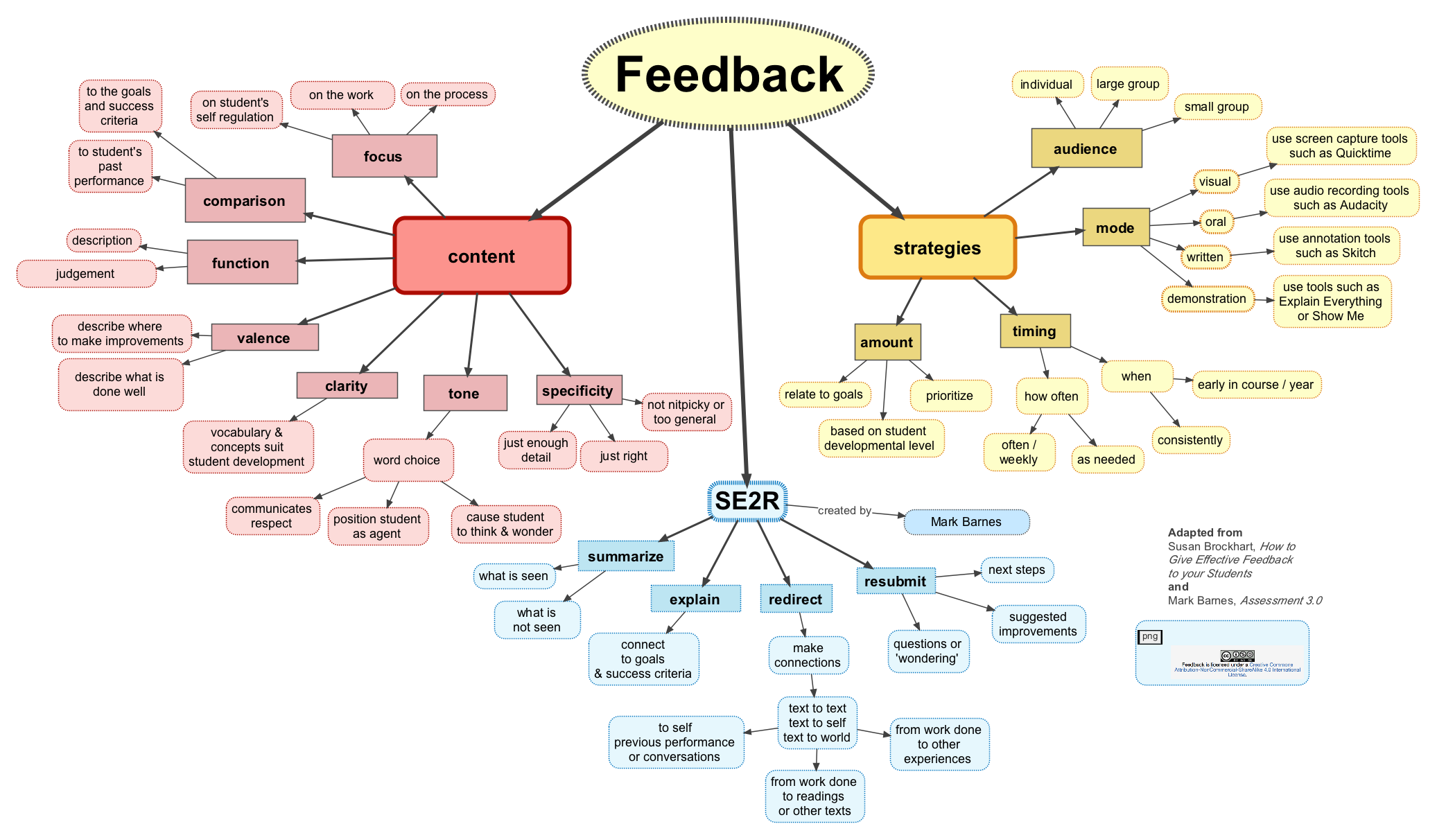
Giving and getting feedback is an essential part of learning. When trying to improve your understanding and actions, it’s necessary to get MORE feedback. Knowing about the feedback process can provide a deeper understanding of it’s purpose and parameters. When giving or getting feedback, keep in mind the content (what is in the message), and the strategies (who, when, how the feedback is constructed). Look at feedback with an eye toward setting goals. Applying the SE2R (Barnes, 2015) framework when providing feedback can help focus on the work and the next steps.

concept map of feedback

Mapping the Concept of Feedback

Actively seeking and acting on feedback will improve teaching and learning. This is not always easy but it is necessary. So, how can your learners seek feedback? How can a teacher seek feedback on their teaching?  How do you go about seeking feedback and who do you get to provide this feedback. When you want feedback, where can you go? As a teacher, there may be a mentor that you can ask. There may be someone in your personal learning network (PLN) that will provide an honest critique of your work from the perspective of a ‘critical friend’. With innovative approaches using technology, this feedback can be provided without needing to be physically present in the same space at the same time. It’s a matter of being willing to engage with video, audio, media and text to support your reflection and feedback. So how do you do this?

Seek out one or two in your PLN that can do a ‘deeper dive’ of your work. Make sure you let them know what type of feedback you are looking for and how you intend to use the feedback. If you plan to publish their feedback in any way, let them know. Collect and share your work. You can ask someone to video you while teaching, focusing only on your actions, not that of your students. You can capture audio using recording apps (iTalk, voice memo) or software (Audacity, Garageband). You can screencast your digital work or share a link. You can publish to a shared digital space (Google docs). If you are open to the opportunity, you can do a shout out to all who read or connect with you in digital spaces to provide comments or tweets. With all these options for feedback, come choices. How will you decide what format the feedback will take? Creating video or audio feedback may not feel comfortable, but is shown to be more effective than a written version.

Once the feedback is given review it carefully. Know that it’s not about you, but about your work. See what is right and good, then focus on areas that need some attention.  If the feedback is provided in the SE2R format, it will provide strategic observations, as well as specific and focused next steps. It’s up to you to accept and act on the feedback provided. Take time to think about what this feedback means for your teaching practice. Think about how you can apply these strategies and techniques to your own work with students.

  • Are there ‘quick fixes’ that can be done right away?
  • Are there elements that will require deeper changes to what you do and how you do it?
  • What one or two things will you start with and how will you hold yourself accountable?

As I review the purpose of feedback and the process of delivering feedback, I reflect and consider the feedback techniques and strategies I am currently using. I see the potential of applying a range of new technologies to improve my feedback practices. Completing an audio recording of comments on an assignment may be ‘heard’ and acted upon, rather than written comments that are read and dismissed. Creating a screencast of web-based work will provide a visual recording of what is seen, where connections and corrections can be made, and potential next steps to be considered.

So, send me some feedback please. Make it visible and audible. I’m learning and need feedback to improve.

References

COFA online UNSW. (Oct. 26, 2010). Using audio feedback in your teaching – case study. Retrieved from https://youtu.be/s0d-fzUmZ28

Barnes, Mark. (2015). Assessment 3.0. Thousand Oaks, California: Corwin Press

Brockhart, Susan M. (2008). How to Give Effective Feedback to your Students. ASCD Publications, Alexandria, Virginia.

Posted in Learning, Teaching | Tagged , , , , , , , , , , | 2 Comments

Getting out of the cold

fire in snow

Fireside in the Snow

It’s been a little chilly around here lately. This long, white winter has gotten to me! My mind has slowed down and turned introspective. It’s cold in my head! It’s a little bit like frostbite of the synapses. Nowhere to go except to the fireside to warm up.

As I read and reflect on digital literacy, teaching with technology, learning in digital spaces and all things ed.tech, my mind sluggishly restarts.  Maybe this is how it should be – taking time to do a ‘slow-think’.  Just sitting beside the fire with others in digital spaces. Doing the methodical navel-gazing that comes from sitting watching the flames.

My unhurried meandering mind connects to words written by Sean Morris.  “The wise teacher will reflect before adopting and implementing” and “its innovation by reflection. Moving forward by standing still”.  So, sitting here warming up is one way of innovating. I’m happy here by the fire – moving forward by sitting still. My way of getting out of the cold!

fireside 2Howard Rheingold, in Net Smart, encourages my fireside contemplation to cultivate an “ongoing inner inquiry” since it “could produce a more thoughtful society”. I’m all for that! Come sit by this fire. Let’s continue to reflect when publishing web pages, posting to blogs, commenting to blog posts and tweeting out links. Let’s get out of the cold, together.

Posted in Talking, Together | Tagged , , , , , | Comments Off on Getting out of the cold

The ‘Distributed Play-Doh’ Effect

I’ve been taking some time to look back to look forward. This is important to do from time to time. While watching the recording of the final Google Hangout held for the #MOOCMOOC from Hybrid Pedagogy, the idea of ‘distributed play-doh’ was tossed into the closing remarks. These disconnected concepts took shape in my reflective mind and something colourful, malleable and shared has emerged.

Screen Shot 2015-03-06 at 8.24.55 AMPlay-doh is a smooth, pliable and non-sticky substance.  By itself, play-doh is inert. It sits on the table waiting for someone to create. When a creative mind engages with play-doh,  beautifully crafted and carefully shared images and 3-D objects are the result.  It will stick to other play-doh and blend into colourful amorphic blobs when combined.  Educational technology is similar to play-doh – it doesn’t do anything until a human hand can shape it into something worth sharing. Combining is essential, but once connected it’s hard to separate.

Distribution is a way to give something out to a group. It’s a process of arranging, connecting and sharing objects or events. The distributive property in mathematics shows how combining or recombining items in an equation can produce equivalent results. Distributed knowledge is a way of connecting ideas and concepts, redistributing them to create and recreate. Sometimes serendipity, or the play-doh effect, comes along to ‘awaken the wonder junkie’ found inside each of us.


Papert would revel in distributed play doh. His notion of educational technology as a creative tool to engage students in controlling their learning environments connects to my notion of how distributive play-doh could work.

  • Both are colourful and pliable where possibilities are endless.
  • They will stick together and can be hard to separate once connected.
  • There are multiple options for creation.
  • Imagination and wonder can fuel the creation process.
  • Both can recombine in unique ways with learning as the equivalent outcome.
  • Sharing your creations enhances and extends the possibilities.
  • New colours, or new contributors, can take the creative process in new directions.

So, in reflection, educational technology, and particularly MOOCMOOC experiences, are like distributive play-doh. So too are other explorations in digitally creative spaces. Blogs, tweets and social media creations are the play-doh tools in digital places. Distributing them across learning networks will result in recombinations that may (or often do not) result in equivalent learning but do result in “cognitive ecstasy”.  The potential emanates like the aroma of brand new play-doh. Similar to opening a new can of play-doh, there is joy to be found in creating and distributing something beautiful with digital media. As I write, these two separate, but now joined ideas, enhance my thinking.

First, an hour of play with play-doh or while creating and distributing digital media can tell a lot about a persons passions, interests and connections.

Screen Shot 2015-03-06 at 8.54.56 AM

Second, students creating with digital media have endless possibilities and outcomes – just like with play-doh. They need time to explore and manipulate, combine and create.

Screen Shot 2015-03-06 at 8.59.06 AM

So, play on with play-doh and educational technologies. Play on with #moocmooc and sharing digital content. Play on where cognitive ecstasy can result. Distribute and contribute to the learning endeavours for all. Curiosity, colour, and creativity will rule.

Of that, I think Papert would approve.

References

DreamTV. (Jan. 8, 2014). What is play-doh? Retrieved from https://www.youtube.com/watch?v=OV_VPV91Tsk

Shots of Awe. (Sept. 16, 2014). The ecstasy of curiosity . Retrieved from https://www.youtube.com/watch?v=VOVmVMJEhg8&feature=youtu.be

Stommel, J. (Feb. 27, 2015).  MOOC MOOC: Critical Pedagogy // Critical Digital Pedagogy Retrieved from  https://www.youtube.com/watch?v=AYm1AX6qPDY&feature=youtu.be

Posted in Talking | Tagged , , , , , , , , , | Comments Off on The ‘Distributed Play-Doh’ Effect

It’s a Matter of Perspective

alternate title – Things I Know For Sure

I know that seeing things from both sides of an argument can help change your own views on things. Just take that whole dress discussion! First of all, why? Secondly, WHY? As the dialogue and debates raged in media and online, I turned to wonder. Why did this become ‘the great debate’?  It’s a matter of perspective where there are only two options – white or black, blue or gold. This makes argument easy and engagement compelling. When there are more layers or issues involved, it’s not so easy.  So this debate on how things are viewed are fresh in my mind.

Then I read K. Keery Bishop’s blog post Things I Know For Sure. She explains why she knows that

  • everyone is on a learning journey
  • listening is a hard skill
  • celebrating progress is an on-going goal
  • time and energy are finite resources
  • learning comes from sharing

This was followed by A. Dunsinger who explains why she knows for sure that

  • change is good but it can be hard
  • we all need ‘critical friends’
  • we need to be willing to modify our views
  • we need to listen before we talk
  • always find a way to enjoy your day

The challenge is on – let’s make sure the ideas and debate continues as long and loudly as the views of that dress!

Here are five things I know for sure. These are not in any order or hierarchy and without a specific focus, but could be applied to your own context or perspective – they are neither white and gold or blue and black.

  • image of baby eating spaghetti

    Learning is messy

    Learning is messy.  Like a baby eating spaghetti – messy! Sometimes you wear your mistakes like a stain, but eventually it washes off. You have to get your hands dirty and make it fun or it doesn’t ‘stick’. The best lessons learned are those where it’s slippery and gooey because if it’s too easy, you don’t remember them. Learning is oh, so delicious when you finally ‘get it’. Maha Bali shows this to me in her blog posts all the time – yummy, messy and good fun learning from her perspectives.

  • Stories can teach. You learn the most from telling your own stories, but the stories of others are great for learning too. Teach me something by telling me a story. Let me see, hear and feel the experiences from another perspective. I’ll compare and contrast them with my own and it’ll make my mind build connections. By writing my own story, it teaches me to look at myself differently and helps others see my side of things. Luis Perez will continue to teach me through his stories e.g. I am More Powerful Than You Think
  • image of bouncing balls

    Ideas bounce

    Ideas bounce.  But only if they are let out of the box. Once an idea is set free, it could bounce high (like that whole dress thing) or it could bounce once and stop. Ideas bounce around in your head all the time. Ideas bounce when you make them visible by putting them on paper or talking about them. Sometimes bouncing ideas collide with others and a whole new game is started. Getting ideas about teaching and learning ‘out of the box’ is important, but so is bouncing them around. David Carruthers bounces some good ones out to anyone willing to play.

  • Variety is the spice of life.  Trying new things and exploring differing views adds flavour to your day. Finding unusual combinations can result in a whole new experience – who knew sweet and sour would go so well together!  Traditional spices for me are not the same as yours but we can sample from each other to transform what we experience. My friend and fellow learner, Angela N. in Santiago, Chile, adds variety and spice to our conversations about personalized learning.
  • image of snowman melting

    Snow always melts

    Snow always melts. For those of us in Canadian climes, this is a truth that is sometimes hard to remember when we are into the 28th day of a deep freeze, or shovelling for five days straight!  But, I know – it’ll melt some day …. soon. We should enjoy and revel in it’s wonderful whiteness because it will end. Not everyone in the world will experience the highs and lows this snow can bring. There are joys that come from the first snowfall, the first blizzard that cancels school, the first day when you hear a robin’s song. All good things, or bad things, do come to an end. My experiences through this long, cold winter in #moocmooc, Hybrid Pedagogy and SOOC4Learning have come to an end, but the ideas and conversations keep melting into my thoughts and actions.

So, don’t stop talking about that dress, because it clarifies and changes our perspectives. But also think about, write about, shout out the five things you know for sure! Your views will clarify and change my perspectives. What do you know for sure? What do they mean for you? What’s your view on this?

Images

Bikes and Books. (Dec. 27, 2010). melting snowman. Flickr Creative Commons. https://flic.kr/p/9chV1h

Risolvo, A. (March 12, 2007). Bouncing Colours. Flickr Creative Commons. https://flic.kr/p/bhLYA

Singh, G. (May 18, 2007). Noodles of Fun. [image] Flickr Creative Commons. https://flic.kr/p/LDtWD 

Posted in Talking, Together | Tagged , , , , , , , , , , | 1 Comment