Teaching students, who are becoming teachers, how to teach is complicated AND complex. There’s no simple solution. There’s no set of guides or magic method that works for everyone, all the time. To define a framework or establish a process is incredibly complex. Simple solutions or direct paths through the tasks are not possible. Yet that is what much of teaching has become. It’s a progression through a set of readings, activities and learning events from the start of a lesson, unit or course to the end point. Teaching accomplished! The analytics and assessments measure learner success and teaching efficacy!
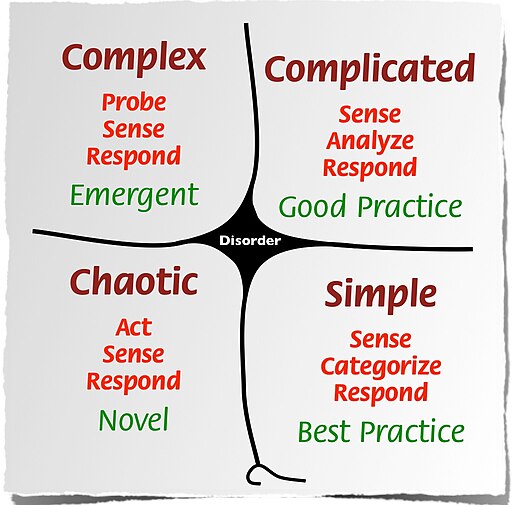
My reflections this week are coming from the conclusion of a term as well as some #HumanMOOC explorations. I’m focusing on why I teach, how I teach, and what I teach. It’s complicated! But more importantly, it’s also complex! It involves my own learning, modelling visible thinking and doing it to teach it. It’s fluidly recursive between ‘good practice’ and ’emergent practice’ (as defined by the cynefin framework by Dave Snowden). It’s an infinite mobius loop that flips over and under – teaching and learning become one and the same. Interestingly, this loop of reflection is returning from a previous post (Work of a Different Kind).
After listening to The Rhizomatic Lense, Dave Cormier’s address at ICERI2015, I know that my teaching is becoming more rhizomatic than constructivist. This is resulting from frictions between open and closed teaching systems, between structured syllabus and free exploration, between outcomes that are targets for learning and personal reflective practice. It’s a foundationally different approach to teaching than any I’ve experienced. It’s complex.
Although it is complicated, there can be a set path to follow when designing a course or laying out a plan for student learning. Yet there is no ONE guide to guide all guides! There is NO one plan to plan all planning! As I crafted a ‘welcome cast’ for a new online course I looked for a guide or plan of what should be included, what sequence it should take, and how to create one. Turns out I need to write my own guide and plan to find my way through it! I learn to teach about instructor videos by learning about instructor videos. It’s complicated but there is a solution. It’s complex because there are many possible solutions for this one scenario.
Lesson planning and unit planning have been the bread & butter (or rice, beans or equivalent food staple) of teaching new teachers how to teach. Teaching to write a lesson plan has an outcome – it’s a well crafted, detailed lesson plan. There is no doubt that planning lessons are complicated – lots of threads to weave into a plan of action (classroom management, learning outcomes, sequence to follow, materials to use, assessment strategies to employ, etc.). Yet the best planned lessons don’t measure up to the complexity of the teaching part. So many potential elements impact the actual doing of teaching, as any experienced educator can relate (particularly around holiday seasons).
So planning any video for online teaching or learning is complicated but not complex. There isn’t a simple solution when planning and creating video for online instruction since instructors, designers, equipment, context, content, and audience all impact the outcome. It’s complicated because more than one solution can evolve for each circumstance. An abundance of options and opportunities makes this process difficult (as I experienced this week). The complex part comes when video is used interactively, collaboratively, and subversively to be a catalyst, to create friction for student thinking. How I integrate this ‘welcome cast’ into the course design as a means to get students engaging and interacting in the first week of an online course will determine a basis for the rest of the course. It sets the tone and establishes my presence as the instructor.
But my rhizomatic experiences are impeding my constructivist practices. Good practice tells me to present my video as a model, ask students to create something similar, while providing multiple means of expression and sharing insights in a collaborative discussion about self in digital space. But when rhizomatic learning steps in, there are no clear answers. When the community is the curriculum and the direction is driven by those in the learning space, be it ‘garden or stream’ (as it is described in the #HumanMOOC), the integration of an instructor created ‘welcome cast’ video becomes complex. It requires some emergent practice or new ways of doing things. There’s no guide or ten-tip solution.
How do I teach? I’ve used a constructivist methodology. My role has been as a catalyst or provocateur. My planning shapes events so students are doing, engaging and creating followed by reflective action resulting in peer and self assessment. The focus has been on me, as instructor and subject expert. The learning events, sequence and assessments are designed and planned before the learning begins. It’s been complicated but there’s always been a potential solution.
 How will I teach? I don’t know. I can honestly say it’s emerging. It’s complex and uncertain. Ideas and techniques are rhizomatically growing in a garden community of like-minded ‘irises’ (Dave Cormier’s analogy in the keynote video). The #HumanMOOC is my current learning space where I’m exploring ideas of open curriculum, learner direction, fluid syllabus, self assessment and instructor as learning participant. My ‘welcome cast’ is a work of friction.
How will I use this video to instigate and agitate student engagement? Is that the purpose of a ‘welcome cast’? Should it be a one way delivery of an instructional statement or the opening line of a conversation? How do I teach about critical digital literacy from this very first contact? Any answers are welcome. Take some time to comment.
https://vimeo.com/user46457816/
References
Attribution of image of cynefin framework – By Snowden (Own creation, own work) [CC BY 3.0 (http://creativecommons.org/licenses/by/3.0)%5D, via Wikimedia Commons
Irises image – Pixabay, no attribution required.
Video attribution – By HJ.DeWaard Attribution-NonCommercial-ShareAlike 4.0 International

 I teach with technology. I teach new teachers to teach with technology. I talk to teachers about teaching with technology. I am immersed and swim deeply in the ed tech pool. It’s in my Twitter, my blog, my personal learning focus. I am a connected educator. My connections reach out from my computer and mobile devices to local, regional, global friends, colleagues and like minded learners. How did this happen? Where and when did it happen? What do I do to find ways to stay closely connected while maintaining a sense of self? How do I disconnect when this is part of my persona?
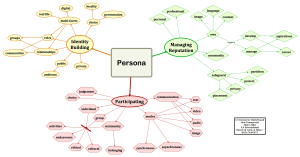
 So what’s in a name? This became part of a discussion last week when
 Culture and context will determine how you begin. Our ‘real’ names evolve from our backgrounds (family, geography, nationality). Our persona and presence in digital spaces emerges from our name. When developing an identity, our name is one way of being recognized. It is partnered and supported by our digital image. Despite the fact that the digital world may not forget, our digital names and images can be renovated and changed to suit our potential. Our names should not limit our existence in digital space or put up barriers for others to find us. In digital spaces, we can even teach others how to say our name (
 Why is it so challenging to publicly declare our names in digital spaces? What are decisional factors when selecting or creating accounts in digital spaces? Do you keep it REAL or do you use an interesting moniker?

 I’ll focus on COLOUR (or color for those who spell it without a ‘u’). I personally like to keep the ‘you’ in colour, as I’ll explain in a bit.
 Analogies and metaphors for colour are prevalent in art, literature, and history. Colour can determine regional and national culture. Colour is used to determine belonging, status or brand identification. My travels to Peru helped me realize the importance of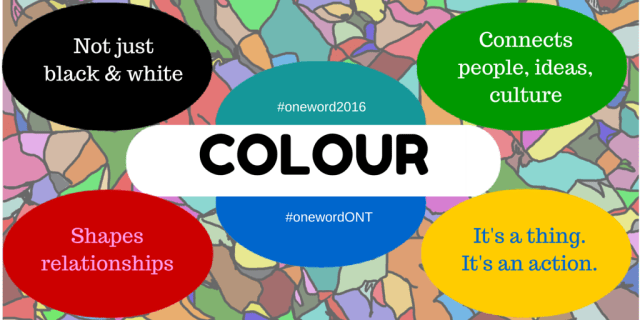

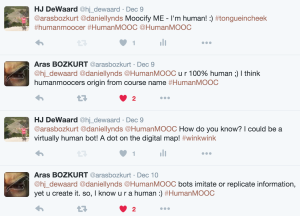
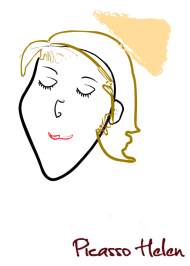 This week’s conversation with Kate Bowles about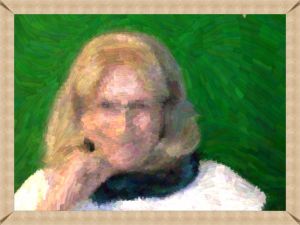


 Five Flames 4 Learning