Out of my comfort zone!

It’s unsettling. It’s got me wondering what I’m doing and how I get myself into these things.

I’ve been pushed and pulled into new and interesting spaces. I’ve been encouraged to share and talk in places and spaces that are new to me. It’s leaving me feeling very much out of my comfort zone. I need to recognize my culpability in this process. I’ve allowed this to happen. I could easily say no and the comfort of familiarity will surround me. But that’s ultimately why I accept the challenge, why I agree to do it. These opportunities change me. They are catalysts for my continued learning.

This week I’m participating in Research and Innovation Week events at the university where I teach. I’ve prepared a poster (for the first time) and a presentation to showcase the work I’m doing in the Faculty of Education. To make this more comfortable and easier on my emotions, I’ve focused on the work and how it improves learning for students. I’ve shifted the focus from me to a ‘third thing’ – the work, the learning, the theoretical foundations behind why and how I teach. With this imposter syndrome lurking in my mind, since I don’t see myself as either a researcher or an innovator, I’m forging ahead to showcase what my students are learning and achieving.

meme-to-startThis week I’m participating in a locally organized one day conference for educators (Push Your Learning).  It’s a chance to hear about innovative work being done by educators in classrooms since the presenters are teachers sharing their work with students in a variety of contexts and topics. I’m excited to be presenting on topics of interest to me. As part of this conference, there is an Ignite session where I’ve been invited to talk about digital citizenship. It’s all about ‘entertain us and make it quick’. Teachers talk in front of people all the time. I’ve presented at conferences more often than I can remember. But this Ignite is causing some discomfort. The idea of talking to a large group, with 20 slides that I’ve created, for 15 seconds per slide, for a 5 minute engaging presentation is pushing me way out onto thin ice. I’m more about conversation than presentation so this is definitely an uncomfortable place. But I’m learning lots about myself, my interests, my topic, and the logical flow of ideas as I prepare for this event. Is there a place for Ignite style presentations as part of teaching and learning?

I’ve been participating in a MOOC that has me exploring some uncomfortable truths about a shared Canadian story. It’s a course exploring Reconciliation through Indigenous Education from the University of British Columbia. It’s week five and despite the challenging topics, ideas and materials, I’m learning in this uncomfortable space. I’ve taken on this challenge because of my #oneword for 2017. Allyship is meaningless without gaining some perspective. My understanding is shifting as I learn with others about Indigenous history, world views, and how learning happens in traditional ways.
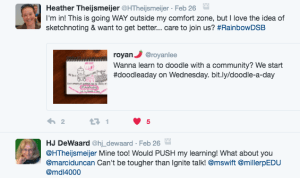
screen-shot-2017-02-28-at-8-32-04-amBeginning tomorrow, the month of March will shift me into the uncomfortable space of drawing as a means of expression. I’m picking up the challenge from Heather Theijsmeijer to join into the #DoodleADay event proposed by Royan Lee. I’ve decided to try this challenge to push myself into using my Instagram account with purpose and to re-ignite my sketch noting that started after attending a session with Sylvia Duckworth and reading Nick Sousanis’ blog posts. Let’s see what creativity evolves.

life-begins-at-the-end-of-your-comfort-zone-imgurAs I walk through these uncomfortable spaces and events, I remember that I’m only in them because of choices I’ve made. I’m here by design. I am learning and experiencing which makes it all worth while.

What’s getting you out of your comfort zone?

Where are you going to chose to participate that makes you feel a little uncertain?

What choices will you make to keep learning and exploring?


Image: http://imgur.com/gallery/OmnImn9


Posted in Learning | Tagged , , , , , , , , , , | Comments Off on Out of my comfort zone!

Safer Internet Day – what will you do?

sid-logoDid you know? February 7th is recognized globally as Safer Internet Day.

Did you know? With so many days recognizing various events, organizations or people, this day may be under the radar for you. As a citizen of a global community, this one is worth keeping on your annual days to remember, if only as a trigger to think about how you can become safer on the internet.

This year’s theme – Be the change: Unite for a better internet!

My effort to be the change will revolve around awareness and action. I’m becoming more informed about resources available to educators, parents, and children in Canada to support internet safety. I’ll be doing an internet audit on February 7th to make changes to support my own internet safety and security. I’ll encourage and call for action by others across Canada (#SaferInternetDayCA) to take small steps to BE THE CHANGE and unite for a better internet.

Safer Internet Day? There’s an org for that!

The Canadian Centre for Child Protection is the supporting organization here in Canada. The Safer Internet Canada web site promotes this annual event.  Free resources and lessons are available from this site as well as from the Safer Internet Day global website where a searchable collection of resources come in a variety of languages and topics.  The Safer Internet Day Infographic provides a snapshot of this organization and how it is working to promote and bring awareness to some essential digital literacy topics. You can do your part to ‘be the change’ by following on Facebook and/or Twitter using #SID2017 and #SaferInternetDay. Unofficially I’ve started using the #SaferInternetDayCA since it’s not currently in use for any other purpose – setting a new trend for others to join into this conversation!

AWARENESS as Priority One

This is by no means an exhaustive set of resources, but ones that are available through the Canadian Centre for Child Protection website for FREE (and for educators, free without a hidden agenda or sign up is good!)

  • The Door that’s not Locked – resources in both official languages, this site contains resources that are grade specific, free and downloadable including Internet safety tools, cell phone safety, personal boundaries and online games
  • Kids in the Know – an interactive safety program for students from Kindergarten to Grade 9 including many free and downloadable safety tip sheets and resources when supporting student safety both online and offline
  • Zoe & Molly Online – specifically for parents and educators working with students in Gr. 3-4 on the topic of online and personal safety. Free, downloadable comic book, Smart Board files and safety lessons are provided.
  • What’s the Deal? for grade 7-8 and It is a Big Deal for grades 9-10 are two resources available to download with accompanying teaching guides to help families and educators respond to issues of cyberbullying, how to respond to unsafe situations online, relationships and identifying when to get help. Also available is the resource guide School and Family Approaches to Intervention and Prevention: Addressing Self/Peer Exploitation for those supporting youth in addressing incidents of self/peer exploitation.
  • The National Cyber Security Centre in the UK provides infographics on topics of password security, cybersecurity, cyberattacks, BYOD and managing your information risks. These are worth a look for personal and organizational change to raise awareness in building a safer internet.
  • Media Smarts Canada is a go-to site for all kinds of resources and supports for learning about media and digital literacies, not just for one day but year round! It’s a rich restore of information, research and lesson plans for teachers, parents and anyone who wants to learn more. The Helping Kids Make an Impact When They Witness Cyberbullying would be a great read as a Safer Internet Day action item.

ACTION as Priority Two

Here are some suggestions, from the many you may find when you start searching for safer internet strategies. Pick ONE actionable item to try on February 7th, 2017. Tweet about it using the #SID2017 and #SaferInternetDayCA hashtags. Post your actions to Safer Internet Day on Facebook. Take one step!

  • Do an internet or digital identity audit. You may only get to step one, but a marathon is only completed by putting one foot in front of another. I’ve been through step one and now may ‘level up’ by analyzing my digital identity.
  • Listen to Episode 73: A Safer, More Private Internet (Part 1), Tide Podcast produced by Doug Belshaw and Dia Barnes. Then take a look at the resources & links provided.
  • Review passwords and password protection/storage options. Try this guide to password security. I don’t currently use a password management system but may look at this option – then there’s only one master key to rule them all.
  • Read stuff from Me and My Shadow
    • Tracking … So What? 7 Things We Know You’re Going to Say – debunking common arguments around data and privacy
    • The 8 Day Data Detox – start cleaning up your digital life. While I’ve tried a self imposed digital detox before, and found the experience refreshing, this will have to wait until a later point in the year when my work schedule won’t suffer as a result of my withdrawal from all things digital.

u-thereThat’s enough to get anyone started. Let’s make this an event that everyone is thinking about, talking about, acting on. It may not get the traction or reach of the #BellLetsTalk day, but it’s worth spreading the word and sharing the conversations about this topic with each other and with our children.

Together we can BE THE CHANGE and UNITE for a BETTER INTERNET!

Hey, U THERE?   What will you do on February 7th? 

Posted in Teaching | 2 Comments

The Power of ONE WORD

One word can have significant impact, if it’s the right word for you. I know this from experience. This is my third year to use the #OneWordONT challenge to reflect, connect and contribute – thanks Julie Balen. You’d think selecting ONE WORD would get easier with practice. It doesn’t.

Each year brings new perspectives, challenges, insights and resolutions. This year is no different. As I reflect, as we often do at the beginning of a new year, I recognize that I’ve been changed by the focus that ONE WORD can bring. My first word was HEART. This became my call for the year to find ways to share heart-felt moments and to open my heart towards others. Last year, I chose the word COLOUR and this focus changed the lens I used, particularly when listening to news stories. It opened my eyes to new perspectives and points of view. It shifted my cultural stance. I can now see that these two words have incrementally changed me – they became words of ‘friction’.

The power of one word is not insignificant! ONE WORD can gently guide, carelessly catapult or instigate change in unknown ways throughout the coming year. I need to reflect and select my ONE WORD with care.

I’ve taken time to play with some ideas and tried out some one word contributions from previous participants (found on Twitter and blog posts). I’ve been digging into an online dictionary and thesaurus. I’ve been tinkering with words in VisuWords and Lexipedia since these are great places to play with words.

I’ve left myself open to opportunities. Thanks to some serendipity in my search, I’ve decided to select a word will provoke and catalyze change in my life. This word does not sit easily on my mind or slip effortless from my lips. It’s a word that will make me uncomfortable in the coming year. Its a difficult word to figure out, but I’ve got a whole year to work on that. This word is going to push me out of my comfort zone.

My ONE WORD is ALLYSHIP.

First, I’d to thank Rusul Alrubail for this word. Her blog Through These Words… was the starting point. I’d never heard or seen this word before Rusul introduced it to me in January 2016. Serendipity brought me back to this post where I had commented on Rusul’s thoughts. She responded with words that resonated and have come back to challenge me yet again.

“Thank you so much for stopping and sharing your thoughts here. I agree with you, remaining silent in open spaces is easy for many reasons, and listening and speaking often is hard. But I think here’s where we should push outside our comfort zone and do something that’s hard but still support our belief in solidarity and social justice. It was hard for me to write this post, no matter how lightly I touched the surface of inequality in education. But through the many conversations I’ve been having with other educators, I was empowered to share my own thoughts. So thank you for sharing yours🙂”

Second, I’d like to thank the Digital Media Lab 2016 conference for bringing together two diverse people who’s voices shared personal experiences about the need to speak out and stand together – Digital Dreamers: Jose Antonio Vargas talks with Henry Jenkins. As I come to try to define this word, I’m looking for models and actions to guide me. Henry Jenkins, a media researcher, talks about his background and how he’s come to stand (sit) on a stage with Jose Antonio Vargas. The whole talk is worth a listen, but I think that Jenkins describes ALLYSHIP starting at about the 18 min mark.

I’d also like to thank Gord Downie, who is bringing ALLYSHIP to Canadian contexts. This is a model that will resonate and shape my understanding and actions into this coming year. I’m not the only one who is finding inspiration in Gord Downie‘s actions and words. Just read Joseph Boyden’s seven love songs for Gord Downie in Macleans Magazine to gain insights. I’d have the same reaction if I met either of these ALLYSHIP mentors.

allyshipFinally, since this word has been ‘calling’ me out, I’ve been looking for definitions to help me shape and guide my thinking. Turns out, it’s not so easy to define. Rusul has provided some insights in her blog post. I came across this Guide to Allyship that expanded on some of the ideas. I’ve tried to capture the connected ideas into a word cloud that may help in the coming year. You can take a closer look at this word collection on this interactive Tagul word cloud. Best part is, I’ve got a year to work with this word and learn more about my own ALLYSHIP. The new year awaits!

What’s your ONE WORD for 2017?

Posted in Together | Tagged , , , , , , , , | 1 Comment

Why I listen – your voice is compelling

djfdklj-copyI listen because your words compel me.

I listen because your voice enriches my life.

As you share your voice, through text, words, images, voice recordings or videos you add depth and meaning to what it means to be human. I just wanted to let you know – I’m listening.

This goes to you Laurie Azzi. You wrote about Why I Write. Your voice resonates and echoes against my own memories of car rides, unfortunate accidents that shaped my childhood, and images of myself, shaped by my past and present.

This goes to you Chris Friend. Your post on Hybrid Pedagogy – Giving Voice to Written Words –  compels me to create more resonance with my writing. You words spoke to me about why Laurie’s ‘text evokes a sound’. You encourage me to ‘talk more’, to ‘write to make ourselves heard’.

This goes to you Maha Bali, Rebecca Hogue and Autumm Caines. Your voices bring together a chorus of others through Virtually Connecting. Voices that share ideas and celebrate discourse. Voices that don’t always agree but come together to collectively complement or harmonize through conversations and laughter. I often return and re-listen to completed Virtually Connecting conversations and video recordings using the text from the close captioning to clarify and simplify the symphony of voices.

This goes to you Doug Belshaw and Dai Barnes. TIDE podcasts bring your voices into my world while I drive. Ideas spill through my sound system and I listen attentively to your kitchen conversations that weave your experiences through and between my own. Each week I listen and enjoy the humour, the insights and the connections you explore with new ideas. Engaging in your conversations using Anchor.FM was an opportunity not to be missed. Your invitation to participate in the recording of TIDE #71: Slacking off (Pt 2) encouraged me to ‘talk more’.

I’ve recorded my own voice (My Voice is My Choice) as a practice of self-listening. Hearing my written text through a voiced recording, played back in stops and starts, helps me clarify writing, reading and the flow of ideas. As Chris Friend reflects “spoken text offers an opportunity for richer involvement with the content”. For me, it’s a reciprocal relationship between sounds and written ideas.

In the past I’ve asked my students to record themselves and post these recordings to their blog. Using openly accessible digital tools, they tinker while recording their voices for digital space. The mere thought of recording, let alone listening to their own voices, can be daunting. The technical challenges of creating a recording and embedding this to their blog is a process of making decisions, shaped by digital identity considerations. Some use SoundCloud while others explore alternatives such as Audacity or Garage Band. Weaving a link back to their blog sites or embedding the audio file adds to the decision making process. Students problem solve as they work through the many little steps to make this happen since digital difficulties and issues often emerge. Digital fluencies are modelled as they find ways to make things work to suit their personal needs and preferences, honouring the voice being shared, while also considering their audience.

diamond-on-music-sheetThere are many voices in my digital spaces, more than I can mention. These voices colour my days with shades and tones. Each day brings an opus of ideas through a variety of texts, images and recordings. Sometimes it’s the assignments students create to complete course expectations. Other days it’s serendipity that leads me to listen deeply. Colourful concertos in digital spaces can become masterpieces of dissonant and disparate voices to explore.
Just thought I’d reach out and let you know – I’m here and I’m listening.

Your words are compelling.


Image Attribution:
Hands – https://morguefile.com/search/morguefile/5/words/pop
Diamond on music sheet – https://morguefile.com/search/morguefile/5/diamond%20on%20music/pop 


Posted in Talking | Tagged , , , , , , , , , , , | Comments Off on Why I listen – your voice is compelling

As Easy as Riding A Bike

The saying “it’s as easy as riding a bike” really got me thinking!

What are the things I do in open digital spaces that just come naturally?  Now that I’ve done them so many times, worked through the issues and challenges of learning how to do them, what mindsets do I take for granted?  How do I figure out how to do things digitally? Why is being ‘open’ my default mode or why can I keep trying things out, digitally speaking – like riding a bike?

I may not always consider the difficulties others face when trying digital and technology tasks for the first time. For me, learning how to ride a bike didn’t happen until well into my teens. It wasn’t easy on an old hand-me-down bike since I lived on a road that, with a gravel base, was not great for stability. But once I mastered riding, I now enjoy biking since it comes easily to me. What essential bike riding habits and mindsets do I take for granted in my current, smoothly-paved-pathway environments?

These thoughts link to my teaching practices. Last night, in the final class for the semester, we watched this Backward Bike video.

I encouraged my students to talk about all the ‘backward bike moments’ they’ve faced during this course. It was intended to be a reflective activity for them, but it became more so for me. As an instructor of digital teaching and learning, I take for granted the skills and mindsets I bring to the learning. I’m working from a solid foundation of experience with digital technologies.

My ‘backward bike riding’ moments, when using digital technologies for teaching and learning, are not the same as my students. I’ve developed a set of skills to deal with ‘backward bikes’. I’m supported by a whole network of helping hands, ready to reach out when I’m wobbly or catch me when I fall. There are individuals in communities that encourage me, talk me back onto that bike and cheer when I get things going the right way. My students are getting on that bike, many for the first time and there are challenges and frustrations they face that I need to understand and find ways to support.

Teaching and learning in open digital spaces is full of ‘backward bike’ moments. It takes a persistent and dedicated effort to master that bike. Whether it takes you two weeks or eight months, you have to keep getting on that bike in order to get it to work. It’s not going to feel comfortable until the switch in thinking happens. Even then, it’s not going to be easy. Having a connected, collaborative, supportive and open network helps you get through the challenges of ‘riding’ that digital teaching and learning ‘backward bike’.

This brings me to why and how this backward bike thing really hit home for me. I’ll thank Donna Miller Fry for the provocation.

Some may read this, stop in their tracks and declare ‘that backward bike looks scary’. Others may be intrigued by the way these backward bike bits fit together and want to give it a try. For me, this flow through digital pathways is as easy as riding a bike. I instinctively know where the pedals are, how to turn the handle, when to brake (break), how to slow down for bumps, and how to pick myself up when I fall sideways. This was a fairly smooth ride through open digital terrain even though I’m still new to Hypothes.is and I’ve never used Anchor.fm before. Having others watch, learn, judge, critique or just enjoy seeing my open, digital ‘backward-bike’ experience is part of the joy of riding.

5-things-i-know-for-sure-copySo, back to the reflection my students are doing as part of their digital teaching and learning. I’ve asked them to write a final blog post about the Five Things they Know For Sure. I’ll use this same framework here. For any of my students who may be interested, here are the five things I know for sure. I’m using the experience of backward bike riding as a metaphor for teaching and learning in open digital spaces.
  1. You may not see much of a difference in what it does or how it works, but teaching and learning with open digital technologies CHANGES EVERYTHING. Just as the backward bike exposes ingrained and rigid ways of thinking, so too will working openly with digital technologies change your knowledge and understanding. Once your default mode is OPEN and DIGITAL, there’s no going back to the ‘old’ ways of doing things.
  2. You WILL fail and fall OFTEN. It’s part of the experience. You will need patience with yourself, with other backward bike riders, and with the bike (although you’ll be tempted to chuck it into the ditch on occasion)! Be persistent, keep getting on and keep trying. One day, it’ll feel natural and it won’t be so hard.
  3. You can’t do it alone, but you need to do it yourself. You’ll need helping hands to steady your wobbly moments. You’ll need supportive friends to pick you up when you fall off. But in the end, YOU need to ride that bike – your friends or colleagues can’t do it for you.
  4. Knowledge DOES NOT equal understanding. Proficiency and fluency does not mean you know how to apply digital technologies to teaching and learning. Once you master the bike, it’s a whole other thing to try teaching someone else to use their bike. You may be fluent using Twitter but linking it to your teaching and classroom collaborations may not logically follow. Your knowledge about digital tools and technologies will help, but understanding comes through application, experience and reflective practice in the classroom.
  5. Don’t avoid learning – it’s worth the frustrations. Once you do learn to ride that backward bike, there are choices and opportunities open to you! It’s worth the effort! Just like in Amsterdam, where bikes rule the roadways, digital technologies are everywhere in today’s teaching and learning landscapes. You may think you can do without and teach without having to learn how to use digital technologies. Some think it’s just another novelty, another new phase that will pass. But you’ll quickly realize that bike riding is the only way to get around. It doesn’t mean you need to ride all the time or even in the same direction others are going. Once you’ve learned how to use digital technologies in open learning spaces, there are choices and opportunities that weren’t there before. There are paths open to you that wouldn’t have been seen or experienced. There are people and places where your voice can be shared and heard. Don’t avoid that new digital technology – take a ride with it and share your experiences along the way.

In the end, it’s about trying.

Whether you find it easy or hard, with persistence and practice, you can rewire the pathways in your brain to work comfortably and confidently with open digital tools and resources. For my students, who may read this post, I’m hoping you enjoy the ride! It may not be as easy as riding a bike, but it is well worth the efforts!


Image credit – CC BY HJ.DeWaard using Canva, Morguefile image of bike

Posted in Teaching, Technology, Together | Tagged , , , , | 3 Comments

A bit after BIT16 – reflections from a cave

The annual Educational Computing Organization of Ontario conference has just ended with echoes of many voices ringing and events resonating in my mind. There may be many blog posts that come from this ‘reflection-on-action’ since those who attended can certainly say it was impossible to reflect-in-action. So here are some top take-aways from my bit of BIT16. (As you read through, think about how these elements could transfer to your teaching practice.)

Bring a friend, meet a friend, make a friend.   The post conference conversations happening on Twitter (#BIT16) echo how important it is to have colleagues from your school, district or region with you, to share the BIT16 experience. Although I was on my own, there were so many familiar faces from local places that my alone-ness didn’t feel lonely.

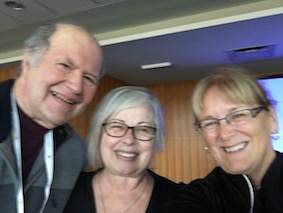
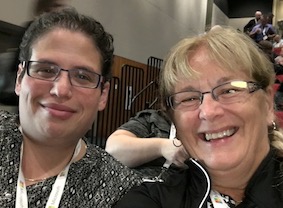
img_0662The conference gave me a chance to meet many virtual friends in a face to face space. They remind me of the important role of conversation and listening in my teaching and learning – so happy to chat with Aviva DunsigerBrian AspinallSusan Kwiecien and more! Renewing digital connections at a BringIT conference is inevitable.
Making new friends from hallway conversations or session discussions will last beyond the conference and continue into digital spaces. Thanks Alanna Callan for the rich conversations and common connections we discovered. Thanks Cathy Beach for going deeper into the vision and actions with A Kids Guide to Canada. So BIT16 was a great place to bring a friend, meet a friend and make a friend.

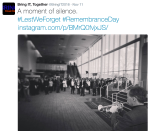
screen-shot-2016-11-13-at-10-02-36-amRemember!   BringIT 2016 is and will continue to be a place to remember those who are gone, or could not attend, but are not forgotten. Since one of the days of this event was Remembrance Day, the conference organizers prepared an emotional tribute to honour and remember. The sound of the trumpet echoing through the conference halls brought tears to many more eyes than my own.

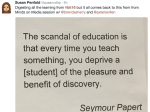
screen-shot-2016-11-12-at-4-18-11-pmReferences and tributes to the work of Seymour Papert was evident in many sessions and presentations. Remembering the impact of this foundational edu-tech thinker and builder was an important way to honour his voice.

With the recent news of the death of Canadian Leonard Cohen, many conversations included personal memories of songs and lyrics written by this poet and writer – a voice remembered.

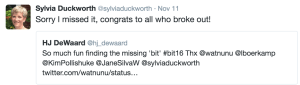
Sending shout-outs to those who couldn’t attend using the #NotAtBIT hashtag was a way to engage others in virtual conversations. Tagging and tweeting was a way to stay connected to others who were missed but not forgotten (Donna Miller FrySylvia DuckworthLeigh Cassell and many more)!screen-shot-2016-11-12-at-4-48-32-pmscreen-shot-2016-11-12-at-4-44-53-pm

For me, it’s great to be able to remember the conference experience by returning to the Lanyrd site as well as the BringIT Together Facebook page. Both are rich repositories of resources, videos of sessions, links and connections. The keynote talks by Shelley Sanchez Terrell (@ShellTerrell) and Jesse Brown (@JesseBrown) were live streamed and archived on the Facebook site so I can remember those ‘aha’ moments.

screen-shot-2016-11-13-at-10-50-42-am

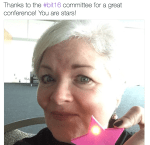
Let Your Star Shine  There were over 300 speakers at BringIT 2016. That’s a lot of ideas and conversations about all kinds of interesting topics. It takes courage to stand in front of one or one thousand and share your light. Stars shone in every conference session, in the learning hall, innovation stations, the DemoSlam, Ignite talks, and the HyperJam. There were so many stars shining in so many ways. There were stars from previous conferences and those who were new to the stage. Every ONE was a light for someone else. Thanks to David and Norma Thornburg (@dthornburg), some of us left with a 3D printed star that lights up!

Find your place in the #BIT16 space!  There were so many sessions and events at this conference that it was a challenge to sort out and decide where to attend. I found myself returning to the Lanyrd site repeatedly, trying to find what fit my interests and needs, then changing my mind at the last moment.

img_0690

With Norma & David Thornburg

I applied David Thornburg’s ideas of learning spaces (campfires, watering holes, caves, life) as I travelled through the conference events. I found sessions and moments that fit the description for each of these learning spaces – the watering hole was the social in the learning hall at the end of the day and in the BreakOutEDU play space; the campfires happened in most sessions where conversation around the topic expanded my learning; cave moments happened in silent reflection with a coffee or curled up in my hotel room. It was a great honour to meet David and Norma Thornburg and hear about their work with STEM projects (lanyrd.com/sfcxgc) – one bright campfire moment that is a highlight from the conference.

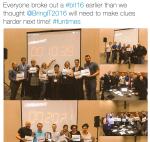
screen-shot-2016-11-13-at-11-52-59-amIt’s all about the ‘US-IES’!  When it comes to enjoying time together the motto of BringIT 16 and BIT16 was all about the ‘us’ – fewer selfies, more we-sies and us-ies. The roving frame that found it’s way into many conference spaces added to the feeling of friendship and inclusion. Photos together were encouraged and celebrated – especially at the BreakOut EDU event! Cameras were turned to capture groups, gatherings with others into the photo frame to share the moments of learning. The ‘us-ies’ became a way to connect and have fun (including a few photo-bombs)!screen-shot-2016-11-13-at-1-30-54-pm

Tinkquiry counts!  After BIT16 ends, it leaves a legacy for those who attended and those who could not. Individuals and groups will continue to think about, tinker with and inquire into the ideas and explorations from BringIT16. Thanks to Peter Skillen (@peterskillen) and Brenda Sherry’s (@brendasherry) play with words, the ‘tinkquiry’ will continue and it all counts for deeper learning. Part of this notion of ‘tinkquiry’ is deeper reflection on conference experiences such as this one by Doug Petersen – Observations from a conference and Aviva Dunsiger’s post – Breaking At #BIT16: My Self-Regulated Conference Experience.

Just a bit of my learning from #BIT16.

Where have you posted your campfire conversations, your watering hole learning or cave reflections. Link them here – leave a URL in the comments or share them through the @BringIT16 Facebook and Twitter sites.

Let the learning linger and the ‘tinkquiry’ continue.

Posted in Learning, Talking, Teaching, Technology, Together | Tagged , , , , , , | 4 Comments

Radical Doubt and Digital Identity – “Dubito, ergo cogito, ergo sum”

I am! I exist! My digital self is me! Do I doubt about digital identity or about myself? Absolutely. What do I really know about my digital self?

As I reflect on digital identity and digital citizenship, I’m waxing philosophical. Descartes, as shared on Wikipedia, explored the deeper meaning of life. The phrase “I doubt, therefore I think, therefore I am” prompted this reflection, but Ken Bauer and iTec Semana i Course, 2016 was the catalyst. Descartes postulates that thinking and knowledge results from radical doubt. How does this apply to digital identity?

As I reflect about personal doubts and digital identity, I’m asking myself

  • Is digital persona uniquely different than physical, in-the-flesh identity?
  • How or where do we behave or share our ‘selves’ differently in digital spaces?
  • How do affinity spaces shape my digital presence?
  • Are digital identities a ‘transitional technology’ (Dave Cormier)?
  • Do we own our identity or do we rent or lease a presence in digital space?
  • Is our digital identity enriched as we give away parts of our selves, as we share with others?

meme-to-startI won’t pretend to have the answers to any of these questions. There are doubts in my thinking about digital identity. Some thoughts about digital identity are expressed here.

Personal identity is a transitional technology. Who I am in digital spaces and what I share changes over time. Iterations are inevitable. In digital spaces, I live in perpetual beta! I have littered digital space with bits of myself, my thinking and where I’ve shared digital creates. My identity is shared differently in specific communities, conversations or events. Iterations and permutations or my self exist as I think about what I’m doing, learning or making. John Seely Brown talks about play and tinkering as a way of knowing. Digital identity is a work in progress and I tinker on my presence as I make and remix. In shaping my digital identity I need to be aware of ‘tethered capitalism’ (Belshaw, 2016) and who owns my presence. I’ll carefully consider the costs (financial, reputational, effort) as I transition through digital spaces.

Digital identity is crafted through conversation. Sharp edges of opinions or rock solid thinking is smoothed and shaped through talking and listening to diverse and contrary voices. This happens in physical, face to face places and can be amplified in digital spaces. My identity has shifted as I participate with really smart people. When I listen to dissimilar voices, I accommodate new ideas into my mental schema. As I present or argue in social media, my identity is crafted or renovated. As I collaborate in digital spaces, I become a connector of ideas, people, and resources.

Media matters as digital identity is constructedMarshall McLuhan is known for the phrase ‘the medium is the message’. In terms of my digital identity, the media I chose to create and share will shape the message of myself. My digital voice, personal biases, interests, and distractions will be evident through my media messages. As I share in digital spaces, I need to consider the audience, production and text. Media matters in digital identity to honour and respect digital selves by producing and sharing material that is inclusive, accessible and empathic. For example, when making memes or movies, who’s voice is present or absent, disenfranchised or excluded. Are my audio recordings accessible to all or are hearing impaired persons excluded from my media message. Where and how do I share my intention, bias or explicitly identify the filters I’m using in my media texts? Media choices make my identity open and available if that is my choice.

Digital identity is enriched by being humanly present. I make choices in all social media spaces on what to share and how to share it. Being honest, personable and hospitable is part of my personality and this will come out in digital texts and media. While I’ve become more comfortable sharing my face in image or video, I can certainly understand when others are not. Beginning with a ‘third thing‘ in a blog post or tweet can build a human element to your digital presence. Digital identity does not need to share personal or private information but does need to be personable, relatable and contextual. Digital identity is enriched by sharing the physical, human side of your being. I’ve share my self using a ‘shoe selfie story‘ as a low barrier digital activity to sharing my self in digital space.

Digital identity does not happen in isolation. Yes, you can think it’s all about you, but it isn’t. Your digital identity is a relationship, certainly with your self, but ultimately, it’s in relationship with others. In digital spaces it’s often easier to find your affinity group. James Paul Gee talks about affinity spaces in terms of participatory presence in gaming communities, but it is applicable to all digital spaces where we build relationships. Choices in how and when I shift and move from periphery to central activator within an event, activity or community will redefine my relationship with others. Collaboration shifts my my position within affinity groups. My place in digital networks shapes my digital identity.   It’s important to find your affinity space and participate in some way. These will become your circles of influence, your trusted guides and your personal digital network.

Digital identity is yours to build and control. Digital identity doesn’t just happen – it takes time, effort and attention. Managing a digital identity is important. Starting and building identity doesn’t happen in the short term. Like any project manager knows, you have to have a plan, make selective decisions and manage the work over the long haul. Taking control is the first step. Curating your identity is part of the never-ending process. Uniformity can set your identity as unique in a world full of digital personae – see Amy Burvall’s website or blog as an example of how to select and consistently use design principles in a digital presence. I actively curate my digital makes, creates and productions in order to shape my presence in social media spaces. I monitor and act when issues or responses are required. Be willing to share your work through Creative Commons licensing to build a better internet.

So, back to the philosophy – when thinking about digital identity, doubt can be a catalyst for action. There isn’t any one person actively using the internet and digital media who doesn’t have doubt or faces fear when putting their ‘selves’ out there. Doubt can prompt and shape decisions as you build your identity online.

What are your doubts and how will you overcome them? Who will you become as you reflect on your doubts about digital identity?

“I doubt, therefore I think, therefore I am” – digitally me.

References

Belshaw, D. (2016, Sept 15). Digital Literacy, Identity and a Domain of One’s Own.

Gee, James Paul. (n.d.). Affinity spaces: From Age of Mythology to Today’s Schools.

Bauer, K. iTec – Digital Identity Course site

Posted in Talking, Together | Tagged , , , , , , , | 8 Comments

It’s Not about Raising My Average

“We are each the average of the people we hang out with and the experiences we choose.”

Seth Godin, June 13, 2016. (Seth’s Blog)

When I really think about it, my average is, well …., it’s average. It’s not in the realm of Canadian astronaut Chris Hadfield. I’m admittedly and certainly not astronaut material. Topics of conversation in my average day aren’t about rocket science or black holes. But I enjoy reading and experiencing stuff that challenges my thinking. I enjoy connecting to people who talk about difficult topics where I’ll mostly listen to learn. But raising my average isn’t why I do what I do. I’m not consciously choosing experiences that will improve my average. I’m not connecting to smart people to make myself appear smart. I risk and push myself into open spaces to raise my awareness, to learn something new. I step out of my comfort zone to show others it’s OK to risk when learning new things by reaching out and talking to smart people.

Seth Godin talks about the courage it takes to raise your average, as an individual or organization. It takes guts to seek out and engage with people who express ideas and sharing information that you know nothing about – it’ll show your averageness. It’s a risk! Agreed! To seek out and actively engage with smart people and challenging ideas is daunting, but in the end, it will make a difference. It’s not about raising my average, it’s about getting in the game! It starts by taking that first step! It starts by reaching out to others!

Over the past year, I’ve had to dig deep into my courage bank to talk to smart people about challenging topics. I keep reminding myself that this is my choice. I’m stepping out of my comfort zone! It’s a necessary risk to improve my practice as a teacher and learner.

  • When attending the  New Media Consortium Summer Conference, sharing experiences as a conference correspondent and talking to leaders in educational technology were risks with the inevitable outcome of raising my thinking. I raised my game by attending conference sessions, town hall meetings and participating in hallway chats.
  • Participating with Virtually Connecting, in conferences of interest, as a virtual or on-site buddy, I continue to push myself out of comfortable spaces to expand my thinking. Participating at NMC2016 as a Virtually Connecting onsite buddy, I engaged in rich conversations with Autumm Caines, A. Michael Berman, Bryan Alexander, Maya GeorgievaGardner Campbell, and Dr. Ruben Puentedura. Virtual buddies also share challenging ideas and creative thinking that improves my understanding.
  • With the Digital Pedagogy Lab in Prince Edward Island and Virginia, I stepped into virtually spaces with smart people that made my mind work really hard. I turned to video annotation to clarify my understanding. This resulted in a collaboration with Rebecca Hogue and Britni Brown O’Donnell (Transcription as Deep Listening) that raised awareness by going deeper into an exploration of listening in virtual spaces. That’s why I keep risking and stepping into the open. It’s a conscious decision to risk and work hard at engaging in deep thinking.
  • Collaborating and co-constructing in CLMOOC this past summer raised my creativity. Sharing time and space with participants kept me on my toes, virtually speaking. Humour, insights, honesty, support and understanding were shared in good measure and resulted in an  experience in unbounded creativity and media production.

As I begin a new academic year, joining together with students I’m just getting to know, I’ll continue to step out of my comfort zone and risk going deeper. I’ll support students as they step out of their comfort zones by learning something new in digital and media spaces, many who will be blogging for the first time.

Together we’ll deepen our thinking through rich conversations about difficult topics when teaching with media and digital literacies. Ideas and challenges will continue to spark new directions of thinking for us. Collectively, we’ll seek out and connect to smart people who will share ideas we’ve never thought of before.

It’s not about raising our average. Our understanding and awareness will raise up and go deeper when talking openly about topics that challenge our perceptions, biases and beliefs.

It’s not about raising your average. It’s about improving yourself and understanding your part in our collective humanity.

It’s not about raising my average. It’s about being the best I can be to make a difference for others. That’s the risk worth the reward.

How will you raise your understanding? Who will you reach out to? How will you do this? Where will you risk yourself to gain inspirational rewards?


Posted in Learning, Talking, Teaching | Tagged , , , , , | 1 Comment