What are my options?

Agency is about taking control of my own learning. Agency in teaching includes making the right options available for my students. Designing spaces that meet the needs of all students means that universal design for learning principles (UDL) need to be applied. Since I design digital spaces that are used within physical places, I need to carefully review my options.

What are the options students currently have in my courses?  As I examine the choices in the courses I teach, I discover that options abound, yet there is more work to do. While a variety of digital technology is prominent, students also engage with low tech options with paper, markers, and physical sticky notes.  What are the options for students to ‘show what they know‘, the HOW of learning?  It is important to provide choice and voice in physical actions, expression and communication, and executive functions.

Providing options for physical action should consider the motor demands of tasks. This includes how students respond physically and how they navigate in physical and digital spaces. Within digital tasks, options to use text, image, video, voice recordings are provided. Dragon dictate and Word Q are available and encouraged. One student produced a Quicktime screencast as part of her inquiry into this Ministry of Education licensed software. Here is her video recording.

image of visual poster

Visual Poster using QR codes

  • One way that students connect digital spaces with physical places is through the use of QR codes. Students create visual posters that include four or more QR codes linked to digital content relevant to their topic. Many students create new collections or content to support their inquiry.
  • In one class, students collaboratively drew an image of today’s student. This was completed using a method of their choice – digitally or hand drawn. Some were done in Cacoo while others were completed with chart paper and markers. Here is one example.

Providing options for expression and communication means that text is not the only choice. To show what they know students can apply a variety of media. Using a variety of media is not only encouraged, it is expected.  Sandbox tasks allow students to explore a variety of Web 2.0 tools while applying critical media and digital literacy skills to their work. Students create blog responses, produce comics that show understanding of concepts, and engage with others using a variety of online collaborative tools. For each physical class, my option is to introduce and use one new tool, activity or resource that my students can apply to their own teaching/learning practice. They learn by DOING IT.

  • image of padlet use in the classroom

    Using Padlet

    Padlet was used to explore student understanding of the topic of constructivism.

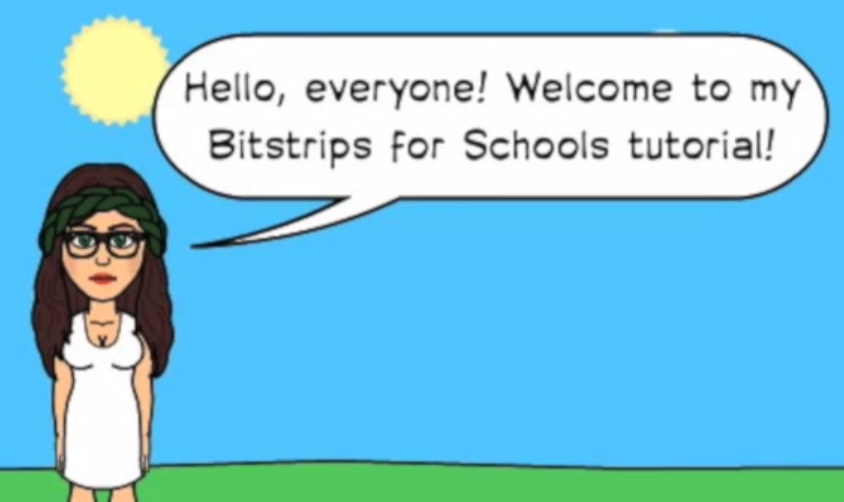
  • Students create a comic strip to demonstrate what they learned for a variety of topics. Once they have created their digital avatar in Bitstrips, the class photo shows a who’s who of digital characters.

    image of bitstrip comic

    Using Bitstrips to communicate ideas

  • Students responded to an online survey form to identify their stance toward the issues relevant to media literacy.

Providing options for executive function will focus on self regulation, sustained effort, persistence, being personally aware, and metacognitive tasks. This can include goal setting, to-do lists, calendars, and checklists. Feedback for improvement is essential. Reflections on, in and of actions is integrated into the process and final products students create.

image of using Reminders

Using REMIND

  • Remind is one tool used this year but it is uni-directional (from teacher to student). While it provides a way for me to connect to students to remind them of tasks to do or ideas to remember, it does not ensure they apply self regulation or sustained effort.
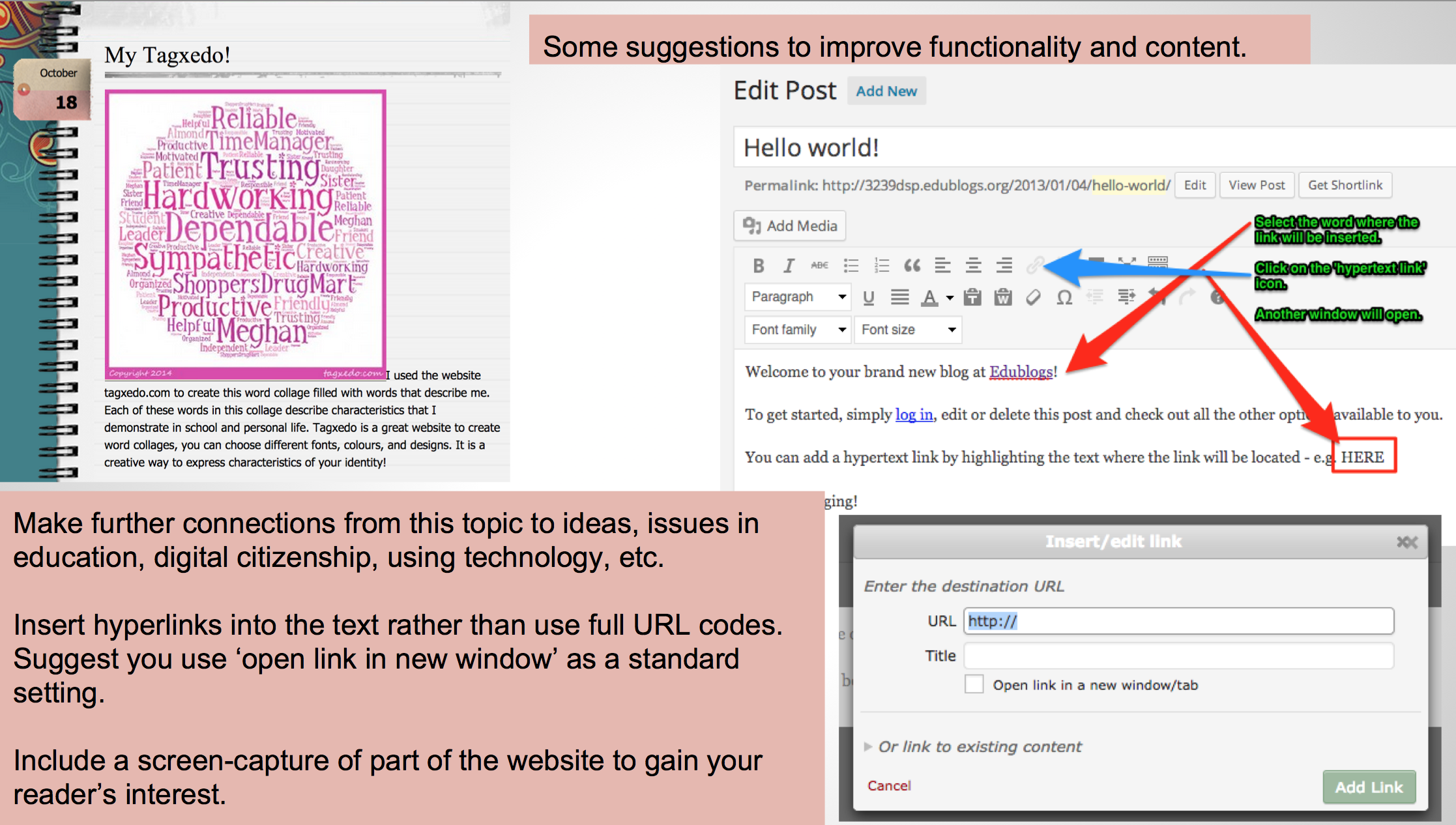
  • This year I provided feedback to students as a google presentation using skitch to annotate images captured from their blog sites. While this was an effective way to show students what I noticed or where to make improvements,  it did not ensure that students understood my directions or suggestions.

    image of feedback

    Providing specific feedback

  • For the major assignment in one course, students create their own rubrics using a framework constructed in class on a google spreadsheet. Once students craft their rubric, they submit them for feedback prior to submission with their final project.
As I reflect and review my options, one area of the UDL principles for action and expression will require increasing potentials for agency for students. Engaging students in options for executive function can include collaborative calendars, to-do-lists, checklists and goal setting. Providing these options will ensure that students take control of their own path through their learning within these courses.

Universal design for learning principles can transform teaching and learning.  The application of UDL to course design will be my option to transform personal agency in teaching and learning. If you want to provide options for your students, you can learn more about UDL on the SOOC4Learning site and follow on Twitter #SOOC2015.

Posted in Learning, Teaching, Technology | Tagged , , , , , , , , , , , , , , , | Comments Off on What are my options?

Making Meaning Makes Me

image

Meaning Maker Making Meaning

Listen to the author reading this blog post.

I am what I make! I make sounds, movement, shapes, text, and things. I am a shaper and maker, tinkerer and creator in the physical space where I exist and in the digital space where I engage with ideas, images, and others. I am shaped by my relationships with these processes and products. I learn by doing IT! When I cook or garden, things are shaped by my actions. I become shaped by the things I create. When I teach, I am shaped by the actions and relationships with content and others. This, in turn, shapes my teaching self.  MacLuhan, Piaget, Papert, Friere and Vygotsky all have a place in my making and learning.

image of elements within learning environments

Frierian Learning Environments

As I conceptualize Frierian learning environments for the final week of my Hybrid Pedagogy and #moocmooc experiences, I become more comfortable with notions of educational emancipation and critical pedagogy. At the same time, I am less comfortable in my perceived role as agent of change. A vision where academic disciplines develop an inclusive understanding that is the basis for authentic dialogue with indigenous knowledge (Blikstein, pg. 6) resonates with my underlying beliefs about schooling and learning. The recognition of valid learning occurring within the world and of the world needs to be acknowledged. It’s a reciprocal relationship between academia and real world learning. Having a foot within both worlds (schools and higher education) makes me a prime example of practitioner as academic, or is that academic as practitioner.

But this is not enough. The models and case studies shared by Blikstein bring forth a call to action for the integration of indigenous wisdom into closer relationship with academic knowledge. To humanize and empower learners in my own local contexts, but also at all levels of global educational endeavours, requires me, the academic, to make and be re-made by the generative themes in my local communities. With my own academic environment leading the way in teaching & learning with/from indigenous people, I look toward my own work in academia and the disconnect with local indigenous communities. With the focus of my own course in Media and Digital Literacy, how can this empower and humanize the indigenous heritage of oral storytelling? Where are the opportunities to bring academics into relationship with local ‘ways of knowing’?

Blikstein reminds me that I need to “focus on the role of technology in such initiatives, as an emancipatory tool for mobilizing change in schools and empowering students” (pg. 2). By permeating the microcosm of digital storytelling and working through the “microscopic choices of what to teach and what to value, who has voice, who ultimately decides” (pg. 25) a rich and relevant learning environment can be created. Through the experience of digital stories from the rich roots and oral traditions of indigenous storytelling and blending this into the academic realm of knowledge building networks, there is a way to realize the Frierian learning environment. In this way, my course work and teaching can build links between traditional curriculum and indigenous expertise (Blikstein, pg. 24)

image for making digital storiesLevering digital technologies as an agent of change can happen with digital storytelling because of it’s ‘chameleoneque adaptivity’, the unique variety of resources, the complexity of the projects, the mobility of content and products, and the multiple entry points (Blikstein, pg. 22). This brings me back to where I started. Through my own work in digital storytelling, I am transformed. By engaging in digital storytelling within teaching and learning environments, I become a change agent. I call others to action. I make a space for change of self and story, within learning communities. So, I end with a call for your actions to tell your stories of indigenous knowledge. Where do you share and make change happen, in dialogue, when sharing your stories?

References

Blikstein, P. (n.d.). Travels in Troy with Friere: Technology as an agent of emancipation. Retrieved from http://www.blikstein.com/paulo/documents/books/Blikstein-TravelsInTroyWithFreire.pdf

CBC News. (Feb. 20, 2015). Lakehead University in Thunder Bay, Ont. to mandate indigenous learning. [web page] http://www.cbc.ca/news/canada/thunder-bay/lakehead-university-in-thunder-bay-ont-to-mandate-indigenous-learning-1.2963546

Posted in Talking, Teaching, Technology | Tagged , , , , , , | Comments Off on Making Meaning Makes Me

My Voice and My Choice

My voice represents me.  When I record my voice and listen to the audio file, I am given an alternative view of my-self. How I sound to others is not always the way I think I sound. Over the past few weeks I’ve explored the options of adding my voice to digital spaces, not always with the expected results. I am a reluctant writer, but when I read my work aloud, I hear the errors, omissions, or misunderstandings that come from word choice. I am now consistently using this read aloud technique to edit and enhance the self reflection of my writing.

This inquiry into adding voice to the written word started with a blog post titled Faithful Listening by Jonathan Sircy. This article piqued my interest since it was a novel way of  ‘reading’ student assignments, evaluating work and looking at personal bias in assessment. I thought about the importance of voice and choice in writing (Six +1 Traits), and the impact reading out loud has for students (World Read Aloud Day).

This led to my first attempt at adding my voice to a blog post (Stories to Bank On), using a snowball microphone and recording with Audacity. I exported the file in mp3 format and then uploaded to Audioboom with the hope of embedding the digital file into my blog post.

My second attempt worked the same way, but this time I also uploaded the audio file to Sound Cloud which allowed me to embed the sound file directly onto my blog post (Agent of Change in Six Feet of Snow). This was a step closer to what I wanted to achieve. Providing a reader with the option of hearing the blog post ensures that reading the written text will no longer be the barrier. Text readers will to the job, but my voice will add the richness of emphasis, pacing, and personalization to the reading experience.

audio recording of parts of this blog post

Click on image to hear My Voice using Adobe Voice

This past week, in the SOOC4Learning course that I am working on, we were asked to look at  apps that would extend and enhance how we represent materials for our students. I chose to look at Adobe Voice since I was not aware of the functionalities in this app. I found some examples (see references below) and examined the affordances that Adobe Voice can add to my writing.  In this way, I hoped to gain an additional tool to provide voice and choice for my students.

There were several challenges to overcome – writing a script, finding the images to go with the text, recording a fluid and seamless reading of the script, and managing the file once completed. For students with difficulties in oral communication this tool would not be an easy one to use. While Audacity allows for cutting and clipping out errors as material is read, Adobe voice allows for short, brief passages that can be recorded and replaced. Sharing options are limited and downloading the file is not an option.

This experience extended my awareness of another tool available for students to add their voice to their reading and writing. Adobe Voice provides a clear and compelling recording with all the functionality of robust audio recording tools. While Adobe Voice will remain in my digital tool collection, it may not be the ‘go-to’ option when creating personal audio files.

Resources

Wylie, Jonathan. (May 8, 2014). The new Adobe voice: Digital storytelling with style. [online blog post] http://jonathanwylie.com/2014/05/08/the-new-adobe-voice-digital-storytelling-with-style/

Cook, Vicki. EDL584. (?)  http://voice.adobe.com/v/5VCjtK_9rtF 


Posted in Talking, Technology | Tagged , , , , , , , , , , , | 1 Comment

My personalized learning

My personal journey into the ‘MOOC’osphere and personalized learning happened in two ways at once. I’m participating in a free, online course offered through ISTE and also participating in an online book club where we are reading and discussing Personalized learning: A guide to engaging students with technology by Peggy Grant & Dale Basye.

The online MOOC is delivered through the Canvas learning management system. I’ve experienced and worked with Moodle, Blackboard and Desire to Learn (D2L) but had not explored Canvas before signing up for this course. The participants truly are from all over the globe. Amazing to see the range of job descriptions and purposes for learning about personalized learning.

image of book coverFor week two, our inquiry takes us into defining the terms that are connected to personalized learning – individualized and differentiated. Knowing how they can morph and by used as synonymous to personalized learning can lead to clarity for the concept being explored.  According to the author, Dale Basye, personalization includes ‘the whole enchilada’. It refers to preferences, interests, paced instruction, academic goals, method, pace, curriculum and content. However, the difference lies in the role students play in the process. “Personalized learning involved the student in the creation of the learning activities” (Basye). Not only does the teacher respond to student interests and needs, students are actively involved in managing their own learning – taking control and ownership. They are active participants in the process. Teachers become activators and facilitators of the learning. Technology plays a critical role in providing purposeful, meaningful and engaging personalized learning. Teaching and learning, with the power of technology, becomes the “ultimate collaboration between teacher and learner” (Basye).

concept map

Concepts of Personalization

In order to get a better understanding, I turn to concept mapping to help visualize the connections. This concept map is created in a free, web based mapping tool called Text2Mindmap. The link is found here: text2mindmap.com/mHaeKfT

Questions around my own personalized teaching and learning will be explored throughout this inquiry. My philosophy of education and personal pedagogical practices align well with the notion of personalized learning. With the work I did within the Masters of Educational Technology program at the University of British Columbia, my own learning was very much personalized. I chose my own path and work schedule. I chose the topics and explorations that worked best for me. The tasks allowed me to make decisions and apply my learning energy to dynamic learning opportunities. There were multiple layers of support that resulted in energizing relationships with instructors and classmates. My personal experiences were a model for me in how personalized learning feels.

Now I apply these same techniques and strategies to my own work with my students, with some success. Systemic and organizational barriers will impede the progress towards true personalization, but elements of choice and voice will continue to be my mode of co-teaching and co-learning. Throughout this course, I will continue to explore further to see where changes can result – as Ken Robinson states, in an organic and non-linear fashion.

References

Basye, D. (Aug. 2014). Personalized vs. differentiated vs. individualized learning. Retrieved from https://www.iste.org/explore/ArticleDetail?articleid=124

Patrick, S., Kennedy, K. & Powell, A. (Oct. 2013). Mean what you say: Defining and integrating personalized, blended and competency education. iNACOL. Retrieved from http://www.inacol.org/cms/wp-content/uploads/2013/10/iNACOL-Mean-What-You-Say-October-2013.pdf

Robinson, K. (Feb. 2010). Bring on the learning revolution. Retrieved from http://www.ted.com/talks/sir_ken_robinson_bring_on_the_revolution

Posted in Talking, Teaching, Technology, Together | Tagged , , , , , | Comments Off on My personalized learning

Registration not required!

When passionate learners gather together, registration is not required. Participation and interest are essential. A commitment to self-renewal is critical. But registration is not required – just drop-in and learn.  #moocmooc and ‘the hole in the wall‘ are examples.

5340808741_1cc193cfc8_zCasual learning, as a way of acquiring knowledge, is the flip side of formal, scheduled learning events. These impromptu knowledge events (in both physical and digital spaces) are not necessarily a push to dis-establish schools. Rather, they are the flip side of the mobius loop of learning and antithesis to formal learning establishments. Both are necessary. Both provide opportunity for sharing knowledge. Formal and informal ways of learning exist in a push-pull relationship within an ever shifting loop altered by individual, cultural and community needs. Personal preferences and purposes will continue to determine how individuals access, engage and acquire education.

My mother was an avid learner with little formal schooling. In her later years, she became a voracious participant in formal and semi-formal courses. She connected to courses and learning spaces that were free, open and interesting. She passionately applied new learning to art, writing, conversations and reading. Her passion for self-renewal continued until declining health, prevented action. Despite barriers and challenges throughout her life, she ended her days ‘deliberately choosing a life of action’ where knowledge was an aspect of her ‘being in the world’ rather than a commodity to be exploited. Her lifestyle enabled spontaneous independence to pursue passions and relate to others with similar interests. Her legacy for learning, as Illich relates, was one of ‘conviviality’ – “individual freedom realized in personal interdependence, and, as such, an intrinsic ethical value” (Smith, pg. 13).  My mother’s model for learning-as-life resonates with my own knowledge networks.

As I reflected on the topic of de-schooling, I discover that I am as comfortable in formal, structured learning settings as I am in free-flowing learning events (masters level courses vs #moocmooc, SOOC, book clubs, etc.). Both are acceptable and desirable ways for my continued convivial learning. But what’s true for me is not true for all learners. Many, my son included, find frustration, pain and anger in formalized school settings and yet continue to strive for meaningful learning in unstructured and convivial ways – with individual freedom and personal interdependence. The options need to be kept open for these learners as well as those who find comfort in structure.

I also discovered that Illich’s ‘learning as action’ is found within my ‘learning webs’.  Illich describes four types of learning webs (Smith, pg. 14). These go beyond the current notions of PLN’s (personal leanring networks) or PLE’s (personal learning environments). These learning webs belong to the people, with the people and in the hands of the people, not organizations or formalized structures of learning. These networks operate more like ‘affinity spaces’ and informal learning commons.

  1. reference services to educational objects – eg. Toronto library innovation hub, networks of ‘maker spaces’ e.g. Site3 in Toronto as well as MakerKids locations
  2. skill exchange e.g. my daughter’s making wedding bands experience, edCamps (upcoming HigherEdCamp)
  3. peer matching – finding a partner in inquiry – e.g. edmatch? Twitter (only seven degrees of separation from anyone else in the world!)
  4. reference services at large – service directories, Youtube (find how to do anything with user-created videos)

The reflection of Illich’s learning networks can be seen within Suguta Mitra’s child driven education (the hole in the wall) experience in India or the school-bus classroom, where learning occurs despite all odds. Joy in learning for the sake of knowledge is purpose and reason enough for many. Grandfather teachings and grandmother educators (in the granny cloud or SOLE-self organized learning environments) are necessary ‘ways of learning, being and knowing’.  Informally being in relation with others and with knowledge is one side of the learning loop. Formal and regulated learning is an important flip side for some to unlock learning. There are many learners who need the structured, goal focused, externally directed ways of learning in order to succeed. Balance between formal, structured settings and the free-flow learning environment can provide opportunities for individual choice and voice.

Seeing both sides of the loop will help us ‘disenthrall’ (Robinson) ourselves from the current singular focus on formal, schooled versions of education. It will avoid throwing out the old versions of schooling to the detriment of providing only one track for learning. Flipping the loop and moving from one side to the other can result in non-linear learning through serendipity  and, from personal experience, the best learning happens serendipitously – where no registration is required.

References

Robinson, K. (Feb. 2010). Bring on the learning revolution.

. Retrieved from http://www.ted.com/talks/sir_ken_robinson_bring_on_the_revolution#t-645689

Smith, M.K. (1997-2011). Ivan Illich: deschooling, conviviality and the possibilities for informal education and lifelong learning’. The encyclopedia of informal education retrieved from http://infed.org/mobi/ivan-illich-deschooling-conviviality-and-lifelong-learning/

Posted in Learning, Teaching, Together | Tagged , , , , , , , , , , , | 3 Comments

Agent of change in six feet of snow!

Listen to a recording of this blog post as you read.

It’s difficult to be an anarchist in six feet of snow! As I shovelled and wrangled with the snowblower this past weekend I thought I’d be a bit anarchistic and not follow the rule to clear the sidewalks in front of my house. Being compelled by a law to remove the snow just didn’t have any weight after working on the driveway for over an hour. By then, the snow, and the machine I was manoeuvering, was getting the better of me. But my civic conscience rolled the ‘wheels in my head’ and “thought controlled the will and used the individual, rather than being used by the individual” (Shantz, pg 126).  My civic duty to my neighbours overcame my resistance. The children who walk along my street on their way to school would be in danger from the rushing traffic. I made the decision to act in a responsible way and continued to remove the snow until the sidewalks were cleared.

Wheels in the Head

Wheels in the Head

My mind turned to how anarchy in education works the same way as my snow blowing experience. For classroom teachers or school leaders, it’s the “two levels of the wheels in the head”, identified by Shantz, that control the will.  These levels – the everyday life and the ideals that move people to sacrifice themselves for the greater good – are identified by Shantz as the mechanisms that prevent freedom. But, just as my own wheels rolled over my will to leave the sidewalk unplowed, the will to clear the sidewalk to make a difference for others emerged. This will to make a difference is very much alive in today’s schools. It may be subverted by the machine that operates education (standardized testing, data management systems) there are many individuals in my own educational communities that ‘break the law’, as Thoreau suggests. They make decisions about the injustices, just as Thoreau states, to either ‘let it go’, and hope it will wear smooth or wear out, to consider if the “remedy will be worse than the evil” or break the law if the injustice “requires you to be the agent of injustice to another” (Thoreau, p.7).

6275391782_96df045a4e_mThe term anarchist conjures images of disorder, lawlessness, and nihilism. Educators who make individual decisions, in the best interest of their students or their school, are not viewed as anarchists. These individuals take on the role of agents.  Their agency, when taking control in these classroom/school contexts, makes them agents of change. Educators act from principle, perception and performance of right, to change things and relations (Thoreau, pg 7). Teachers and school leaders frequently make choices to think for themselves and act from their own conscience, rather than the fear of punishment, when injustice impacts children.  There are many who follow the rule “Be kind whenever possible. It is always possible” (Dalai Lama).  This doesn’t make them anarchists – there are still rulers and rules – it makes them agents of change, in small ways that make a difference every day.  Just as my singular actions with a snowblower in six feet of snow, agents of change are everywhere, doing small acts of lawbreaking or law following, for all the right reasons.


References

AJCI, (May 20, 2011). Gears. [image] Retrieved from https://flic.kr/p/9K8Kcr

Becraft, A. (Oct. 23, 2011). Gears of war. [image] Retrieved from https://flic.kr/p/ayx2m3

Shantz, J. (2012). Spaces of learning: The anarchist free skool. Retrieved from http://rebels-library.org/files/anarchistpedagogies.pdf

Thoreau, H.D. (1849). Civil Disobedience. Retrieved from http://xroads.virginia.edu/~hyper2/thoreau/civil.html

Posted in Teaching, Together | Tagged , , , | Comments Off on Agent of change in six feet of snow!

Agency – Give or Take?

Alternate title: Sit long, listen hard, talk lots!

The ownership and authorship of agency was a challenge for me this past week. It has caused me to read and reflect, reread and revisit readings.  I lurked and listened in digital spaces.  This has not been an easy idea to visualize, through any lens, in order to gain clarity.  This concept still sits heavily in my mind as I think of my own role as an educator of soon to be educators.  Can I enable agency or empower others? Are my students taking agency as they take ownership of their learning?  Is it a give and take?  Is agency something that can be given? If so, how?  One realization that comes from my reflections is that agency is not a commodity that can be banked through a give and take.  It emerges through relationship and reflection.

3590904689_5d277122af_mThrough reflection comes understanding.  Ideas gain clarity when viewed through the various lenses of time, events, empathy, revisits or contextual changes.  I think of the image of the eye examination tool where various lenses are applied to ‘see what you see’ or don’t see in many cases.  I’ve tried on various lenses this week – Maha Bali’ & Shyam Sharma’s Bonds of Difference, Ann Gangne’s Agency and Reclaiming Student Demographics, Chris Friend’s Listening to Students and Keith Hamon’s moocmooc & Critical Pedagogy. Each one provides a slightly blurred image of my own understanding and vision of ‘agency’. I had to search for a definition of agency to help clarify – ‘a person or thing through which power is exerted or an end is achieved’ (Merriam Webster Online Dictionary).  From this definition, individual agency in learning is envisioned as taking control, exerting autonomy and setting directions.

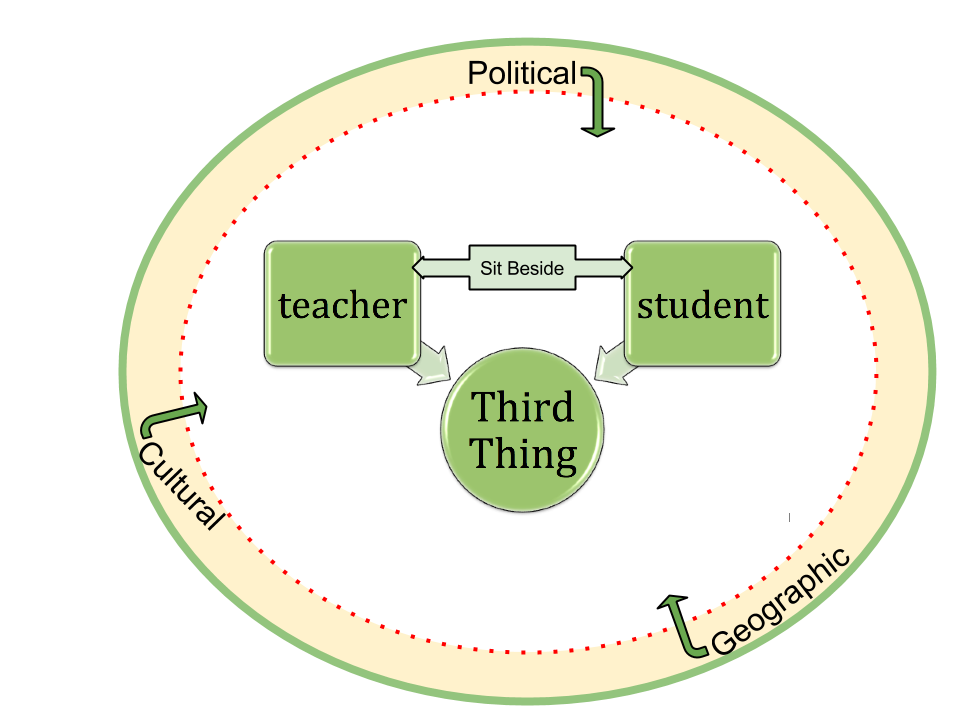
Awakening agency is not a matter of giving or taking.  Agency results from reflection within relationships.  As a teacher, I can no more give a student agency than I can give them motivation.  Agency is gained through reciprocal reflection and action, from student to teacher, from content to context.  As a professional, I cannot take agency without understanding myself as I learn within political, geographic and cultural contexts.  For professional agency, my relationship with learning comes from within, not from external sources or resources.  Certainly the external forces will impact my agency but it is not taken or given by those forces.

Agency-2

Agency in Learning – The Third Thing

Agency is achieved when the focus of the teacher/student relationship begins with the ‘third thing’ (Palmer) and ends with understanding each other.  This ‘third thing’ can be the content, concept, problem, big idea, issue or learning object around which the learning occurs. When you and I, teacher and student, sit beside each other, examine and explore this ‘third thing’, talk about it, problem through it together, we learn first, but also come to know each other and ourselves.  Ways of knowing and ways of being are intertwined in our collaborative agency with new knowledge and strengthened relationship. As I do in my own teaching practice, I move to sit beside my student (or frequently squat down) to talk, listen and learn about what they are doing, thinking, or wondering.  Using metaphor or story is something I’ll  use to clarify thinking or to gain understanding.

Bali & Sharma, in Bonds of Difference: Participation as Inclusion, state “working with and through each other should not be seen as a liability or a hassle. It is a process that can transform us”.  As educators and students grow into the ownership of their individual agency, it is an opportunity to ‘invite participants from different contexts for genuine participation, to listen and learn from others, to enrich their own understanding”.  This can be within face-to-face classroom settings, around an issue “with the language of technique and methodology” (Hamon) or in a diverse, global, virtual discourse such as #moocmooc.  Individual agency emerges from the dialogue, critique, feedback and reflection in which each teacher/learner engages.  My agency within the classroom or digital space is not a give or take, it is an evolutionary and ever changing understanding of my place in context.  Agency evolves for my students as we engage in relationship over ‘third things’.

To conclude, I’ll respond to Ann Gagne’s question about how to ‘expand concepts of agency’ … with low tech or no tech’ – sit long, listen hard and talk lots! There’s no tech required, but tech can enable these conversations well beyond the time and space a traditional classroom context allows. To continue this challenge, how do you find spaces and places to ‘sit long, listen hard and talk lots’? How do your teaching practices allow for the emerging, evolutionary agency within your students or yourself?

References

Maha Bali & Shyam Sharma, Bonds of Difference: Participation as Inclusion http://www.hybridpedagogy.com/journal/bonds-difference-participation-inclusion/

Eye Exam, Flickr Creative Commons, [image]. https://flic.kr/p/6tjjRP

Chris Friend, Listening to Students http://www.hybridpedagogy.com/columns/featured/listening-students/

Ann Gagne, Agency and Reclaiming Student Demographics in Our Discourse (Or Looking for Giroux in a Haystack), http://allthingspedagogical.blogspot.ca/2015/01/agency-and-reclaiming-student.html

Keith Hamon, #moocmooc & Critical Pedagogy http://idst-2215.blogspot.ca/2015/02/moocmooc-critical-pedagogy.html

Parker Palmer, The Third Thing, http://www.spiritualityandpractice.com/books/excerpts.php?id=14443

Posted in Talking, Teaching, Together | Tagged , , , , , , , , , , , | 3 Comments

My Hysterical Performance

I’m a teacher and a woman, so I’m open to passionate conversations. I teach with intensity and focus. This week’s #moocmooc discussion relates to feminist perspectives in critical pedagogies. Nick Kearney’s comment to Lee Skallerup Bessette’s blog post Pedagogies of Care: A #MoocMooc Post has me responding with passion.

Nick writes “Passion is often related to emotion in opposition of ‘rationality’, but is it not more about intensity of focus, and the honouring of presence?”  The age-old patriarchal view of feminine ‘hysteria’ as an emotional over-reaction to events, issues or circumstances jumped to mind. Is passion a feminist domain? Do passionate teachers reveal themselves to be feminist in nature?  I’d like to think that it is more an intensity and an honouring of our true selves than hysterical response. Many male teaching counterparts who express themselves and explore issues are not automatically deemed ‘hysterical’. Rather they are seen as ‘manning-up’.

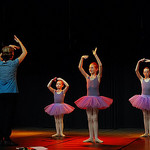
Ballet Preparations

Ballet Preparations, Flickr CC

As bell hooks revealed “teaching is a performative act”. Where would the performance be if passion is not revealed, intensity not exposed or emotional involvement not be encouraged. It is in the performance of teaching that the true self is revealed. Teachers (professors) become vulnerable from the ‘stage’ upon which they stand and express their topics, viewpoints, or focus. Yet this is a necessary “catalyst that calls everyone to become more engaged, become active participants in learning” (bell hooks). As a passionate educator, I reveal to my students the interest, opportunity and liberating learning from my perspective, exposing myself to them as a model. Empowering my students comes from my ‘honouring of presence’ with them, with the subject matter and with my ‘self’. This liberation creates a moment in which we can all turn and shift the focus from self to that of others or the subject matter, thus being free to learn.

Bell hooks’ statement “education is the practice of freedom” resonates and connects to this notion of passion. By intensely focusing and honouring the presence of self and others within the learning space, we become free to speak. Deeply listening and illuminating our true self will free us from boundaries set by stereotypes (gender, race, positions), oppressive ideals, or hierarchies of thought.  Are these feminist ideals? Perhaps! But maybe it’s my hysteria showing!

References

bell hooks. (1994). Teaching to transgression: Education as the practice of freedom. http://books.google.ca/books?id=z5wiAwAAQBAJ&lpg=PP1&pg=PT7&redir_esc=y#v=onepage&q&f=false

Skallerup Bessette, L. (Jan. 26, 2015). Pedagogies of Care: A #MoocMooc post. https://www.insidehighered.com/blogs/college-ready-writing/pedagogies-care-moocmooc-post

Posted in Talking, Teaching | Tagged , , , | Comments Off on My Hysterical Performance