Hospitality revisited

I’m coming back around to a topic that I’ve explored earlier (You are Welcome). Ideas are still trickling through my thoughts as I work on design and construction of online learning spaces. It’s about hospitality. Not just the type of kindness we show to friends and family, but the way we greet and treat others who are new, unknown and foreign. How we welcome people into a space says a lot about who we are, what we believe in, and where our persona shows.

As Canadians begin to welcome Syrian refugees into the country, this notion of radical hospitality is at the forefront of my thinking. What will we do to ensure each individual will find this new space a welcome and safe one? How can we structure and plan for their transition to our foreign shores? What design principles will make a difference as they navigate and wayfind into Canadian culture?

How I design for students new to online learning can also be influenced by ideas of radical hospitality. As the digital space is formed and structured, I need to apply empathy to all my decisions and considerations e.g. where artefacts are located, how navigational elements are located, or how content is presented. It’s easy to design open digital learning spaces – it’s not easy to design them well! Keeping the ‘audience’ or ‘individual’ in mind is essential. Since I will also be host and guide in this learning space, I can fix things as I go, but making sure there is a clear, clean and hospitable space when learners enter the course will leave a lasting first impression.

As I engage and explore collaborative spaces with others from differing backgrounds and contexts (@Bali_Maha, @Wentale, @yinbk), I reflect from my Canadian landscape about how radical hospitality helps build relationships. It’s more about designing hospitality into the culture of digital communities than about finding my individual place. It’s focusing on ‘the other’ and applying empathy, rather than an egocentric online stance. Within the Virtually Connecting community and events, I have had opportunities to explore ideas within a culture of radical hospitality.

So what are the elements of radical hospitality?

Radical Hospitality

This sketch note organizes some ideas from research and readings. These ideas fit for those who will structure physical ‘welcome centers’ and for those who are designing open online spaces.

Radical hospitality doesn’t just happen. It’s designed into the culture and structures by people, for people.

It’s not easy to design radically hospitable places and spaces that work well for the people coming in – but it’s worth doing well!

Some of this thinking was sparked by Gareth Jenkins TEDxPortofSpain talk Design Makes the Difference.

How do you already apply elements of radical hospitality? What’s so radical about them? What elements will you try that you haven’t tried before?

Posted in Talking, Together, Virtually Connecting | Tagged , , , , , , , | Comments Off on Hospitality revisited

Virtually connecting and the paradox of open

Within any experience where educational technology is involved, there lies paradox. Being able to identify these diverse and polarizing entities can influence the direction or stance for an individual response. It’s within the tension that exists in the balance that dynamic and powerful learning can occur. That’s why conferences are such a rich and fertile ground for people to connect, discuss, argue and disagree. Conferences can bring people together or they can polarize when ideas and beliefs become paradoxically entrenched. The conversations at the 12th Annual Open Education Conference (#OpenEd15) in Vancouver were rich in tension as individuals and groups attempted to define and describe open education and open education resources (OER).

Virtually Connecting provided opportunities for conference keynote speakers to engage in clarifying conversations with virtual participants about topics where a push/pull in open education discourse exists. It allowed individuals from distant locations to probe for deeper understanding. The human challenge, when participating in conversations from disparate contexts, as evident in many conference experiences, is to stand your ground on an idea or process rather than ‘turning to wonder’. Maintaining an openness of mind and viewpoint is not a conference requirement but ultimately leads to a richer conference experience.

With the VConnecting experiences at the OpenEd15 conference behind me, I can reflect on the ideas around “being open”. Each of the virtual conversations didn’t necessarily help dissipate the tensions but they certainly clarified the paradoxes evident in my understanding of open education and OER. Capturing the vocabulary from conversations about open education in a word cloud collection shows the diversity of ideas, concepts and issues.word cloud image

The impact of the conversation with Vivien Rolfe, Amy Collier and Jen Ross continues to resonate and create tension in my thinking about what it means for my own course content and learning processes. They discussed the notion of not-yetness in reference to open education and the polarity found in ed tech spaces that are measured, controlled and efficient rather than emergent, generative and diverse. Their concept of the ‘borderlands’ and ‘boundaries’ that define or contain open education challenges me to look beyond the containment of learning in digital courses and learning management systems (LMS).

The conversation with Martin Weller, Mary Burgess and David Porter brought forward the paradox of recording and sharing open education efforts while learning from the missteps or misconstructions of others. Paradoxes that emerged through this conversation included the tensions between experimental vs structured materials, sustainable practices and processes vs consistent finances and funding, as well as faculty engagement vs administrative endorsement.

Conversations with Mike Feldstein and Phil Hill illuminated the paradox between open education as a professional learning community or as a systemic movement toward an ill-defined goal of openness. Their exchange touched on the paradox between closed, contained LMS systems and open conversational spaces. This deliberation examined how to balance the tension between what IS the primary focus in open education conferences or conversations and other potential focus points e.g. textbooks, MOOCs, student agency.

Alan Levine and Brian Lamb’s dialogue, with Robin DeRosa and others, identified the paradox between functional openness and the promising potential of technology to create open web spaces. The discussion of SPLOTS (smallest possible learning open tools) contrasts to the use of an LMS for students and faculty to explore digital spaces in anonymity and ease of use. Using ‘training wheels for the web’ contrasts with the challenges of creating with open web applications.

Vconnecting logo imageThroughout these rich conversations about open education and OER there is evidence of an openness of thought and dialogue from each of the participants. VConnecting provided a space where ongoing discourse can occur beyond the walls or finite times permitted within the conference architecture. Topics of interest will continue to resonate openly beyond the conference framework. Open education will continue to be defined by the paradox between open and closed, between being and not-yetness. Examining, analyzing and exploring these paradoxes will help me hold them in tension.

The open dialogues that occurred at the Open Education Conference 2015 can be viewed at Virtually Connecting.org. While viewing these conversations, consider your definition of open education. Where are the boundaries or borderlands that encompass your understanding of openness? What tensions can you comfortably hold when working toward openness in teaching and learning spaces?

Posted in Talking, Together | Tagged , , , , , , , , , | Comments Off on Virtually connecting and the paradox of open

Wayfinding through course design with some habits of mind

I’m lost but finding my way. There’s sort-of-a-plan and a bit of a map but I’m wayfinding my way through. I keep checking the GPS and re-calculating my direction. I think I know where I’m located and I somewhat have a sense of where I’m going.

I’m working on the design of a new course, one that will be available for online learning at the Faculty of Education. I have guide markers and workflow maps while I create this new learning landscape. Designing in digital spaces is not new to me, but I’ve collected and distilled content and activities primarily for use in face-to-face learning places. Thinking about teaching teacher candidates within an online space is reshaping my work. I’m influenced by the Community of Inquiry framework and my Humanizing Online Instruction – #HumanMOOC experiences. While walking, wandering and wondering my way through these new instructional spaces, I’ve discovered that systems thinking and habits of mind are important considerations.
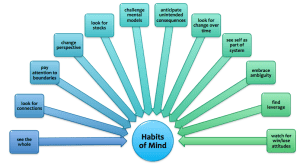
image of twelve habits of mind in systems thinkingLinda Booth Sweeney writes about Thinking about Systems and the 12 Habits of Mind required for ‘systems thinkers’. I’m considering these habits from the perspective of a designer of an online course – it’s a system of bits, pieces, interrelations, interactions, inter-activities and events that shape the whole. Each part needs to be arranged for ease of use, to capture interest, to trigger learning. The habits of mind can help guide my work while designing the whole course. Sweeney identifies the 12 habits: see the whole, look for connections, pay attention to boundaries, change perspective, look for stocks, challenge mental models, anticipate unintended consequences, look for change over time, see self as part of the system, embrace ambiguity, find leverage, and watch for win/lose attitudes.

I’ll consider each of these habits from the course design perspective.

See the Whole: It’s challenging but I keep stepping back and taking a bird’s-eye-view in terms of designing interrelated “wholes” or systems, rather than as single triggering event, or snapshot. I’m crafting the map of the course as I create and traverse the terrain.

Look for Connections: I’m going into this course design by assuming that nothing stands in isolation. Each element fits into the whole design and connects in some way to what comes before or after. I’m looking to build connections from digital to physical and natural spaces. I’ve been pulling threads into the course design to connect people, problems, or events to the learning objects. I’m designing so connecting students comes first.

Pay Attention to Boundaries: Understanding the semi-permeable and hard barriers of time and space will help me “go wide” when using and checking the course boundaries. Clarity in wayfinding will help students maximize time within the course boundaries. Examining and engaging time parameters helps me define the sequences and be critical to what is included and not included.

Change Perspective: By examining elements, activities, information, and sequences when changing the perspective to that of a student can increase my understanding. It’s essential to know what students see will depend on where they are in relation to the course content.

Look for Stocks: As I design the course I need to take stock, look for hidden accumulations (of knowledge, readings, resources, media) that can create delays and inertia or can spark new directions and interests. Strategically locating the ‘easter-egg’ and course hints can help me ensure that students find their way through challenging sections.

Challenge Mental Models: It’s difficult to design a course without challenging my own assumptions about how the course should work. My mental models come from my own online learning experiences and may limit my thinking around where, when, or how to introduce, explore or delve deeply into course elements. Examining mental models will ensure that cognitive dissonance and overloading content or activities is managed carefully.

Anticipate Unintended Consequences: This one is the most challenging for me since the design process is dependant on the ‘unknown’ student. Keeping a generic audience in mind, while walking through the loops of cause and effect and asking “what happens next?” can help me anticipate potential unintended consequences.

Look for Change over Time: It’s essential for me, as the course designer, to take a sequential walk through the course, finding the clearly marked or hidden pathways. As I wayfind, I need to see experiences as a result of previous events that lead to future activities. Maps and scaffolds will ensure successful change over time.

See Myself as Part of the System: As I design, I look for locations and options where I can potentially influence students from within the system, focusing less on blaming myself for making errors and more on how my responses (or my interrelationship with students) can beneficially support or scaffold student learning. I need to remember to design myself into the course since I will be learning with and from the students.

Embrace Ambiguity: As I design this course, I become more comfortable holding the tension of paradox and ambiguity. While time commitments exist when developing a course, it’s important to stand still at times and try not to resolve problems too quickly. The only assurance for me at the design stage is that ambiguity will occur at some points in the course and that I can and will embrace it when it happens.

Find Leverage: Within the design of an online course, I realize that solutions may be far away from the current problems I’m facing. I can track issues and work toward resolutions with an organized work-flow plan. With creative problem solving, I can look for areas of leverage, where one change can impact on the look & feel of the whole system.

Watch for Win/Lose Attitudes: This habit of mind challenges me to be watchful for elements that include a “win/lose” mindset. Keeping universal design for learning principles as a standard way of planning, interacting and creating course content will ensure all students can ‘win’. Knowing where student may feel they will not succeed is where I need to design into the course situations of high interdependence with peers and their instructor.

Reflection

Course design is a systematic process where humans create learning spaces for other humans to enter, engage, interact and gain knowledge. Habits of mind when humans, such as myself as I work on this design process, create knowledge building spaces ensures that the iterative, interdependent and emergent properties of course design are grounded and meet the needs of the humans who enter the system. As I wayfind my way through, I learn more about the application of the design principles for wayfinding in online spaces.

REFERENCE

Booth Sweeney, L . Thinking about systems. http://www.lindaboothsweeney.net/pdfs/systems_literacy_lbsweeney.pdf


Posted in Teaching, Technology, Together | Tagged , , , , , | 1 Comment

Bringing IT Together: How conferences build connections and conversations – BIT 2015 and Virtually Connecting

Are you going? It’s this week! The Educational Computing Organization of Ontario – ECOO BIT 2015 (@BIT2015, #bit15) – is happening in Niagara Falls Wed. Nov 4 – Fri. Nov 6. Bringing IT Together is the theme, and all things education and technology is the focus.

Can’t go (#notatbit15) but still want a conference experience? Read on and find out how!

Vconnecting logo imageIt’s a Virtually Connecting event – the first @VConnecting in Canada AND the first one held at a K-12 educational conference. You can be part of it! Participate virtually with an on-site buddy (me) to build connections and conversations. I’ll be joined by Patrice Torcivia from Cornell University (@profpatrice) as the virtual buddy who will set up and lead the conversation.

Conferences bring people together. ECOO’s been doing it for almost 30 years! It’s a place to share and exchange ideas, best practice, innovations and experiences. It’s not always easy for those who organize these conferences but it’s a valuable exchange of learning for those who attend. It’s not always easy for those who don’t get to attend where a sense of FOMO (fear of missing out) may be experienced. This year, you can join in or watch from virtually anywhere in Ontario, Canada or globally.

I’m preparing to attend and present at the annual ECOO conference this week. Just making some final adjustments to my Wednesday morning session on digital storytelling and inquiry. It’s almost time to pack and check all the necessary digital toys and tools. Twitter is keeping me informed and helping to make connections to others attending the conference (@BIT2015 and #bit15).

But BIT 2015 is going to be a different experience for me. I’m going to host a live, virtual conversation with one of the keynote speakers, Sylvia Martinez (@smartinez). She has agree to spend time connecting to people who can’t get to the conference. She will meet me after her keynote address to talk to people who wish to have a informal conversation with her in a google hangout. If you’d like to bring IT together and join, connect with me through Twitter or email (links below). This hangout will be broadcast live, so you can watch in realtime if you can’t join in. It’s also available for viewing after the event. The link for viewing is included at the end of this post. In this way, the conference experience is extended outward. It’s a way to bring IT together through informal, spontaneous conversations.

This opportunity is also bringing IT together for me in ways I had not anticipated. Since I’m about to meet her, I thought I’d do some research into what Sylvia Martinez is doing in ed tech spaces and what she may share in her keynote address at ECOO BIT 2015. Her work is interesting to say the least.

  • She was part of the team that designed the GPS.
  • Her work focussing on math resulted in the development of Math Blaster software – making a comeback from it’s 1990’s debut.
  • She advocates for empowering learners by allowing for tinkering, making and inventing in the classroom, particularly with 3D printing and MaKey MaKey.
  • Her book, co-authored with Gary Stager, Invent to Learn, is a go-to resource for educators when integrating ‘making’ into their teaching practice.
  • Her latest blog post How to Course Correct STEM Education to Include Girls presents ideas on how to move beyond discrimination and systemic bias for girls in STEM to integrate “real-world topics, real research, real projects, real tools and tangible technology”.

So it’s only natural to bring IT together with Sylvia Martinez using Virtually Connecting since it is a making and tinkering space. I’ve been virtually connecting as a participant in digital spaces to have conversations with people attending conferences focused on topics of interest (HASTAC, Digital StorytellingISSOTL, Educause).  This will be the first time I’m the onsite host and trying to connect with others both virtually to engage them in conversations with keynote speakers and physically while at the conference. If you want to learn more about Virtually Connecting, check out this web site where information, links and hangouts are collected.

If you are interested in joining into a virtual hangout, contact me through twitter (@hj_dewaard) or email (hj.dewaard@gmail.com) and I’ll send you the join link for Thursday morning’s session with Sylvia Martinez. I’m also connecting to set up other on-site conversations, so if you can’t get to ECOO BIT 2015 and would like to talk virtually with someone you know will be at the conference, let me know. I’ll be your virtual conference buddy.

If you can’t join, you can watch the conversation live or watch later. It’s located here:

Posted in Talking, Technology, Together | Tagged , , , , , , , | Comments Off on Bringing IT Together: How conferences build connections and conversations – BIT 2015 and Virtually Connecting

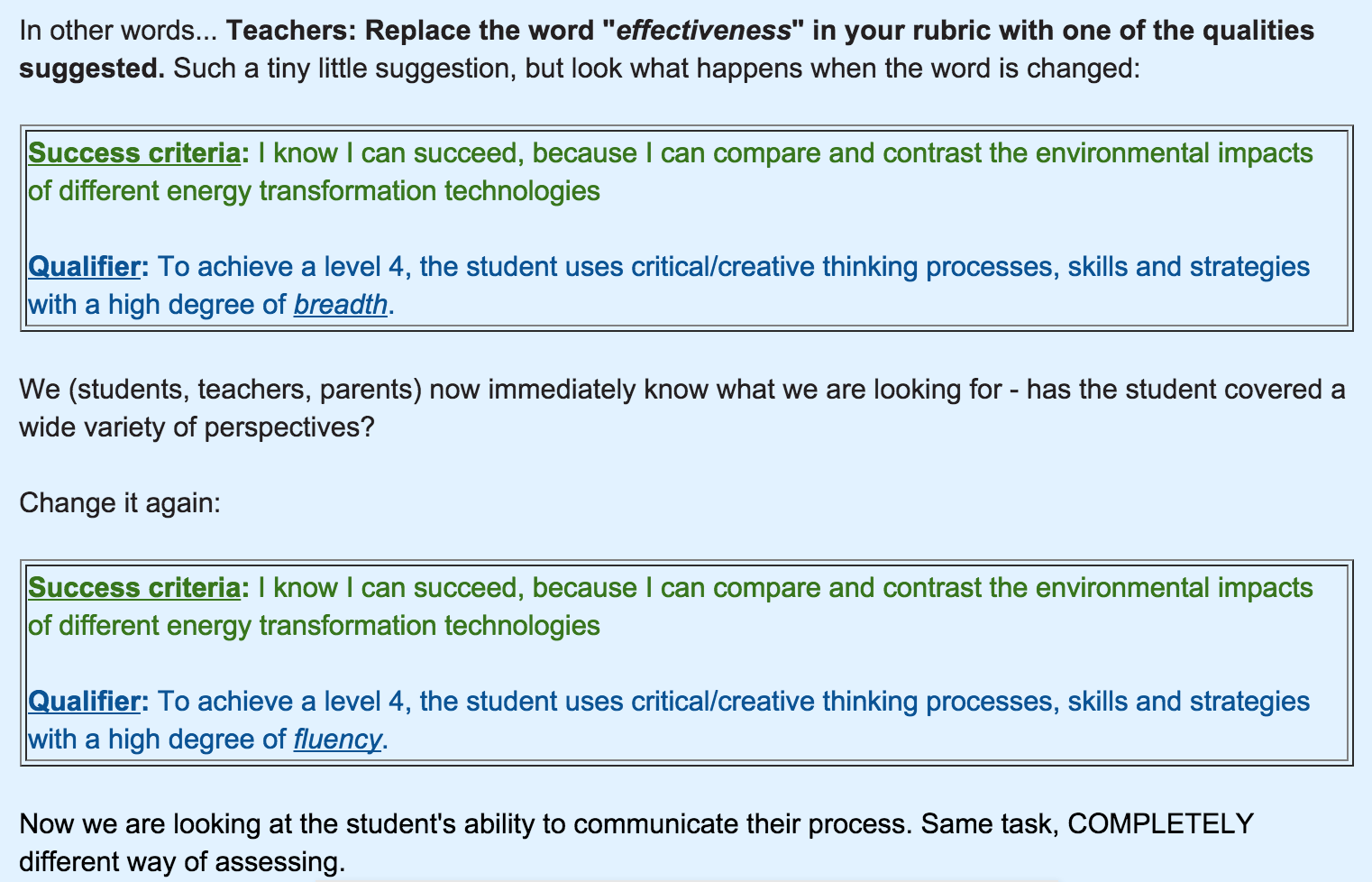
Beyond Effectiveness: the Zen of Flow and #MagicofPage18

Twitter chats are fast and confusing. They flow around questions and sometimes connect ideas.  That’s what happened last night when the topic focused on ‘what do we mean by learning?’.  Participants sometimes bounce ideas into the flow of the diverse collections of conversations. It’s only when you go back and reflect, review and re-live the conversation that you find gems of ideas that spark new directions.

That spark happened when the conversation diverged from ‘what is learning’ to ‘how do we assess learning?’. This flowed into a connection to the Growing Success document that teachers in Ontario use as a guide for assessment and evaluation. Within the flow of the conversation a gem of ‘magic’ appeared. It’ll be missed if it’s not revealed and reviewed. It’ll be lost again once the flow moves on, so here it is. Thanks Donna Miller Fry for pulling this gem from the stream.

image of tweetAs Heather Theijsmeijer reveals, it’s magic that is hidden in plain sight. But it takes a magnifying glass, focused on the words, to unwrap it’s true magic. It’s on page 18! One small paragraph that can be overlooked in the flow of ideas around assessment and evaluation.

When assessing student learning, the achievement chart determines the levels to which learning is measured. “The descriptors indicate the characteristics of the student’s performance, with respect to the particular criteria, on which assessment or evaluation is focused. Effectiveness is the descriptor used for each of the criteria in the Thinking, Communication, and Application categories. What constitutes effectiveness in any given performance task will vary with the particular criterion being considered. Assessment of effectiveness may therefore focus on a quality such as appropriateness, clarity, accuracy, precision, logic, relevance, significance, fluency, flexibility, depth, or breadth, as appropriate for the particular criterion.

Heather T. blogs about this magic when it was first revealed to her and colleagues in “Ditching “Effectiveness” – the Miracle of Page 18“. Once the ‘trick’ was revealed, she shared her thoughts.

image of blog post

This magic flows into greater understanding of my own learning, as well as student learning. It changes how to ‘effectively’ assess when learning is evident and to what level learning has occurred. It’s a flow away from a word that is ill-defined and hard to understand. It establishes a clearer concept when creating rubrics to ‘measure’ learning.

The real magic comes when students can use this magic to see their own success in learning and assess their performance against something that is clear and understandable. Within that ‘zen’ moment when performance and ideas flow from the surface into deeper waters is where the magic of learning occurs. That’s when real learning is realized, by both student and teacher. When students can see this flow, feel this flow, focus on achieving this flow, then the magic of learning and assessment come together. It’s revealed in the quality of learning – appropriate, clear, accurate, precise, logical, relevant, fluent, flexible, deep and wide!

Where do you find the #magicofpg18? How can you recreate this magic in your own learning or teaching?

Let’s fill Twitter with some #magicofpg18! It’s not just for Ontario educators!

Here’s the full ‘flow’ of the twitter chat conversation in a STORIFY.

Posted in Learning, Talking, Together | Tagged , , , , , | Comments Off on Beyond Effectiveness: the Zen of Flow and #MagicofPage18

What Dewey and Yoda reveal about learning – a #twisted pair challenge

The #twisted pair blogging challenge was proposed by Steve Wheeler recently and it’s been twisting  in my mind since I was called on by Sarah Honeychurch. The idea is to match a pair of real or imaginary characters, personalities or people while thinking about learning and teaching. This has certainly extended my thinking about how things go together – teaching and learning, salt and pepper, digital and analog. It has also connected for me to a learning opportunity about the elusive concept of ‘learning’ where I am exploring What Do We Mean By Learning Anyway?. As part of my dive into this topic, I’m exploring how my learning and teaching connect to the ideas and actions of John Dewey and the Jedi Master Yoda.

As I compared and contrasted their perspectives through an education and learning lens, three truths emerged.

Truth #1: Look beyond the conflict of ‘either-or’

Dewey states “It would not be a sign of health if such an important social interest as education were not also an arena of struggles, practical and theoretical.”  If it is important, then it’s important to argue about it. Dewey describes the ‘either-or’ issue and determines that, once the causes of conflict are determined, instead of dividing an argument, it’s important to move to a deeper and more inclusive representation in practices and ideas.

Jedi Master Yoda is a product of conflict. After living for 900 years and spending his final years on a swamp planet, he is a powerful force within the Jedi Council. He has experienced battles between the light and dark forces and accepts the inevitable conflict that exists. He works beyond the either/or in the conflict between good and evil to find balance within himself, his ‘padawans’ and the universe.

These perspectives inform the underlying truth that learners and teachers need to have an awareness and understanding of both sides to a topic or issue and generatively evolve their work through conflicts to create innovative, inclusive solutions. As a learner and teacher, I need to examine both sides of an argument, discourse, or practice to find a balancing point for my students and myself.

Truth #2: Experience is an essential instructional tool

Dewey examines theoretical principles in their abstraction and determines that theories “become concrete only in the consequences, which result from their application”. Actions are external applications of thoughts. Dewey exposes the “organic connection between education and personal experience”. But Dewey cautions about a “belief that a genuine education comes about through experience does not mean that all experiences are genuinely or equally educative”. Dewey sees the important role played by the interactions between the ‘mature and the immature’ in shaping learning and experience.

Jedi Master Yoda would agree that experience is essential. After 900 years of training Jedi knights, he is sought out as the mature influence on a younger, inexperienced but promising student, Luke Skywalker. In his instructional practice, Yoda strategically uses experience to teach Skywalker about the power of the force within. Raising an X-wing fighter out of the swamp indelibly teaches the young Jedi about the power of mind over matter. The phrase ‘do or do not – there is no try’ is attached to this learning experience.

For both Dewey and Yoda, experience is an essential component of instruction. Experience teaches valuable lessons. The challenges faced by learners and teachers is in choosing the right experiences that lead in the desired direction. Not all experiences will instruct the right way – they can lead to good or not-so-good consequences.

For my own teaching and learning, experiences provide opportunities for growth and reflection. When looking back or looking forward to events, actions or experiences, my learning and my teaching practices evolve and transform. Conflict between ideas, theories and practices create new opportunities to experience.  It’s up to me to determine the right path.

Truth #3: Learning is growth on a continuum

Dewey states “Growth, or growing as developing, not only physically but intellectually and morally, is one exemplification of the principle of continuity”. This continuity means “every experience both takes up something from those which have gone before and modifies in some way the quality of those which come after”. For Dewey, learning is a continual process of evolution and change.

After 900 years of living, Jedi Master Yoda has seen many developments that result from experiences that have gone before – his work with Anakin Skywalker modifies and changes the quality of his experiences with Luke Skywalker. The evolution of the forces for good and evil in the Republic impact how the Jedi Master teaches his young ‘padawans’.

Both Dewey and Yoda would see the transition and transformation of teaching and learning as a continuum – relying on the past to inform the present and shape the future. The ‘disruption’ of the continuum by forces of either-or, light-or-dark, would result in imbalance and hardship.

For my own learning, there is a clear path or continuum where I can trace the steps in my growth and perspectives on the events, experiences and opportunities in my past, present and soon to occur. These stepping-stones lead me to where I am today and shape the educational decisions I make. Looking back and reflecting is an important part of the continuum of growth. Sometimes, as Yoda states, it’s a process of unlearning what I have learned. As I teach others about educational technology it’s important for me to visualize this continuum but not be bound by the process – sometimes leaps of learning can jump the line.

If you would like to read more about the #twisted pair challenge, take a look at this collection of posts relating some unusual pairings with a focus on learning and teaching practice.

Who would you twist together and how do these #twisted pairs influence, inform, expand your understanding or confirm your experiences in teaching and learning? The twisting continues!

References

Dewey, J. (n.d.) Experience and Education http://ruby.fgcu.edu/courses/ndemers/colloquium/experienceducationdewey.pdf

Jedi Master Yoda, http://yoda.locutus.be/yoda.php

Posted in Learning, Teaching | Tagged , , , , , , , | Comments Off on What Dewey and Yoda reveal about learning – a #twisted pair challenge

An ‘inuksuk’ moment – listen deeply

image of inuksuk

R. Hartnup: Inukshuk cairn on Eagle Ridge

I’m sharing this inuksuk for those who may find it. It holds meaning and importance. It is created from my own experiences and a moment in time that has importance for me.

On the Canadian landscape there are many of these markers. From a deep Inuit tradition, the inuksuk is a symbolic marker left behind to mark a path or share a food resource (Canadian Encyclopedia). Pointing the way toward a safe place or a secure cache of material, these rocky icons now dot the roadsides as you travel the country. It’s a fitting image for this Virtually Connecting event because there’s a secret cache here. Under this marker lies a repository of ideas and thoughts about digital storytelling.

These insights were shared by Joe Lambert from his rich experiences and connections over 20 years of working with people telling stories within international contexts. These were responses to questions presented by virtually connected participants in an organized video chat from the 6th International Conference on Digital Storytelling. It was a collaboration between virtual buddies Joe Murphy and myself with support and participation from Maha Bali, Autumm Caines, Sarah S. and Lisa H. along with physical buddies Katie and Jean.

Connecting with people involves making sense of diverse thoughts and perspectives. The intention of this conversation was to extend and enhance the conference experience with people who can’t attend the conference physically. This was “not a broadcast but a conversation; not a relationship between star and fan, but between peers” as Maha Bali and Rebecca Hogue write in Beyond Twitter: Virtually Connecting at Conferences.

For me, this experience shifted my position from ‘fan’ to ‘peer’ – having a deep conversation with Joe Lambert, a ‘star’ in the digital storytelling sphere. It was a chance to just talk and ramble around with some ideas, experiences and potential with digital storytelling. Deeper threads (ethical practices, humanity, culture, privilege) are woven through the conversation. Joe Lambert shares the importance of facing risks while sharing painful memories in safe and supportive environments. Expertise in counselling and professional caregiving are needed for sensitive stories involving personal health, injury trauma, or violence. Barriers for storytelling can include losing face within a cultural context, losing voice within a society or community, or losing hope within a personal challenge. When the risk is great and the revelations are painful, the story telling is particularly challenging but there is a transformative power  – your story telling changes me or clarifies perspectives – thus creating greater understanding.

Insights from this Virtually Connecting experience with Joe Lambert – listen deeply, make space for the story to emerge, let silence speak, and honour the voice of the storyteller. Thank you Joe Lambert for sharing time, thoughts, experiences and insights on digital storytelling.

Where do you find ‘inuksuk’ moments – those secret caches of ideas that help you make meaning? Do you mark the space so others can find it? Do you show the way in digital spaces for others to follow?

Listen deeply – here’s the full conversation with Joe Lambert.

Posted in Learning, Talking, Together | Tagged , , , , , | 2 Comments

Conversations build Connections

Sometimes it’s tough to travel. You just can’t get to meet people, have conversations, join together to play with new tools or even just hangout to talk. Teachers need this time more than anyone. Sharing ideas, tips, tricks, resources, and tools takes time. Having a chance to reflect, by talking through ideas is a great way to get better together. The metaphor for this blog reflects how important it is for educators to sit down around the fire (or any other gathering space) to talk through things with willing listeners. Two upcoming events for me will allow conversations from far and near.

From FAR

One such conversation will be with Joe Lambert, someone who’s work and writing has guided my teaching about digital storytelling. I will be hosting my first Virtually Connecting hangout with participants and speakers at the Voice for Change – Digital Storytelling 2015 Conference in Massachusetts. I will be the virtual buddy while onsite host, Joe Murphy, will be present at the conference and hold the informal conversation with Joe Lambert – Story Centre founder and executive director. His Digital Storytelling Cookbook and Digital Storytelling: Capturing Lives, Creating Community are valuable resources for those interesting in learning about digital storytelling in the classroom and community. Joe Lambert’s sessions at the conference focus on digital storytelling through the public health lens and stories to validate experiences of youth in current social, economic and labour markets.

As part of my preparation for this event I’m in my own digital sandbox, exploring the affordances, issues, challenges and success with Google Hangouts (GHO) On Air. I had an informal, impromptu personal coaching session – my coach was in Cairo Egypt (thanks Maha!). We communicated using Slack and Twitter, while using a GHO in a non-recording session. For a brief time I turned on the recording function with a resulting feeling of success after working through several technical glitches and issues. The technical can interfere or interrupt the physical conversations, but virtual conversations extend the range and enhance the possibilities.

Then I set up the hangout space and invited Joe Murphy to practice in the space and get to know him. We had an informal conversation about our similarities, perspectives and backgrounds – from Ontario to Ohio. The link to Saturday, Sept. 26th session is all ready to go @VConnecting with Joe Lambert at #voicesforchange 6th Annual Digital Stortelling Conf. It’ll start at 11:30 a.m. EST but I’ll be getting ready to hangout before that. Check, check and check again. Don’t want technical issues to impact good conversations. I’ll continue to explore this format for conversations throughout this week and reflect on the experience in a followup post.

AND NEAR

I’m also preparing for conversations that will be ‘near’ only because I will travel a significant distance to be present. I’ll be with educators who want to learn together about tools and technologies to infuse into their teaching. This week I’m making time to prepare resources, review practices, make adjustments to materials, play again with some of the tools and plan the journey. I’ll be the lead learner with teachers at IGNITEd on Manitoulin Island. It’s a trip I’m looking forward to making – it’s a wonderful time to travel in Ontario with leaves just starting to change colours. I’ll learn so much from them as they explore green screen, screen cast and stop motion animation. The conversations will build connections. The learning will continue beyond the fireside time.

Where do you find conversations happening? Are they F2F or through digital fireside chats? Maybe the water cooler is a preferred spot to gather. Coffee conversations are the ‘go-to’ choice for many.

Posted in Talking, Together | Tagged , , , , , | Comments Off on Conversations build Connections